ISSN: 3056-929X (Online)
Asst.Prof.Dr. Pensri Bangbon
Editor-in-Chief
Email: imj.sshe@gmail.com
Mr. Werawit Rajcote
Editorial Assistant
Email: veerawit.ppn@gmail.com




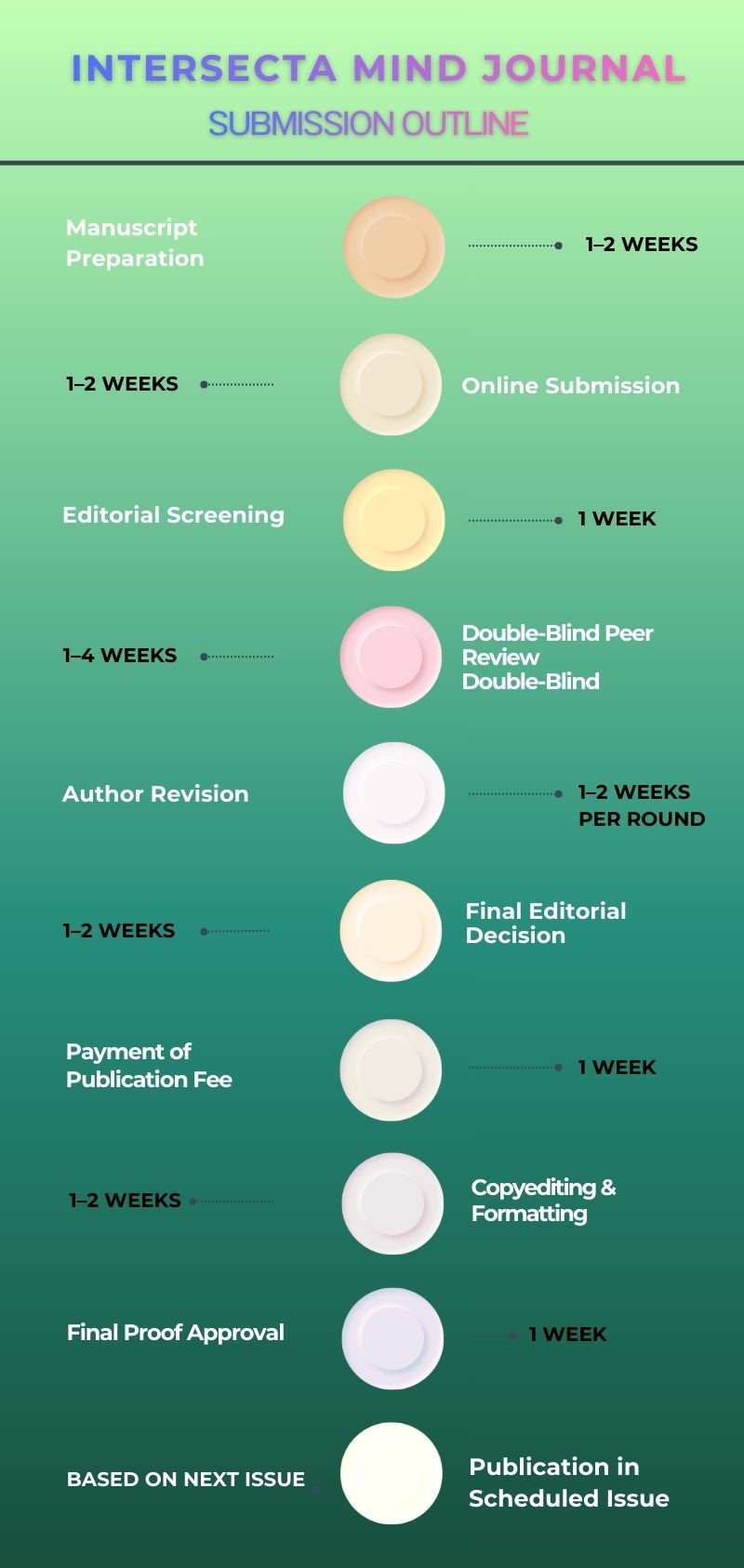
Interested in submitting to this journal? We recommend that you review the About the Journal page for the journal's section policies, as well as the Author Guidelines. Authors need to register with the journal prior to submitting or, if already registered, can simply log in and begin the five-step process.
Research Ethics Guidelines for The Intersecta Mind Journal
Author Ethics:
a. Honesty and Integrity:
Authors must ensure the accuracy and truthfulness of their research findings by presenting data and results transparently.
Any form of data manipulation or fabrication is strictly prohibited.
b. Authorship and Acknowledgment:
All individuals who significantly contributed to the research must be listed as authors.
Proper acknowledgment of sources, funding, and collaborations is essential.
c. Plagiarism:
Authors must avoid plagiarism by appropriately citing and referencing sources.
Originality in research is highly valued, and any form of intellectual theft is unacceptable.
d. Ethical Treatment of Subjects:
Authors must prioritize the well-being, dignity, and rights of human subjects involved in their research.
Reviewer Ethics:
Informed consent must be obtained, and confidentiality should be maintained.
Reviewer Ethics:
a. Impartiality:
Reviewers must evaluate submissions objectively, without bias towards the author's identity, affiliation, or personal beliefs.
Constructive feedback should be provided to help authors improve their work.
b. Confidentiality:
Reviewers must treat the content of the manuscript as confidential information and refrain from discussing it without permission.
Any conflicts of interest that may compromise the review process must be disclosed.
c. Timeliness:
Reviewers should promptly complete their assigned reviews within the agreed-upon timeframe.
If unable to meet deadlines, reviewers are expected to communicate this to the editorial team.
d. Professionalism:
Reviewers must conduct themselves with professionalism, maintain respect in their critiques, and avoid personal attacks.
Constructive feedback should focus on the scientific merit of the work.
Based on the Research Ethics Review Committee for Research Involving Human Subjects:
a. Informed Consent:
Researchers must obtain informed consent from all human subjects involved in the study.
The consent process should be comprehensive, ensuring participants understand the nature and purpose of the research.
b. Privacy and Confidentiality:
Researchers must implement measures to protect the privacy and confidentiality of participants.
Data should be anonymized wherever possible, and access should be restricted to authorized personnel.
c. Beneficence and Non-maleficence:
Researchers must ensure that the potential benefits of the research outweigh any potential harm to participants.
Steps should be taken to minimize risks and protect vulnerable populations.
d. Ethical Reporting:
Researchers must accurately and transparently report their findings, including any unexpected outcomes or challenges encountered during the study.
Full disclosure of conflicts of interest is mandatory.
Adaptations for Social Sciences, Humanities, and Fine and Applied Arts:
a. Cultural Sensitivity:
Researchers must recognize and respect cultural nuances in the research context, adapting methodologies to suit the unique characteristics of social, cultural, artistic, and linguistic studies.
b. Community Engagement:
Involvement of the community in the research process is encouraged, ensuring their perspectives are considered and valued.
c. Interdisciplinary Collaboration:
Researchers are encouraged to collaborate across disciplines to enrich the understanding of complex issues in society, culture, art, and languages.
d. Creative and Artistic Expression:
Special consideration should be given to the ethical implications of research involving creative and artistic expression, recognizing the subjective nature of these endeavors.
These guidelines are designed to uphold the highest standards of ethics in research involving human subjects within the context of Social Sciences, Humanities, and Fine and Applied Arts. Researchers, authors, and reviewers associated with the Second Allied Academic Group at Chulalongkorn University are expected to adhere to these principles to ensure the integrity and ethical conduct of research activities.
This journal permits the responsible use of Artificial Intelligence (AI) and AI-assisted technologies for language improvement, translation, formatting, and other supportive functions. Authors must disclose any substantive use of AI in the manuscript. AI tools cannot be listed as authors and cannot assume responsibility for the work. Authors remain fully accountable for the accuracy, originality, integrity, and ethical compliance of all submitted content. Failure to disclose significant AI use or the submission of AI-generated fabricated content may result in rejection, retraction, or other editorial actions.
Authors are required to disclose any use of Artificial Intelligence (AI) and AI-assisted technologies in a dedicated section entitled “Declaration of AI Use.” This declaration must clearly identify the AI tool(s) utilized, describe the purpose of their use, and specify the extent of their contribution to the manuscript. All AI-generated content must be critically reviewed, validated, and, where necessary, revised by the authors. The authors retain full responsibility for the accuracy, originality, integrity, and scholarly quality of the manuscript and must ensure that all content complies with the journal’s ethical and publication standards prior to submission.
Policy on the Use of Artificial Intelligence (AI) and AI-Assisted Technologies in Scholarly Publishing
This journal supports the responsible, transparent, and ethical use of Artificial Intelligence (AI) and AI-assisted technologies in scholarly research and publication. The policy aims to maintain research integrity, accountability, originality, and transparency while allowing appropriate use of emerging technologies.
Authors may use AI tools for:
The following practices are not permitted:
Authors must disclose the use of AI-assisted technologies in a separate section entitled:
“Declaration of AI and AI-Assisted Technologies”
The declaration should include:
Example:
"During the preparation of this manuscript, the authors used ChatGPT (OpenAI) for language editing and grammar refinement. All outputs generated by the AI tool were reviewed, revised, and verified by the authors, who take full responsibility for the final content of the manuscript."
The editorial office reserves the right to:
Failure to disclose significant AI use may constitute a breach of publication ethics and may result in:
ISSN: 3056-929X (Online)
Asst.Prof.Dr. Pensri Bangbon
Editor-in-Chief
Email: imj.sshe@gmail.com
Mr. Werawit Rajcote
Editorial Assistant
Email: veerawit.ppn@gmail.com



|
Pacific Institute of Management Science |
|
222/2 M.1 Phaholyothin Rd., Bantam, Mueang Phayao 56000 Phone +66(0)54 887-188, www.ipacific.ac.th |
|
Editor contract: Tel. +66819839797 |
|
Email: imj.sshe@gmail.com |
 |
|
All materials published by Intersecta Minds Journal are licensed under |
|
A Creative Commons Attribution-NonCommercial-NoDerivatives 4.0 International License. |