ISSN: 3056-929X (Online)
Asst.Prof.Dr. Pensri Bangbon
Editor-in-Chief
Email: imj.sshe@gmail.com
Mr. Werawit Rajcote
Editorial Assistant
Email: veerawit.ppn@gmail.com




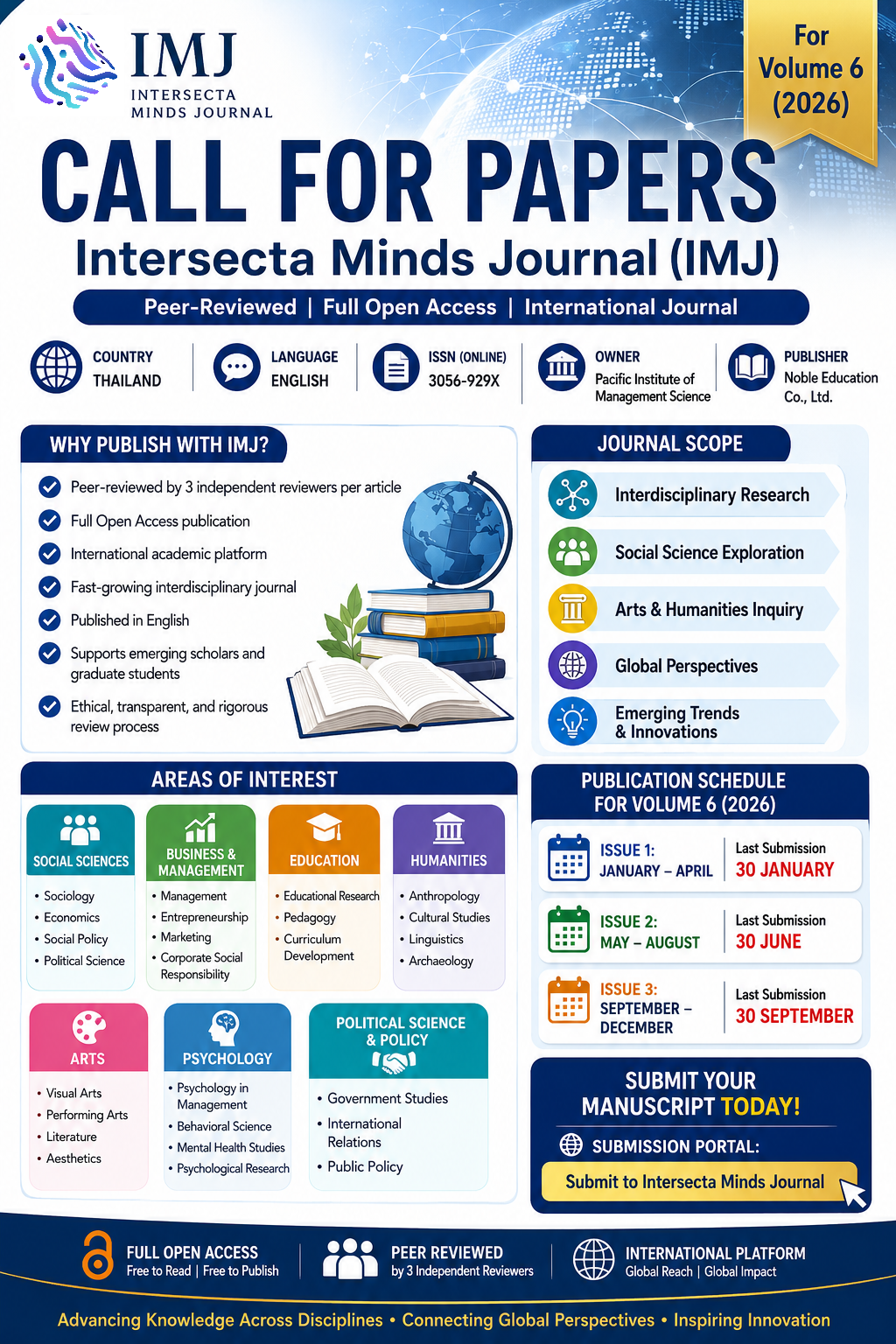
Welcome to Intersecta Minds Journal, a distinguished platform of multidisciplinary at the forefront of intellectual exploration dedicated to the convergence of Social Science, Psychology, Arts and Humanities, Business, Management, and Education. Established with a vision to transcend disciplinary boundaries, our journal is a dynamic space that champions interdisciplinary dialogue, fosters academic excellence, and contributes to the global tapestry of knowledge.
Mission:
At Intersecta Minds Journal, our mission is to create a vibrant nexus where scholars, researchers, and practitioners converge to explore the multifaceted dimensions of the human experience. We strive to facilitate a rich exchange of ideas, nurture emerging talent, and contribute to the advancement of society through ethical and impactful scholarship.
Intersecta Minds Journal: Scopes and Aims
Welcome to Intersecta Minds Journal, a multidisciplinary journal platform dedicated to fostering intellectual exploration and advancing knowledge in the realms of Social Science, Arts and Humanities, Business, Management, and Education. Our mission is to provide a space for scholars, researchers, and practitioners to share their insights, engage in interdisciplinary discourse, and contribute to the vibrant tapestry of human understanding. Here are the scopes and aims that define our commitment to excellence.
Scopes:
1. Interdisciplinary Discourse:
We encourage submissions that bridge the gaps between traditional academic disciplines, fostering a rich exchange of ideas and perspectives. Interdisciplinary research is at the core of our journal, reflecting the interconnected nature of human experience.
2. Social Science Exploration:
Our journal welcomes contributions that delve into the complexities of human societies, exploring topics such as sociology, psychology, anthropology, economics, political science, and more. We aim to showcase research that deepens our understanding of societal structures, dynamics, and challenges.
3. Arts and Humanities Inquiry:
Creativity and culture are integral aspects of the human experience. We invite submissions that explore literature, philosophy, history, fine arts, and other facets of the humanities. This includes critical analyses, theoretical frameworks, and artistic expressions that contribute to the intellectual landscape.
4. Global Perspectives:
Intersecta Minds Journal is committed to representing diverse global perspectives. We seek submissions that address issues on a global scale, fostering cross-cultural dialogue and understanding. Our goal is to create a truly international platform for the exchange of ideas.
5. Emerging Trends and Innovations:
We are dedicated to staying at the forefront of academic exploration. Manuscripts that shed light on emerging trends, innovative methodologies, and groundbreaking theories are particularly encouraged. Intersecta Minds Journal aims to be a hub for cutting-edge research and forward-thinking scholarship.
Aims:
1. Knowledge Dissemination:
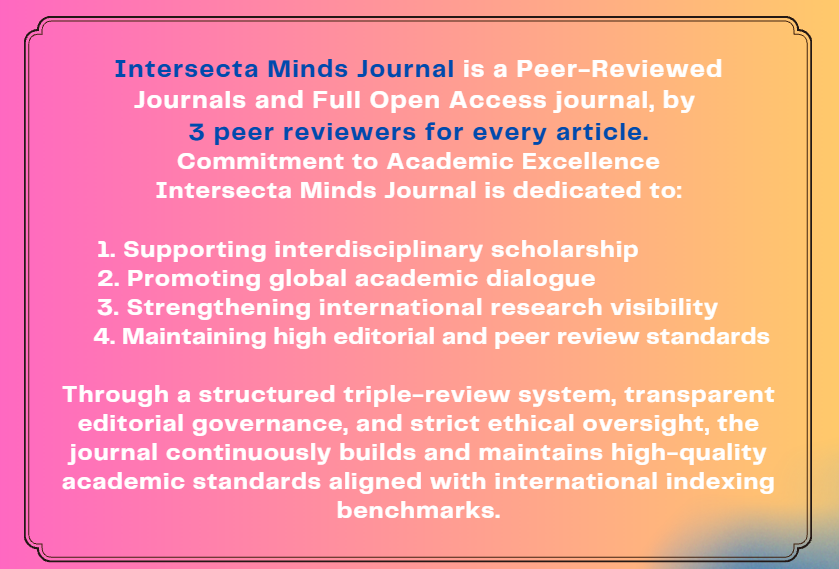
We strive to disseminate high-quality, peer-reviewed research to a global audience. By publishing a diverse range of articles, we contribute to the democratization of knowledge and the accessibility of academic insights.
2. Facilitating Dialogue:
Intersecta Minds Journal aims to create a dynamic space for scholarly dialogue. We host a platform where authors can engage with their peers, fostering meaningful discussions that transcend disciplinary boundaries.
3. Supporting Emerging Scholars:
As part of our commitment to nurturing academic talent, we actively encourage submissions from emerging scholars and graduate students. We believe in providing a supportive environment for the next generation of thinkers to showcase their work.
4. Promoting Ethical Scholarship:
We adhere to the highest standards of ethical conduct in research and publication. Our aim is to promote integrity, transparency, and responsible scholarship throughout the academic community.
5. Contributing to Social Progress:
Intersecta Minds Journal recognizes the role of research in driving positive social change. We aim to publish work that not only advances academic understanding but also contributes to the betterment of societies and communities worldwide.
Key Areas of Interest:
Mission:
At Intersecta Minds Journal, our mission is to create a vibrant nexus where scholars, researchers, and practitioners converge to explore the multifaceted dimensions of the human experience. We strive to facilitate a rich exchange of ideas, nurture emerging talent, and contribute to the advancement of society through ethical and impactful scholarship.
Distinctive Features:
1. Interdisciplinary Nexus:
We take pride in being a catalyst for interdisciplinary research, recognizing the interconnected nature of human phenomena. Our platform welcomes contributions that transcend traditional academic silos, encouraging a holistic understanding of complex societal issues.
2. Global Perspectives:
Intersecta Minds Journal serves as a global hub for diverse perspectives. We actively seek submissions that reflect the rich tapestry of global cultures, providing a comprehensive view of the challenges, triumphs, and innovations shaping societies worldwide.
3. Innovative Scholarship:
Embracing the spirit of exploration, we prioritize cutting-edge research, emerging trends, and innovative methodologies. Our commitment to staying at the forefront of academic discourse ensures that our readers are exposed to the latest developments in Social Science, Arts, and Humanities.
4. Engaging Dialogue:
Beyond being a repository of knowledge, Intersecta Minds Journal is a dynamic forum for scholarly dialogue. We foster an environment where authors and readers can engage in meaningful conversations, promoting a culture of collaboration and exchange.
5. Support for Emerging Scholars:
As part of our commitment to nurturing the next generation of thinkers, we actively encourage submissions from emerging scholars and graduate students. We believe in providing a supportive platform for early-career academics to showcase their work and contribute to the academic community.
Our Commitment:
1. Excellence in Publication:
Intersecta Minds Journal upholds rigorous standards of peer review, ensuring that published content meets the highest levels of academic excellence. Our commitment to quality extends to every facet of the publication process.
2. Ethical Scholarship:
We are unwavering in our commitment to upholding the highest ethical standards in research and publication. Authors, reviewers, and editors alike adhere to principles of integrity, transparency, and responsible scholarship.
3. Community Building:
Beyond the pages of our journal, we aim to build a global community of intellectuals. Intersecta Minds Journal serves as a catalyst for forging connections, fostering collaborations, and establishing a network of scholars committed to advancing knowledge.
Country: Thailand
Language: English
Website: https://so13.tci-thaijo.org/index.php/IMJ
Subject Codes: Social Sciences; Business; Management; Psychology in Management; Political Science; Policy
Owner: Pacific Institute of Management Science
ISSN: 3056-929X (Online)
Subject Codes: Social Sciences; Arts and Humanities; Business; Management; Education
Publisher: Noble Education Co., Ltd.
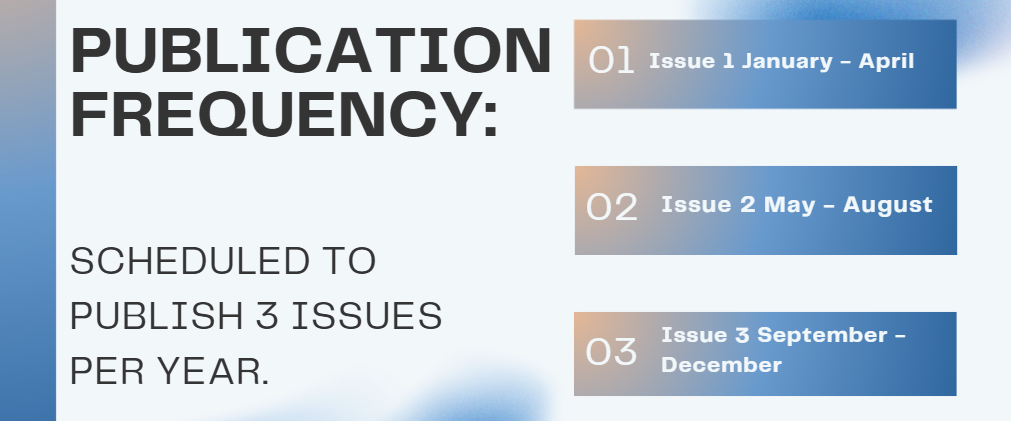
Publication Frequency: Scheduled to publish 3 issues per year.
Issue 1 January - April
Issue 2 May - August
Issue 3 September - December
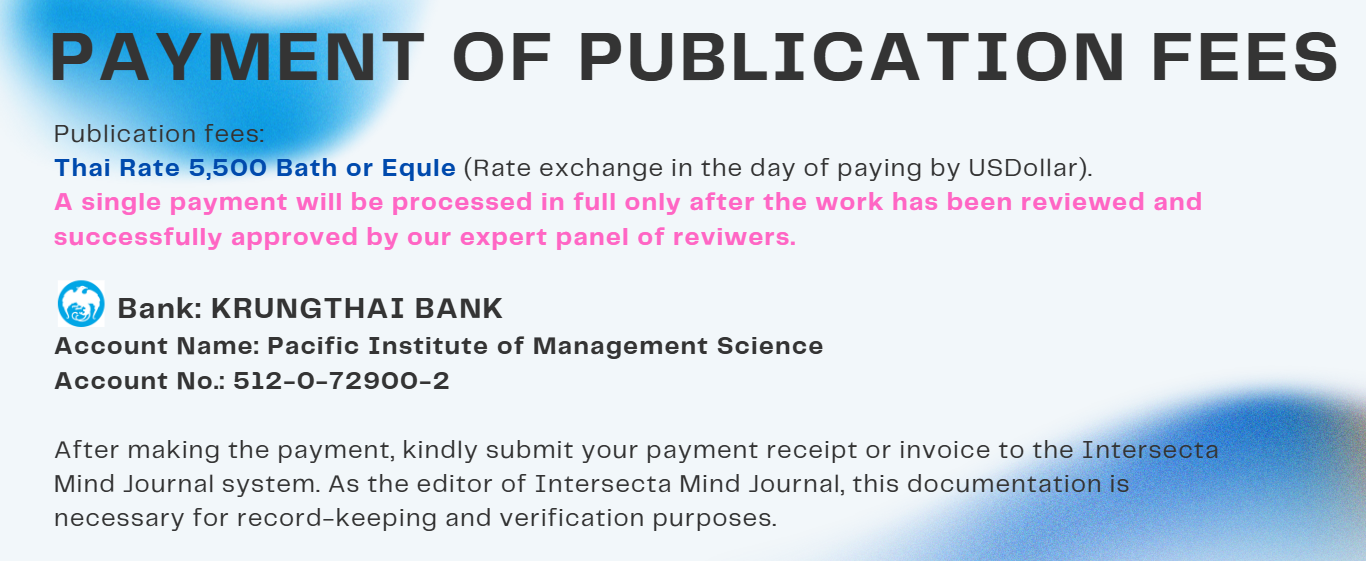
As an open access journal with no subscription charges, a fee (Article Publishing Charge, APC) is payable by the authors, or their institution or funders, to cover the costs associated with publication. This ensures your article will be immediately and permanently free to access by everyone.
The Article Publishing Charge for this journal is:
Publication fees: Thai Rate 5,500 Bath or Equle (Rate exchange in the day of paying by Thai Bath).
A single payment will be processed in full only after the work has been reviewed and successfully approved by our expert panel of reviwers.

Bank: KRUNGTHAI BANK
Account Name: Pacific Institute of Management Science
Account No.: 512-0-72900-2
After making the payment, kindly submit your payment receipt or invoice to the Intersecta Mind Journal system. As the editor of Intersecta Mind Journal, this documentation is necessary for record-keeping and verification purposes.
Join us on this intellectual journey as we navigate the intersections of minds, explore the nuances of human experience, and contribute to the ever-evolving landscape of Social Science and Management Science. Intersecta Minds Journal: Where Ideas Converge, Minds Intersect, and Knowledge Flourishes.

Research Ethics Guidelines for The Intersecta Mind Journal
Full version at : https://so13.tci-thaijo.org/index.php/IMJ/about/submissions
Author Ethics:
1. Honesty and Integrity
Authors must ensure the accuracy and truthfulness of their research findings by presenting data and results transparently.
Any form of data manipulation or fabrication is strictly prohibited.
2. Authorship and Acknowledgment
All individuals who significantly contributed to the research must be listed as authors.
Proper acknowledgment of sources, funding, and collaborations is essential.
3. Plagiarism
Authors must avoid plagiarism by appropriately citing and referencing sources.
Originality in research is highly valued, and any form of intellectual theft is unacceptable.
4. Ethical Treatment of Subjects
Authors must prioritize the well-being, dignity, and rights of human subjects involved in their research.
Reviewer Ethics:
Informed consent must be obtained, and confidentiality should be maintained.
Reviewer Ethics:
1. Impartiality
Reviewers must evaluate submissions objectively, without bias towards the author's identity, affiliation, or personal beliefs.
Constructive feedback should be provided to help authors improve their work.
2. Confidentiality
Reviewers must treat the content of the manuscript as confidential information and refrain from discussing it without permission.
Any conflicts of interest that may compromise the review process must be disclosed.
3. Timeliness
Reviewers should promptly complete their assigned reviews within the agreed-upon timeframe.
If unable to meet deadlines, reviewers are expected to communicate this to the editorial team.
4. Professionalism
Reviewers must conduct themselves with professionalism, maintain respect in their critiques, and avoid personal attacks.
Constructive feedback should focus on the scientific merit of the work. Based on the Research Ethics Review Committee for Research Involving Human Subjects:
1. Informed Consent
Researchers must obtain informed consent from all human subjects involved in the study.
The consent process should be comprehensive, ensuring participants understand the nature and purpose of the research.
2. Privacy and Confidentiality
Researchers must implement measures to protect the privacy and confidentiality of participants.
Data should be anonymized wherever possible, and access should be restricted to authorized personnel.
3. Beneficence and Non-maleficence
Researchers must ensure that the potential benefits of the research outweigh any potential harm to participants.
Steps should be taken to minimize risks and protect vulnerable populations.
1. Ethical Reporting
Researchers must accurately and transparently report their findings, including any unexpected outcomes or challenges encountered during the study. Full disclosure of conflicts of interest is mandatory.
Adaptations for Social Sciences, Humanities, and Fine and Applied Arts:
2. Cultural Sensitivity
Researchers must recognize and respect cultural nuances in the research context, adapting methodologies to suit the unique characteristics of social, cultural, artistic, and linguistic studies.
3. Community Engagement
Involvement of the community in the research process is encouraged, ensuring their perspectives are considered and valued.
1. Interdisciplinary Collaboration
Researchers are encouraged to collaborate across disciplines to enrich the understanding of complex issues in society, culture, art, and languages.
2. Creative and Artistic Expression
Special consideration should be given to the ethical implications of research involving creative and artistic expression, recognizing the subjective nature of these endeavors.
These guidelines are designed to uphold the highest standards of ethics in research involving human subjects within the context of Social Sciences, Humanities, and Fine and Applied Arts. Researchers, authors, and reviewers associated with the Intersecta Minds Journal and Noble Education Co. Ltd. are expected to adhere to these principles to ensure the integrity and ethical conduct of research activities.
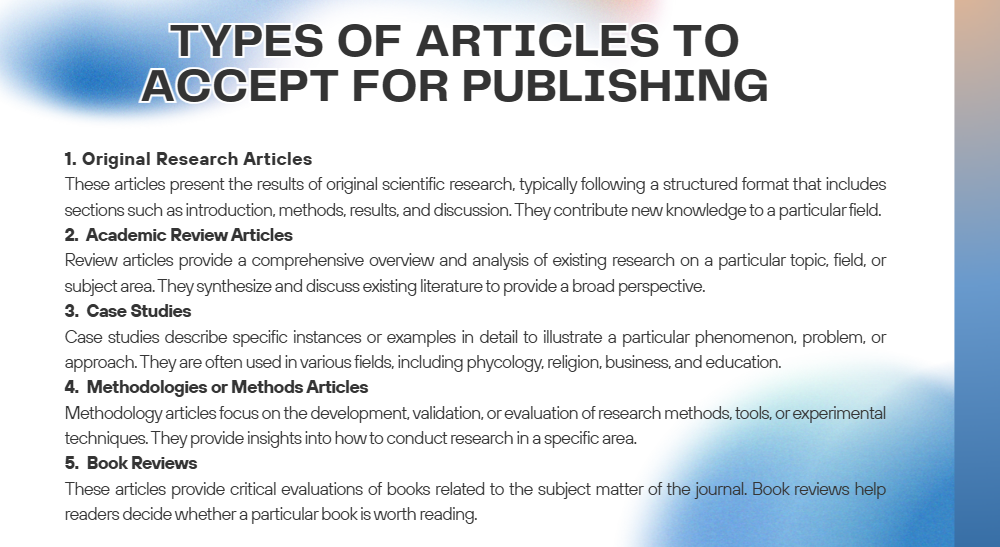
These articles present the results of original scientific research, typically following a structured format that includes sections such as introduction, methods, results, and discussion. They contribute new knowledge to a particular field.
Make a new submission to the Original Research Articles section.
|
1 |
Abstract: The abstract should be concise and encompass the research idea or problem/objectives, research methodology, study population and sample groups, research tools, analysis, and research findings, within a range of 200-300 words. |
|
2 |
Introduction: This section aims to describe the background and significance of the problem leading to the research. It should highlight research gaps to underscore the necessity of the study. |
|
3 |
Objectives: Present the research objectives and hypotheses. |
|
4 |
Literature Review and Theoretical Framework: This involves reviewing relevant literature and research, as well as establishing the theoretical framework for the study. |
|
5 |
Research Methodology: Outline the components such as research type, study population, sample groups, selection techniques, research tools, research procedures, data collection, and analysis methods. |
|
6 |
Results: Presentation of Research Findings, Align the presentation of findings with the research objectives or hypotheses. |
|
7 |
Discussion: Discuss the results in accordance with the objectives, citing relevant research to support the discussed issues and content. |
|
8 |
Conclusion: Summarize the findings, ensuring they align with the objectives and emphasize the significance of the research. |
|
9 |
Suggestions and Implementations: Provide suggestions or new knowledge gained from the study, or implementations or new Body of Knowledge from the research, present recommendations for the public, and propose ideas for future research. |
|
10 |
Declaration of Interests: State any financial or personal relationships that could influence the study. If none, write: "The authors declare no competing interests." |
|
11. |
Ethical Considerations: Confirm that ethical guidelines were followed, including approvals from ethics committees and informed consent from participants, if applicable. |
|
12. |
Conflicts of Interest: Disclose any potential biases or financial ties that may affect the study. If there are none, state: "No conflicts of interest to declare." |
|
13. |
Acknowledgements: Credit individuals or organizations that contributed to the study (e.g., funding, technical support) but not the patient. |
|
14. |
References: Ensure that citations within the article and at the end follow the APA6 format and maintain language appropriateness. |
Review articles provide a comprehensive overview and analysis of existing research on a particular topic, field, or subject area. They synthesize and discuss existing literature to provide a broad perspective.
Make a new submission to the Academic Review Articles section.
|
1. |
Abstract: State the significance, results of the study, and knowledge gained from the study, within a range of 200-300 words.
Keywords: Essential part of producing for readers to discover your article when conducting research 3-5 words. |
|
2. |
Introduction: Explain the background and significance of the issues and concepts to be presented. |
|
3. |
Content: Consist of a study of relevant documents and related theories. 1) Presenting details supporting the main issues and concepts. 2) Presenting secondary ideas clearly, correctly, and appropriately. 3) Complete accuracy, linkage, and organization of content. |
|
4. |
Conclusion: Comprehensive and consistent with the objectives, useful. |
|
5. |
Suggestions and Implementations: Provide suggestions or new knowledge gained from the study, or implementations. |
|
6. |
Appropriateness of English language use. |
|
7. |
Declaration of Interests: State any financial or personal relationships that could influence the study. If none, write: "The authors declare no competing interests." |
|
8. |
Ethical Considerations: Confirm that ethical guidelines were followed, including approvals from ethics committees and informed consent from participants, if applicable. |
|
9. |
Conflicts of Interest: Disclose any potential biases or financial ties that may affect the study. If there are none, state: "No conflicts of interest to declare." |
|
10. |
Acknowledgements: Credit individuals or organizations that contributed to the study (e.g., funding, technical support) but not the patient. |
|
11. |
References: Ensure that citations within the article and references of the article are correct according to APA format. |
Case studies describe specific instances or examples in detail to illustrate a particular phenomenon, problem, or approach. They are often used in various fields, including phycology, religion, business, and education.
Make a new submission to the Case Studies section.
|
1. |
Abstract: A brief summary of the entire case study. Can be narrative (flows as a short story) or structured (with subheadings). A structured abstract is preferred for clarity and consistency, within a range of 200-300 words.
Keywords: Essential part of producing for readers to discover your article when conducting research 3-5 words. |
|
2. |
Introduction: Provides background on the case and its significance. Places the study in historical, social, or medical context. Mentions any previous similar cases. |
|
3. |
Case Presentation: Describes the patient’s complaint, history, and relevant information. Presents examination findings, test results, and diagnostic impressions. Uses a narrative format for clarity and avoids unnecessary details. |
|
4. |
Result: Management and Outcome that mentions outlines the treatment plan and actual care provided. Includes duration and frequency of care. Reports the patient’s response and outcome, using objective measures if possible. |
|
5. |
Discussion: Analyzes key aspects of the case, including challenges and lessons learned. Explores possible explanations without needing full scientific justification. |
|
6. |
Conclusion: Comprehensive and consistent with the objectives, useful. |
|
7. |
Suggestions and Implementations: Provide suggestions or new knowledge gained from the study, or implementations. |
|
8. |
Declaration of Interests: State any financial or personal relationships that could influence the study. If none, write: "The authors declare no competing interests." |
|
9. |
Ethical Considerations: Confirm that ethical guidelines were followed, including approvals from ethics committees and informed consent from participants, if applicable. |
|
10. |
Conflicts of Interest: Disclose any potential biases or financial ties that may affect the study. If there are none, state: "No conflicts of interest to declare." |
|
11. |
Acknowledgements: Credit individuals or organizations that contributed to the study (e.g., funding, technical support) but not the patient. |
| 12. | References: Ensure that citations within the article and references of the article are correct according to APA format. |
Methodology articles focus on the development, validation, or evaluation of research methods, tools, or experimental techniques. They provide insights into how to conduct research in a specific area.
Make a new submission to the Methodologies or Methods Articles section.
|
1. |
Abstract: A brief summary of the entire case study. Can be narrative (flows as a short story) or structured (with subheadings). A structured abstract is preferred for clarity and consistency, within a range of 200-300 words.
Keywords: Essential part of producing for readers to discover your article when conducting research 3-5 words. |
|
|
2. |
Introduction: Provides background on the case and its significance. Places the study in historical, social, or medical context. Mentions any previous similar Methodologies or Methods Articles. |
|
|
3. |
Methodologies or Methods: Present new or improved research methods, tools, or techniques. Explain their development, validation, and application. Provide step-by-step details and significance in the field. |
|
|
4. |
Discussion: Analyzes key aspects of the case, including challenges and lessons learned. Explores possible explanations without needing full scientific justification. |
|
|
5. |
Conclusion: Comprehensive and consistent with the objectives, useful. |
|
|
6. |
Suggestions and Implementations: Provide suggestions or new knowledge gained from the study, or implementations. |
|
|
7. |
Declaration of Interests: State any financial or personal relationships that could influence the study. If none, write: "The authors declare no competing interests." |
|
|
8. |
Ethical Considerations: Confirm that ethical guidelines were followed, including approvals from ethics committees and informed consent from participants, if applicable. | |
|
9. |
Conflicts of Interest: Disclose any potential biases or financial ties that may affect the study. If there are none, state: "No conflicts of interest to declare." | |
|
10. |
|
|
|
11. |
References: Ensure that citations within the article and references of the article are correct according to APA format. | |
|
|
These articles provide critical evaluations of books related to the subject matter of the journal. Book reviews help readers decide whether a particular book is worth reading.
|
1. |
Abstract: A brief summary of the entire case study. Can be narrative (flows as a short story) or structured (with subheadings). A structured abstract is preferred for clarity and consistency, within a range of 200-300 words.
Keywords: Essential part of producing for readers to discover your article when conducting research 3-5 words. |
|
|
2. |
Introduction: Provides background on the case and its significance. Places the study in historical, social, or medical context. Mentions any previous similar Books. |
|
|
3. |
Book Reviews: Offer a critical evaluation of a book related to the journal’s focus. Summarize: key points, strengths, and weaknesses. Discuss: its relevance and usefulness for readers. |
|
|
4. |
Conclusion: Comprehensive and consistent with the objectives, useful. |
|
|
5. |
Suggestions and Implementations: Provide suggestions or new knowledge gained from the book, or implementations, that help readers decide if the book is worth reading. |
|
|
6. |
Declaration of Interests: State any financial or personal relationships that could influence the study. If none, write: "The authors declare no competing interests." |
|
|
7. |
Ethical Considerations: Confirm that ethical guidelines were followed, including approvals from ethics committees and informed consent from participants, if applicable. | |
|
8. |
Conflicts of Interest: Disclose any potential biases or financial ties that may affect the study. If there are none, state: "No conflicts of interest to declare." | |
|
9. |
Acknowledgements: Credit individuals or organizations that contributed to the study (e.g., funding, technical support) but not the patient. | |
|
10. |
|
|
Guidelines for Writing, Citation, and Reference in APA Format for Intersecta Minds Journal
1. General Writing Format
2. In-Text Citation
Use author-date citation style with parenthetical or narrative citation.
2.1 Parenthetical Citation (Author & Year in Parentheses)
2.2 Narrative Citation (Author's Name in Sentence, Year in Parentheses)
3. Reference List Format
All sources cited must appear in the reference list, arranged alphabetically by author's last name.
3.1 Books
Format:
Author, A. A. (Year). Title of the book. Publisher.
Example:
Smith, J. (2020). Education and philosophy. Oxford University Press.
3.2 Journal Articles
Format:
Author, A. A., & Author, B. B. (Year). Title of the article. Journal Name, Volume(Issue), Page range. https://doi.org/xxxxx
Example:
Brown, M., & Taylor, K. (2021). The impact of Buddhist philosophy on education. Intersecta Minds Journal, 15(2), 25-40. https://doi.org/10.1234/imj.2021.1525
3.3 Conference Papers
Format:
Author, A. A. (Year). Title of paper. In B. B. Editor (Ed.), Proceedings of the Conference Name (pp. xx-xx). Publisher.
Example:
Chen, L. (2019). Integrating Buddhist teachings in higher education. In M. Wilson (Ed.), Proceedings of the International Conference on Education and Religion (pp. 112-120). Springer.
3.4 Websites
Format:
Author, A. A. (Year, Month Day). Title of the webpage. Website Name. URL
Example:
World Health Organization. (2022, March 15). Global education policies in the post-pandemic era. https://www.who.int/global-education
3.5 Dissertations and Theses
Format:
Author, A. A. (Year). Title of the dissertation or thesis (Publication No.). [Doctoral dissertation/Master’s thesis, University Name]. Database Name.
Example:
Wong, C. (2018). A study on Buddhist ethics in contemporary society (Publication No. 123456). [Doctoral dissertation, Harvard University]. ProQuest Dissertations & Theses Global.
4. Additional Notes
5. Sample Reference List
References
Brown, M., & Taylor, K. (2021). The impact of Buddhist philosophy on education. Intersecta Minds Journal, 15(2), 25-40. https://doi.org/10.1234/imj.2021.1525
Chen, L. (2019). Integrating Buddhist teachings in higher education. In M. Wilson (Ed.), Proceedings of the International Conference on Education and Religion (pp. 112-120). Springer.
Smith, J. (2020). Education and philosophy. Oxford University Press.
Wong, C. (2018). A study on Buddhist ethics in contemporary society (Publication No. 123456). [Doctoral dissertation, Harvard University]. ProQuest Dissertations & Theses Global.
World Health Organization. (2022, March 15). Global education policies in the post-pandemic era. https://www.who.int/global-education
6. Final Remarks
If you need further clarification or formatting assistance, consult the Publication Manual of the American Psychological Association (7th ed.) or the official APA Style website (https://apastyle.apa.org/).
This journal permits the responsible use of Artificial Intelligence (AI) and AI-assisted technologies for language improvement, translation, formatting, and other supportive functions. Authors must disclose any substantive use of AI in the manuscript. AI tools cannot be listed as authors and cannot assume responsibility for the work. Authors remain fully accountable for the accuracy, originality, integrity, and ethical compliance of all submitted content. Failure to disclose significant AI use or the submission of AI-generated fabricated content may result in rejection, retraction, or other editorial actions.
Authors are required to disclose any use of Artificial Intelligence (AI) and AI-assisted technologies in a dedicated section entitled “Declaration of AI Use.” This declaration must clearly identify the AI tool(s) utilized, describe the purpose of their use, and specify the extent of their contribution to the manuscript. All AI-generated content must be critically reviewed, validated, and, where necessary, revised by the authors. The authors retain full responsibility for the accuracy, originality, integrity, and scholarly quality of the manuscript and must ensure that all content complies with the journal’s ethical and publication standards prior to submission.
Policy on the Use of Artificial Intelligence (AI) and AI-Assisted Technologies in Scholarly Publishing
This journal supports the responsible, transparent, and ethical use of Artificial Intelligence (AI) and AI-assisted technologies in scholarly research and publication. The policy aims to maintain research integrity, accountability, originality, and transparency while allowing appropriate use of emerging technologies.
Authors may use AI tools for:
The following practices are not permitted:
Authors must disclose the use of AI-assisted technologies in a separate section entitled:
“Declaration of AI and AI-Assisted Technologies”
The declaration should include:
Example:
"During the preparation of this manuscript, the authors used ChatGPT (OpenAI) for language editing and grammar refinement. All outputs generated by the AI tool were reviewed, revised, and verified by the authors, who take full responsibility for the final content of the manuscript."
The editorial office reserves the right to:
Failure to disclose significant AI use may constitute a breach of publication ethics and may result in:
ISSN: 3056-929X (Online)
Asst.Prof.Dr. Pensri Bangbon
Editor-in-Chief
Email: imj.sshe@gmail.com
Mr. Werawit Rajcote
Editorial Assistant
Email: veerawit.ppn@gmail.com



|
Pacific Institute of Management Science |
|
222/2 M.1 Phaholyothin Rd., Bantam, Mueang Phayao 56000 Phone +66(0)54 887-188, www.ipacific.ac.th |
|
Editor contract: Tel. +66819839797 |
|
Email: imj.sshe@gmail.com |
 |
|
All materials published by Intersecta Minds Journal are licensed under |
|
A Creative Commons Attribution-NonCommercial-NoDerivatives 4.0 International License. |