ISSN: 3056-929X (Online)
Asst.Prof.Dr. Pensri Bangbon
Editor-in-Chief
Email: imj.sshe@gmail.com
Mr. Werawit Rajcote
Editorial Assistant
Email: veerawit.ppn@gmail.com



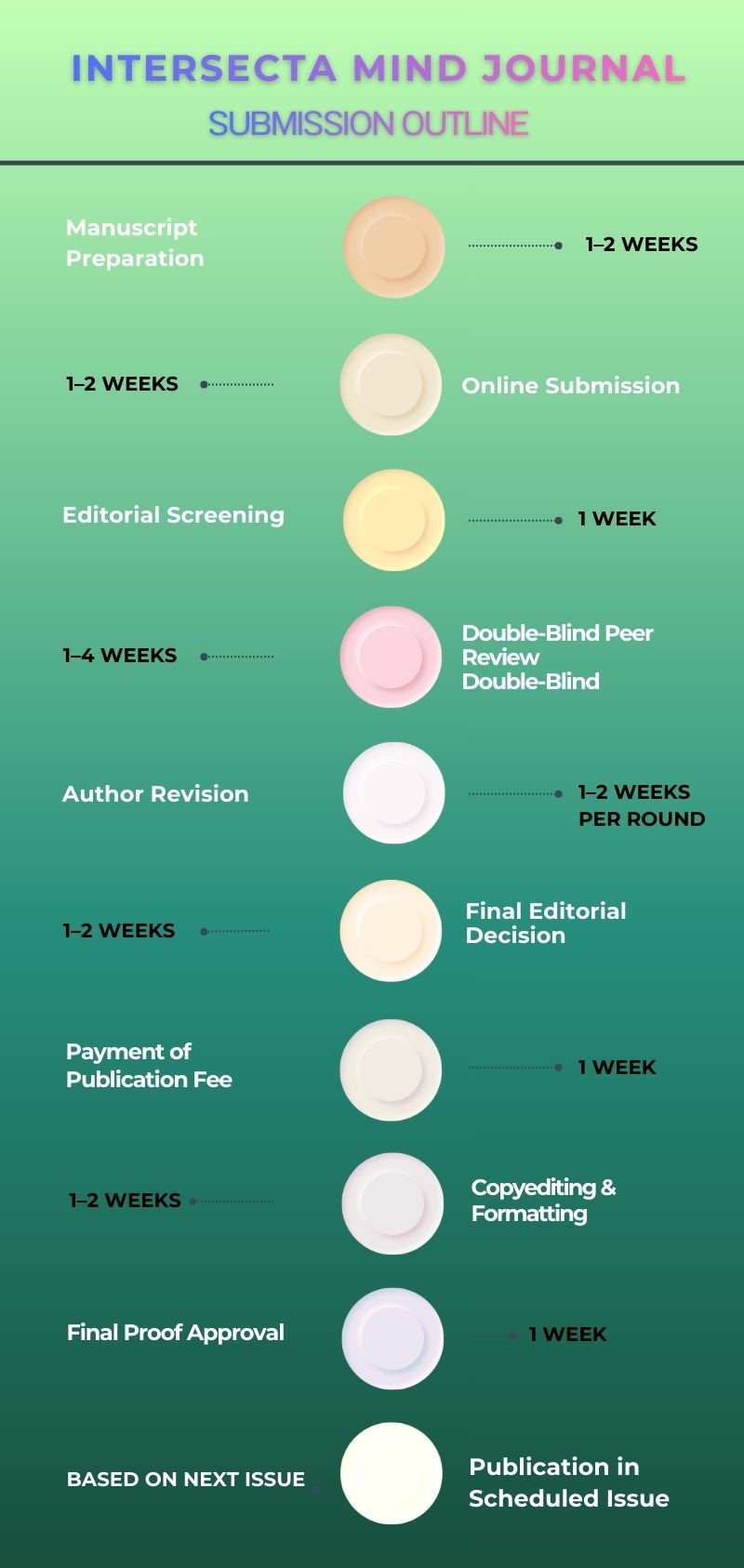
Intersecta Minds Journal upholds a rigorous peer-review process to ensure the highest quality of scholarship across the fields of Social Science, Arts and Humanities, Business, Management, and Education. All submitted manuscripts undergo evaluation by three independent expert reviewers, selected based on their scholarly expertise and research background. Reviewers assess originality, methodological soundness, academic contribution, clarity, and ethical integrity.
By participating in the review process, reviewers affirm their commitment to:
Providing fair, constructive, and timely feedback to authors.
Maintaining confidentiality in accordance with the double-blind review system.
Ensuring that personal biases, conflicts of interest, or competing academic interests do not influence their judgment.
Supporting the enhancement of academic quality, interdisciplinary discourse, and global perspectives.
Intersecta Minds Journal values the critical role of reviewers in fostering scholarly excellence, promoting ethical research, and contributing to the continuous advancement of knowledge.
Authors submitting to Intersecta Minds Journal are expected to uphold the highest standards of academic integrity and responsible scholarship. Submissions must adhere to the following ethical expectations:
Originality and Integrity
Manuscripts must be original, unpublished works that are not under review elsewhere. Authors must avoid plagiarism, data fabrication, and unethical research practices.
Transparency and Accountability
All data, methods, findings, and interpretations must be presented transparently and accurately. Authors should acknowledge all sources, contributions, and funding where appropriate.
Authorship Responsibility
Authorship should be limited to individuals who have made significant scholarly contributions. All authors must approve the final manuscript and agree to its submission.
Ethical Research Conduct
Studies involving human subjects, cultural materials, sensitive data, or community engagement must comply with ethical standards and obtain necessary approvals from relevant bodies.
Conflict of Interest Disclosure
Authors must disclose any potential conflicts of interest that could influence research outcomes or interpretations.
Responsiveness to Review
Authors are expected to engage constructively with peer review feedback and revise their manuscripts responsibly.
By adhering to these principles, authors contribute to a culture of trust, transparency, and excellence in scholarly communication.
Intersecta Minds Journal adopts a strict double-blind peer-review system, ensuring that the identities of authors and reviewers remain confidential throughout the review process. Reviewers are expected to adhere to the following ethical standards:
Confidentiality
All materials received for review are confidential and must not be shared, discussed, or used for personal research or gain.
Objectivity and Impartiality
Reviews must be conducted objectively, without personal criticism. Assessments should be based solely on academic merit, methodological rigor, and relevance.
Conflict of Interest Avoidance
Reviewers must decline assignments where conflicts of interest—financial, academic, institutional, or personal—could compromise impartiality.
Timeliness and Professionalism
Reviewers should complete evaluations within the specified timeframe and communicate promptly if delays arise.
Constructive Feedback
Review comments should aim to improve the manuscript by offering clear, respectful, and actionable suggestions.
Through these ethical commitments, reviewers help maintain the journal’s integrity, credibility, and dedication to promoting high-quality interdisciplinary research.
To ensure robust and comprehensive evaluation, Intersecta Minds Journal appoints reviewers who demonstrate expertise in three core areas relevant to their assigned manuscript:
Reviewers must possess demonstrated scholarly experience—publications, research, or academic qualifications—in the specific discipline or topic area of the manuscript (e.g., Sociology, Psychology, Education, Business, Arts, Humanities).
Reviewers should be proficient in the methodological approaches used in the manuscript, including qualitative, quantitative, mixed-methods, theoretical, or creative methodologies as appropriate.
Reviewers must be knowledgeable about academic ethics, publication protocols, international research standards, and responsible citation and evaluation practices.
This three-pillar expertise model ensures comprehensive, fair, and high-quality reviews aligned with the journal’s interdisciplinary mission.
Editor-in-Chief:
Asst.Prof.Dr. Pensri Bangbon
Email: imj.sshe@gmail.com
Mr. Werawit Rajcote
Editorial Assistant
Email: veerawit.ppn@gmail.com
|
Prof. Dr. Sombat Kanjanakit |
Chulalongkorn University, Thailand |
|
Prof. Dr. Chidchanok Luasinsap |
Chulalongkorn University, Thailand |
|
Prof. Dr. Chaiyong Phromwong |
Bangkok Thonburi University, Thailand |
|
Prof. Dr. Boonthan Dokthaisong |
Mahachulalongkornrajavidyalaya University, Thailand |
|
Prof. Dr. Ratnakar D Bala |
IMRF Institute for Research & Education, India |
|
Prof. Dr. Pankaj Srivastava |
General Secretary of FATER Academic of India, India |
|
Prof. Dr. Raghu Raman |
IBRA College of Technology, Oman |
|
Prof. Dr. Somsak Samukkeethum |
National Institute of Development Administration, Thailand |
|
Prof. Dr. Nina Poyda-Nosyk |
Hungarian College of Higher Education, Ukraine |
|
Assoc. Prof. Dr. Seri Wongmonta |
University of Phayao, Thailand |
|
Assoc. Prof. Dr. Phouphet Kyophilavong |
National University of Laos, Laos |
|
Assoc. Prof. Dr. Meuk Kimsroeun |
Build Bright University of Cambodia, Combodia |
|
Assะ. Prof.Dr.Dr Cheng Boon Liat |
Sunway University , Malaysia |
|
Asst. Prof.Dr. Yannakorn Toprayoon |
The Association of Researcher of Thailand |
|
Asst. Prof. Dr. Peera Panngam |
Pacific Institute of Management Science, Thailand |
|
Asst. Prof. Dr. Sujitra Samukkeethum |
Pacific Institute of Management Science, Thailand |
|
Asst. Prof. Dr. Phakaphorn Butsabong |
Pacific Institute of Management Science, Thailand |
|
Asst. Prof. Dr. Rungruedee Ratchaisin |
Pacific Institute of Management Science, Thailand |
|
Dr. Sarana Photchanachan |
School of Management Shinawatra University, Thailand |
|
Dr. Wasin Phromphitukkul |
School of Management Shinawatra University, Thailand |
|
Dr. Manoch Prompanyo |
School of Management Shinawatra University, Thailand |
Peer Reviewer:
Accounting and Economics
Asst. Prof. Dr. Anong Rungsuk
International College, Phetchabun Rajabhat University)
Email: anong.run@pcru.ac.th
Education Administration and Padagogy
Assoc. Prof. Dr. Kumron Sirathanakul
International College, Phetchabun Rajabhat University
Email: kumron.sir@pcru.ac.th
Buddhist Psychology and Religion Psychology
Asst.Prof.Dr. Pharkhrupalad Chotipath Acharashubho
Faculty of Religion and Philosophy, Mahamakut Buddhist University, Thailand
Email: chotipath.the@gmail.com
Business Management and Scocial Sciece
Dr. Sharma Khemraj
School of Tourism & Hospitality Management, KIIT University, India
Email: imj.sshe@gmail.com
Business Psychology and Educational Psychology
Assoc. Prof. Dr. Boonmun Thanasupawat
Faculty of Education, Uttaradit Rajabhat University
Email: boonmun99@hotmail.com
Hotel Management, HRM and Modern Business Management
Asst. Prof. Dr. Kanlaya Sawangkong
Faculty of Management, Phra Nakhon Si Ayutthaya Rajabhat University
Email: kanlaya.swa@aru.ac.th
Hotel Management and Tourism Industry
Prof.Dr.Chai Ching Tan
National Institute of Development Administration, Thailand.
Email: drcctan@yahoo.com
Social Innovention and Behavior Science
Assist.Prof.Dr. Chatwarun Angasinha
Leadership in Society, Business and Politics, College of Social Innovation, Rangsit University, Thailand.
Email: chattrsu@gmail.com
Research and Statistics in Cognitive Science
Dr.Phanthad Srithiphan
Research and Statistics in Cognitive Science, School of Education Administration, Mahamakut Buddhist University, Thailand.
Email: phanthad@gmail.com
Psychology and Behavior Science
Dr. Chompoonuch Changcharoen
Graduate School, Mahamakut Buddhist University, Salaya, Nakhon Phathom, Thailand.
Email: chompoonuch.mbu@gmail.com
Philosophy and Philosophy of Education:
Dr.Surachai Pudchu
School of Philosophy Religion and Culture, Faculty of Religion and Philosophy, Mahamakut Buddhist University, Salaya, Nakhon Phathom, Thailand.
Email: sura_chai_1981@hotmail.com
Linguistic Studies and Literature:
Dr.Nguyen Thanh Trung
Department of Literature, Ho Chi Minh City University of Education, Vietnam.
Email: trungnt@hcmue.edu.vn
Political and Business Administration
Assoc.Prof.Dr. Sukhumpong Channuwong
Faculty of Liberal Arts, Krirk University, Thailand.
Email: kruprofessor@gmail.com
Education Administration and Social Leadership
Asssoc.Prof.Dr. Kesinee Chiwpreecha
Educational Administration and Change Leadership, Graduate School, Eastern Asia University, Thailand.
Email: kesinee@eau.ac.th
Peace Studies and Research
Dr. Nadnapang Phophichit
Director of Master of Arts in Peace Studies Program (International Program), Mahachulalongkornrajavidyalaya University, Ayutthaya, Thailand.
Email: nadnapang@ibsc.mcu.ac.th
Statistic, Research, and Innovention
Dr. Rattiya Nueaamnat
Research and Academic, Graduate School, Nakhon Sawan Campus Mahachulalongkornrajavidyalaya University, Nakhon Sawan Province, Thailand.
Email: rattitik.prom@gamil.com
English Studies and Linguestic
Dr. Sayan Bhramanin
Department of English Studies, St. Maria Chon Daen School, Phetchabun Province, Thailand.
Email: suwatchano@hotmail.com
Philosophy of Political and Philosophy of Science
Dr. Chetnitipath Promchin
Graduate School, Mahamakut Buddhist University, Salaya, Nakhon Phathom, Thailand.
Email: chetnitipath@gmail.com
Religion Innovation and Applied Buddhism
Dr. Ven.Thich Giac Chinh
Sakyamuni Buddhist Sangha of the United States Organization, University Ave, Suite H, San Diego, California, USA.
Email: dharmameditationtemple@gmail.com
Pali and Linguistic
Prof.Dr. Sumanapal Bhikkhu
Department of Pali, University of Calcutta, India.
Email: sumanapal@caluniv.ac.in
Public Health and Life Science
Assist.Prof.Dr. Sneha Patnaik
School of Public Health, KIIT University, India.
Email: sneha.patnaikfph@kiit.ac.in
Novel Studies and Literature
Dr. Ven.Thich Nguyen The
Binh Thuan School of Buddhist Studies, Binh Thuan Province, Vietnam.
Email: thichnguyenthe@gmail.com
Art, Literature and the Drama
Dr. Dang Ngoc Ngan
School of Literary Theory, Ho Chi Minh City University of Education, Vietnam.
Email: dang_ngan@hcmue.edu.vn
Vietnamese Studies and History
Dr. Chung Le Khang
School of Vietnamese Studies, Ho Chi Minh City University of Education, Vietnam.
Email: chung_khang@hcmue.edu.vn
Managing Director:
Dr.Jakkapong Thipsungnoen
Noble Education Publisher
Email: pumjakkapong@gmail.com
Production Manager:
ISSN: 3056-929X (Online)
Asst.Prof.Dr. Pensri Bangbon
Editor-in-Chief
Email: imj.sshe@gmail.com
Mr. Werawit Rajcote
Editorial Assistant
Email: veerawit.ppn@gmail.com



|
Pacific Institute of Management Science |
|
222/2 M.1 Phaholyothin Rd., Bantam, Mueang Phayao 56000 Phone +66(0)54 887-188, www.ipacific.ac.th |
|
Editor contract: Tel. +66819839797 |
|
Email: imj.sshe@gmail.com |
 |
|
All materials published by Intersecta Minds Journal are licensed under |
|
A Creative Commons Attribution-NonCommercial-NoDerivatives 4.0 International License. |