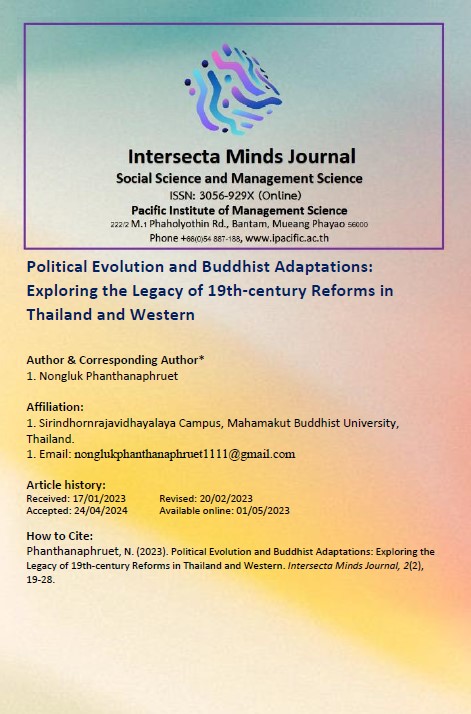
Political Evolution and Buddhist Adaptations: Exploring the Legacy of 19th-century Reforms in Thailand and Western
Keywords:
Western Concept;, Political ScienceAbstract
The 19th century marked a significant juncture in the political evolution of Thailand, then known as Siam, characterized by encounters with Western powers and internal reforms under successive monarchs. This era witnessed a confluence of cultural and political dynamics, shaping the trajectory of Thai society. By examining the comparative approaches to cultural and political reform, specifically through the lenses of Buddhist and Western ideologies, this research aims to shed light on the complexities of governance and identity in 19th-century Thailand.
References
Keyes, C. F. (1989). Buddhist politics and their revolutionary origins in Thailand. International Political Science Review, 10(2), 121-142.
Habermas, J. (1991). Autonomy and solidarity: interviews with Jürgen Habermas. Verso.
Haidt, Jonathan, & Craig Joseph. (2004). The moral mind: How five sets of innate intuitions guide the development of many culture-specific virtues, and perhaps even modules. In Carruthers, P., Laurence, S., & Stich, S. (Eds.), The Innate Mind: Structure and Content. Oxford University Press.
Hwa, P. T. (1971). The Lao Rebellion, 1826-1828. Center for Southeast Asian Studies, University of Michigan.
Harris, I. (1999). Buddhism and Politics in Asia: The Textual and Historical Roots. Buddhism and politics in twentieth-century Asia, 1-25.
Nattaya Chetchotiros. (1995), cited-in Ba, A. D. (2007). ASEAN in East Asia. People’s ASEAN and Governments’ ASEAN, RSIS Monograph, (11), 93-101.
Nithi Aesurivongse. (1993), cited-in Trakulhun, S. (2024). Confronting Christianity: The Protestant Mission and the Buddhist Reform Movement in Nineteenth-Century Thailand. University of Hawaii Press.
Ostrom, E., & Ostrom, V. (2004). The quest for meaning in public choice. American Journal of Economics and Sociology, 63(1), 105-147.
Phra Rajavaramuni. (1987), cited-in Olson, C. (1997). Essential Sources on Thai Theravada Buddhism. Behavioral & Social Sciences Librarian, 16(1), 1-10.
Sanitsuda Ekachai. (2001). The Booze is Part of General Decline. Bangkok Post, 29. Solinger, 1991
Yang, M., Chan, S., Vang, T., Nguyen, T., Ly, M., Phommasouvanh, B., & Cabugao, R. (1989). Depression and posttraumatic stress disorder in Southeast Asian refugees. American Journal of Psychiatry, 146(12), 1592-1597.
Downloads
Published
How to Cite
Issue
Section
License
Copyright (c) 2023 Intersecta Minds Journal

This work is licensed under a Creative Commons Attribution-NonCommercial-ShareAlike 4.0 International License.