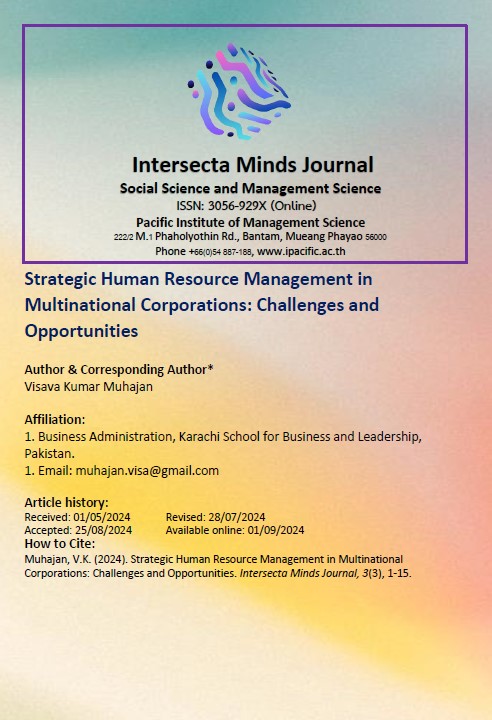
Strategic Human Resource Management in Multinational Corporations: Challenges and Opportunities
Keywords:
Strategic;, Human Resource Management;, Multinational Corporations;Abstract
The study investigates the challenges and opportunities associated with Strategic Human Resource Management (SHRM) in Multinational Corporations (MNCs). With globalization driving increased complexity in the business environment, MNCs face unique HRM challenges and opportunities. The objective of this research is to explore the multifaceted nature of SHRM within MNCs, highlighting the strategic approaches adopted to address challenges and leverage opportunities for organizational success. Through a comprehensive literature review and data analysis, the study identifies key challenges faced by MNCs in SHRM, including resource constraints, cultural differences, and talent acquisition and retention issues. Concurrently, the study also uncovers significant opportunities for MNCs to enhance their SHRM practices, such as leveraging a global talent pool, embracing technology and digitalization, and promoting diversity and inclusion. The results highlight the critical importance of strategic alignment and adaptation in SHRM practices within MNCs. By aligning HR strategies with organizational goals and values, MNCs can foster innovation, collaboration, and continuous improvement. Furthermore, the findings underscore the need for MNCs to remain agile and responsive to changing market dynamics, regulatory frameworks, and technological advancements, ensuring the relevance and effectiveness of their SHRM practices in a dynamic business environment. In conclusion, the study contributes to a deeper understanding of SHRM in MNCs, emphasizing the need for a strategic approach that balances challenges with opportunities to achieve organizational objectives and sustain competitive advantage in a globalized world.
References
Barney, J. B. (1991). Firm resources and sustained competitive advantage. Journal of Management, 17(1), 99-120.
Barney, J. B., & Wright, P. M. (1998). On becoming a strategic partner: The role of human resources in gaining competitive advantage. Human Resource Management, 37(1), 31-46.
Bartlett, C. A., & Ghoshal, S. (1989). Managing across borders: The transnational solution. Harvard Business Review Press.
Boxall, P., & Purcell, J. (2011). Strategy and human resource management. Palgrave Macmillan.
Brewster, C., & Mayrhofer, W. (2012). Handbook of research on comparative human resource management. Edward Elgar Publishing.
Brewster, C., & Sparrow, P. (2016). Globalizing human resource management. Routledge.
Brewster, C., et al. (2018). Human resource management: A global and critical perspective. CIPD Publishing.
Cooke, F. L. (2017). Multinational corporations and global human resource management. Cambridge University Press.
DiMaggio, P. J., & Powell, W. W. (1983). The iron cage revisited: Institutional isomorphism and collective rationality in organizational fields. American Sociological Review, 48(2), 147-160.
Farndale, E., et al. (2010). Handbook of research on comparative human resource management. Edward Elgar Publishing.
Festing, M., et al. (2013). Human resource management in Europe: Evidence of convergence? Routledge.
Harzing, A. W., & Pinnington, A. H. (2016). International human resource management. Sage.
Hahn, R., & Kühnen, M. (2013). Determinants of sustainability reporting: A review of results, trends, theory, and opportunities in an expanding field of research. Journal of cleaner production, 59, 5-21.
Hofstede, G. (1980). Culture's consequences: International differences in work-related values. Sage.
Jackson, G., & Deeg, R. (2008). Comparing capitalisms: Understanding institutional diversity and its implications for international business. Journal of International Business Studies, 39(4), 540-561.
Jackson, S. E., & Schuler, R. S. (2003). Managing human resources in cross-border alliances. Routledge.
Jackson, S. E., et al. (2014). Managing human resources in the global era. Cengage Learning.
Martinson, B., & De Leon, J. (2018). Testing horizontal and vertical alignment of HR practices designed to achieve strategic organizational goals. Journal of Organizational Effectiveness: People and Performance, 5(2), 158-181.
Paauwe, J., & Boselie, P. (2005). HRM and performance: What next? Human Resource Management Journal, 15(4), 68-83.
Puranam, P., Singh, H., & Chaudhuri, S. (2014). Integrating distributed work: Comparing task design, communication, and tacit coordination mechanisms. Management Science, 60(11), 2832-2857.
Schuler, R. S., & Jackson, S. E. (2007). Strategic human resource management. John Wiley & Sons.
Schuler, R. S., et al. (2011). Global talent management and global talent challenges: Strategic opportunities for IHRM. Journal of World Business, 46(4), 506-516.
Smith, M., et al. (2020). The Routledge companion to international human resource management. Routledge.
Trompenaars, F., & Hampden-Turner, C. (1998). Riding the waves of culture: Understanding diversity in global business. McGraw-Hill.
Wright, P. M., et al. (2001). Human resources and sustained competitive advantage: A resource-based perspective. International Journal of Human Resource Management, 12(2), 299-330.
Downloads
Published
How to Cite
Issue
Section
License
Copyright (c) 2024 Intersecta Minds Journal

This work is licensed under a Creative Commons Attribution-NonCommercial-ShareAlike 4.0 International License.