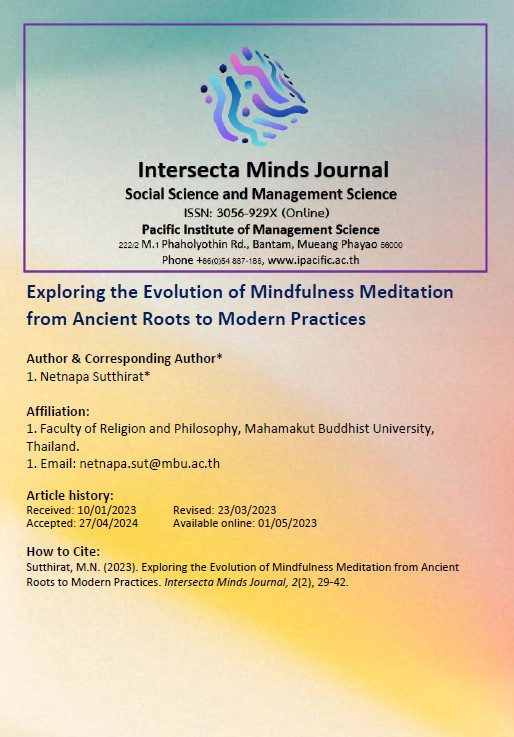
Exploring the Evolution of Mindfulness Meditation from Ancient Roots to Modern Practices
Keywords:
Exploring;, Evolution;, Mindfulness Meditation;, Ancient Roots;, Modern PracticesAbstract
This article delves into the historical trajectory of mindfulness meditation, tracing its development from ancient origins to contemporary applications. Drawing upon insights from diverse cultural and spiritual traditions, particularly Buddhism, the narrative unfolds the evolution of mindfulness practices across centuries and continents. From its inception as a spiritual discipline aimed at awakening to its resurgence in the modern world as a secular tool for stress reduction and holistic well-being, mindfulness meditation has undergone significant transformations. The abstract highlights the role of key figures such as Jon Kabat-Zinn in popularizing mindfulness-based interventions and examines the impact of technology on its accessibility. By exploring the dynamic interplay between tradition and innovation, this article illuminates how mindfulness meditation continues to evolve, adapt, and resonate with individuals across cultures and contexts.
References
Analayo, B. (2003). Satipatthana: The direct path to realization. Windhorse Publications.
Baer, R. A. (2003). Mindfulness training as a clinical intervention: A conceptual and empirical review. Clinical psychology: Science and practice, 10(2), 125-143.
Bodhi, B. (2011). What does mindfulness really mean? A canonical perspective. Contemporary Buddhism, 12(1), 19-39.
Goldstein, J., & Kornfield, J. (1987). Seeking the heart of wisdom: The path of insight meditation. Shambhala Publications.
Goldstein, J. (2002). One Dharma: The Emerging Western Buddhism. HarperOne.
Kabat-Zinn, J. (1990). Full catastrophe living: Using the wisdom of your body and mind to face stress, pain, and illness. Delta.
Kapleau, P. (1989). The three pillars of Zen: Teaching, practice, and enlightenment. Anchor Books.
Khemraj, S., Thepa, P. C. A., Patnaik, S., Chi, H., & Wu, W. Y. (2022). Mindfulness Meditation and Life Satisfaction Effective on Job Performance. NeuroQuantology, 20(1), 830-841.
Rao, K. (2010). Mindfulness: Its Origins, Scope, and Controversies. Journal of Indian Psychology, 28(2), 1-6.
Sedlmeier, P., Eberth, J., Schwarz, M., Zimmermann, D., Haarig, F., Jaeger, S., & Kunze, S. (2012). The psychological effects of meditation: A meta-analysis. Psychological Bulletin, 138(6), 1139-1171.
Sutthisanmethi, P., Wetprasit, S., & Thepa, P. C. A. (2022). promotion of well-being for the elderly based on the 5 Ᾱyussadhamma in the Dusit District, Bangkok, Thailand: A case study of Wat Sawaswareesimaram Community. International journal of health sciences, 6(3), 1391-1408.
Thepa, P. C. A. (2022). Buddhadhamma of Peace. International Journal of Early Childhood Special Education, 14(3).
Thepa, P. C. A. (2022). Mindfulness: A Buddhism Dialogue of Sustainability Wellbeing. In 2022 International Webinar Conference on the World Chinese Religions. Nanhua University. Taiwan. https://urlcc. cc/sysek.
Downloads
Published
How to Cite
Issue
Section
License
Copyright (c) 2023 Intersecta Minds Journal

This work is licensed under a Creative Commons Attribution-NonCommercial-ShareAlike 4.0 International License.