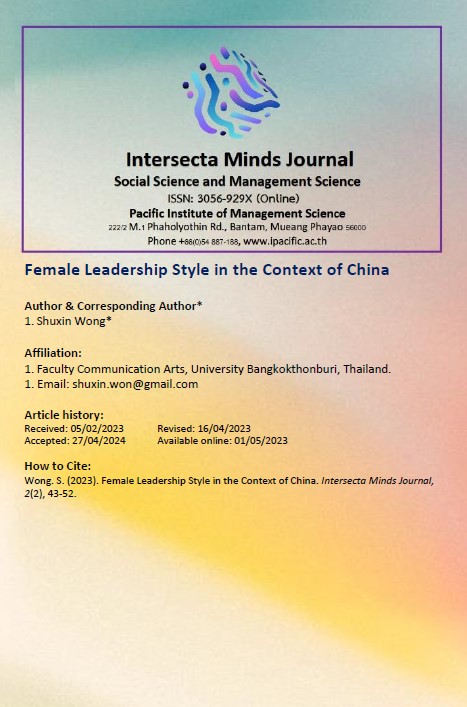
Female Leadership Style in the Context of China
Keywords:
Female;, Leadership Style;, Context;, ChinaAbstract
This study explores the relationship between female leadership style and its influence on employee engagement within the unique cultural and organizational context of China. With an increasing number of women assuming leadership roles in Chinese companies, it becomes imperative to understand how their leadership styles affect employee engagement, which is crucial for organizational success and competitiveness. This research employs a mixed-method approach, combining qualitative interviews and quantitative surveys to gather comprehensive insights. The findings of this study are expected to contribute to the existing literature on leadership and employee engagement, particularly in the Chinese context, offering practical implications for organizations striving to enhance employee engagement through effective female leadership. Ultimately, this research aims to shed light on the significance of gender diversity in leadership and its implications for employee engagement in China.
References
Acker, J. (1990). Hierarchies, jobs, bodies: A theory of gendered organizations. Gender and Society, 4(2), 139-158.
Alesina, A., Giuliano, P., & Nunn, N. (2013). On the origins of gender roles: Women and the plough. The Quarterly Journal of Economics, 128(2), 469-530.
Bakker, A. B., & Demerouti, E. (2017). Job demands-resources theory: Taking stock and looking forward. Journal of Occupational Health Psychology, 22(3), 273-285.
Chen, C. C. (2004). Leadership effectiveness in international assignments: Individual and organizational factors. In R. S. Bhagat & R. M. Steers (Eds.), Handbook of Culture, Organizations, and Work (pp. 229-252). Cambridge University Press.
Cheng, X., Guo, C., & Ioannou, I. (2003). On the evolution of a traditional society: A longitudinal study of the family in China. Journal of Comparative Family Studies, 34(1), 25-47.
Cherniss, C., & Goleman, D. (2001). The Emotionally Intelligent Workplace: How to Select For, Measure, and Improve Emotional Intelligence in Individuals, Groups, and Organizations. Jossey-Bass.
Chin, J. L., Trimble, J. E., & Garcia, J. E. (2016). Handbook of the psychology of women and gender. John Wiley & Sons.
Deng, X., & Gibson, D. (2009). Leadership in Chinese management: Case studies of three Chinese managers in a Sino-Japanese joint venture in Beijing. Asia Pacific Business Review, 15(2), 169-189.
Duan, J., Xiao, Q., & Xie, Z. (2019). The relationship between emotional intelligence and job performance: Moderating effects of transformational leadership and leader-member exchange. Leadership & Organization Development Journal, 40(7), 797-808.
Eagly, A. H., & Chin, J. L. (2010). Diversity and leadership in a changing world. American Psychologist, 65(3), 216-224.
Goleman, D. (1995). Emotional Intelligence: Why It Can Matter More Than IQ. Bantam Books.
Gooty, J., Gavin, M., & Ashkanasy, N. M. (2012). Emotions research in OB: The challenges that lie ahead. Journal of Organizational Behavior, 33(5), 593-596.
Gupta, V., Turban, D. B., Wasti, S. A., & Sikdar, A. (2008). The role of gender stereotypes in perceptions of entrepreneurs and intentions to become an entrepreneur. Entrepreneurship Theory and Practice, 32(3), 439-471.
Guo, L., & Sanchez-Burks, J. (2017). Social interaction shapes the adaptive value of emotion recognition: Evidence from China. Management and Organization Review, 13(2), 243-271.
Hofstede, G., & Bond, M. H. (1988). The Confucius connection: From cultural roots to economic growth. Organizational Dynamics, 16(4), 5-21.
Huang, X., Iun, J., Liu, A., & Gong, Y. (2016). Does participative leadership enhance work performance by inducing empowerment or trust? The differential effects on managerial and non-managerial subordinates. Journal of Organizational Behavior, 37(2), 204-224.
Kossek, E. E., & Zonia, S. C. (1993). Assessing diversity climate: A field study of reactions to employer efforts to promote diversity. Journal of Organizational Behavior, 14(1), 61-81.
Lam, T., & White, L. (1998). Human resource management, management control and trust in Chinese modern enterprises. The International Journal of Human Resource Management, 9(3), 570-585.
Li, Y. H., & Hung, H. C. (2009). Enhancing employee performance and job satisfaction through the implementation of high-performance work systems. International Journal of Manpower, 30(3), 223-242.
Luo, Y., & Shenkar, O. (2006). The multinational corporation as a multilingual community: Language and organization in a global context. Journal of International Business Studies, 37(3), 321-339.
Mayer, J. D., & Salovey, P. (1997). What is emotional intelligence? In P. Salovey & D. J. Sluyter (Eds.), Emotional development and emotional intelligence: Implications for educators (pp. 3-31). Basic Books.
Shen, W., Chanda, A., D'Netto, B., & Monga, M. (2019). The impact of servant leadership on job satisfaction: The contingent role of leader–follower reciprocity. International Journal of Human Resource Management, 30(14), 2109-2133.
Sy, T., Tram, S., & O'Hara, L. A. (2006). Relation of employee and manager emotional intelligence to job satisfaction and performance. Journal of Vocational Behavior, 68(3), 461-473.
Tang, C. Y., Wong, C. S., & Law, K. S. (2010). Relationships between leader-member exchange and emotional intelligence: An exploratory study with Chinese employees in Hong Kong. The Leadership Quarterly, 21(1), 68-80.
Tsui, A. S., Zhang, Z. X., Wang, H., Xin, K. R., & Wu, J. B. (2006). Unpacking the relationship between CEO leadership behavior and organizational culture. Leadership Quarterly, 17(2), 113-137.
Downloads
Published
How to Cite
Issue
Section
License
Copyright (c) 2023 Intersecta Minds Journal

This work is licensed under a Creative Commons Attribution-NonCommercial-ShareAlike 4.0 International License.