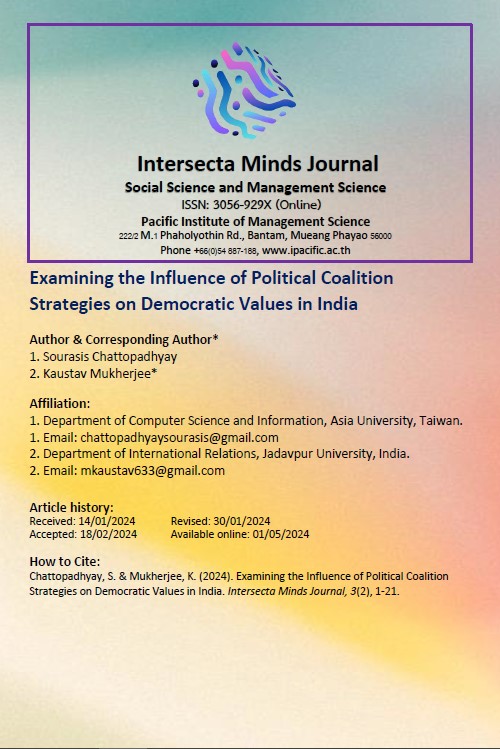
Examining the Influence of Political Coalition Strategies on Democratic Values in India
Keywords:
Political Coalition; , India Coalition; , NDA Coalition; , UPA CoalitionAbstract
Following the common pattern, coalition parties in governance typically operate with an eye on upcoming elections, leading to potential conflicts as they compete for support. Additionally, ministers and their affiliated political entities often maintain personal stances on crucial matters. The willingness of these parties to compromise on these individual preferences is crucial for the formation of a coalition government. India's political landscape, influenced by regional parties, has seen increased interconnectivity. Recent trends suggest that a coalition, particularly one dominated by a single party, tends to function in a monopolistic manner when making significant decisions within the federal system. This puts the integrity and sustainability of the coalition under constant scrutiny. Given the close intertwining of a democratic nation's ethics and political values with public sentiments, moralities, and political perspectives, this study seeks to explore this area and provide tangible evidence supporting India's ongoing transition in political coalition strategy. Through comparative analysis, the research concludes that India's current democratic ethics are undergoing a distinct transformation, primarily leaning towards dominant party rule rather than collective coalition decision-making—a notable departure from past coalition instabilities. The current coalition led by NDA is often perceived as Modi Doctrine, implying a command under a dominant party. The research highlights instances of decisions made by the Narendra Modi-led government, justifying them to enhance regional and national image and integrity. However, as outlined in this article, these culturally motivating conservative decisions, while controversial and dramatic, do not contribute to India's democratic image and secular objectives in a sustainable manner, irrespective of the perceived impact on economic growth under the current nation-first strategies of the NDA government. Consequently, the dimensions and stability of a coalition remain volatile and transitional within the context of India.
Downloads
Published
How to Cite
Issue
Section
License
Copyright (c) 2024 Intersecta Minds Journal

This work is licensed under a Creative Commons Attribution-NonCommercial-ShareAlike 4.0 International License.