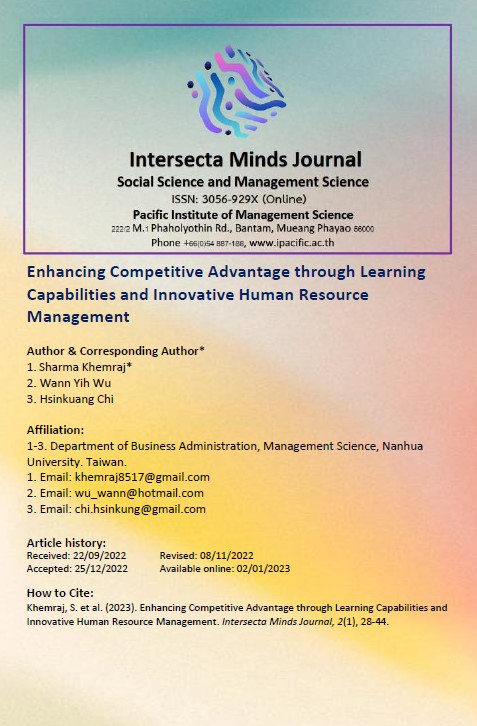
Enhancing Competitive Advantage through Learning Capabilities and Innovative Human Resource Management
Keywords:
Knowledge Share; , Employee Skillset; , Staff Management; , HRM Innovation; , Innovation PlanAbstract
In an effort to increase their sales, customer base, and market share, businesses are always looking for new ways to strengthen their competitive advantages. Levels of competition have risen as a result of the quick changes brought about by globalisation, improvements in information technology, and other factors. Incorporating efficient methods of human resource management into business operations helps companies reach their objectives. Here, we take a look at the company's learning process and cutting-edge HR management system, as well as its current state and ecosystems, and assess them according to their ability. This article examines the need, scope, and inclusion trend of a learning-based workplace climate integrated with innovative HR segment, as well as the extent to which the policy aids the organisation in achieving its goal. It relies on secondary data from authentic sources such as current research, organisation documents, press reviews, government reviews/records, etc. Last but not least, the article makes some suggestions for where this policy could go from here as well as different ways that organisations can integrate (the goal is to identify an integration mode that works for any size or type of business, regardless of its infrastructure, so that it can inspire more ambition and growth).
References
Abdul Ghani Azmi, I., & Hashim, J. (2022). Do HRM practices facilitate innovation? A qualitative study in a developing country. Innovation & Management Review, 19(4), 368–381. https://doi.org/10.1108/inmr-09-2020-0122
Andrew, S., & Somerville, E. (2022). Innovative HRM and Organizational Performance. https://doi.org/10.20944/preprints202212.0477.v1
Aslam, A., Eugster, J., Ho, G., Jaumotte, F., & Piazza, R. (2018, April 9). Globalization helps spread knowledge and technology across borders. IMF. https://www.imf.org/en/Blogs/ Articles/2018/04/09/globalization-helps-spread-knowledge-and-technology-across-borders
Azeem, M., Ahmed, M., Haider, S., & Sajjad, M. (2021). Expanding competitive advantage through organizational culture, Knowledge sharing and organizational innovation. Technology in Society, 66, 101635. https://doi.org/10.1016/j.techsoc.2021.101635
Bai, Y. (2022). Innovative mode of human resource management of university teachers based on Intelligent Big Data Analysis. Computational Intelligence and Neuroscience, 2022, 1–10. https://doi.org/10.1155/2022/7345547
Khemraj, S., Thepa, P. C. A., & Chi, H. (2021). Phenomenology In Education Research: Leadership Ideological. Webology (ISSN: 1735-188X), 18(5).
Kyove, J., Streltsova, K., Odibo, U., & Cirella, G. T. (2021). Globalization impact on multinational enterprises. World, 2(2), 216–230. https://doi.org/10.3390 /world2020014
Lušňáková, Z., Benda-Prokeinová, R., & Juríčková, Z. (2022). Attitudes and involvement of employees in the process of implementing innovations and changes in companies. Behavioral Sciences, 12(6), 174. https://doi.org/10.3390/bs12060174
Onsardi, O., Ranidiah, F., & Bahrun, K. (2019). Human Resource Competencies in the Era of Globalization. https://doi.org/10.31219/osf.io/dsh97
Panigrahy, N. P., & Pradhan, R. K. (2015). Creativity and Innovation: Exploring the Role of HR Practices at Workplace. National Conference Held at Ravenshaw Business School.
Rusok, N. H., Samy, N. K., & Bhaumik, A. (2023). Learning culture and innovative work behaviour: Does attitude toward change matter? International Journal of Professional Business Review, 8(5). https://doi.org/10.26668/businessreview/2023.v8i5.1504
Siraj, N., Hágen, I., Cahyadi, A., Tangl, A., & Desalegn, G. (2022). Linking leadership to employee’s performance: The mediating role of human resource management. Economies, 10(5), 111. https://doi.org/10.3390/economies10050111
Sousa, M. J., & González-Loureiro, M. (2015). Formalisation versus tacitness: Keys for creating and sharing knowledge in innovative large organisations. Independent Journal of Management & Production, 6(1). https://doi.org/10.14807/ijmp.v6i1.251
Stallings, B. (2001). Glbalization and Liberalization: The Impact on Developing Countries (1st ed., Vol. 14). UN-Economic Development Division.
Wijaya, G. A., Misbahudin, D., Baha, M. A., Yanti, A. D., & Pasaribu, P. N. (2023). The influence of human resource management practices, Organizational Innovation and Learning Organization Culture on Innovation Work Performance. Jurnal Manajemen, 14(1), 57. https://doi.org/10.32832/jm-uika.v14i1.9779
Downloads
Published
How to Cite
Issue
Section
License
Copyright (c) 2023 Intersecta Minds Journal

This work is licensed under a Creative Commons Attribution-NonCommercial-ShareAlike 4.0 International License.