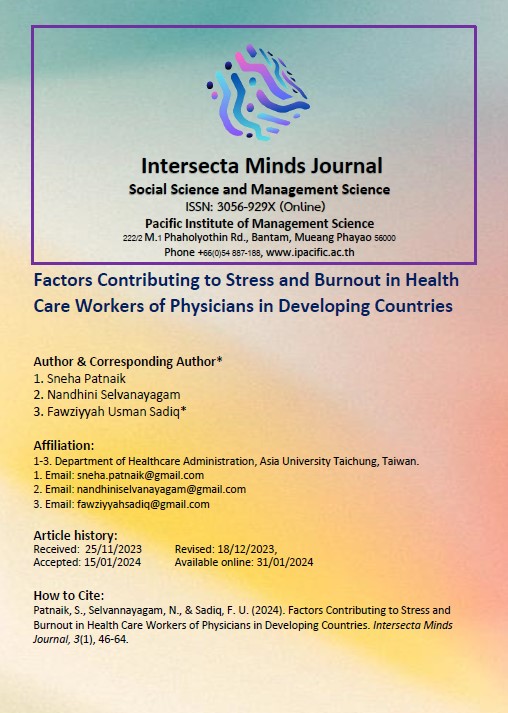
Factors Contributing to Stress and Burnout in Health Care Workers of Physicians in Developing Countries
Keywords:
Burnout;, Stress;, WHO;, Healthcare;, Physicians;Abstract
Stress and burnout among doctors and other medical staff in underdeveloped nations were the focus of this research. Factors such as these include financial limitations, emotional strain, overburden, little resources, a bad working environment, and social demands. The study set out to alleviate stress, protect healthcare workers' well-being, and improve healthcare delivery in these nations sustainably by creating focused treatments, supporting policies, and systemic improvements. The COVID-19 epidemic has had a profound influence on burnout, a mental illness defined by emotional lethargy, pessimism, and a lack of efficacy. Problems with staff turnover, emigration rates, sick leave, patient safety, and treatment quality may result. Doctors experience burnout at a higher rate than the general population because they work longer hours and are less satisfied with their careers and lives overall. Because of variations in cultural and organizational variables, the precise prevalence of burnout differs among studies. A mere 34% of NHS workers in 2022 said they did not feel emotionally tired on the job, while 37.4% stated the exact opposite. The rates of burnout were most significant for those working in ambulance duties, among other healthcare professions. With the help of 831 medical professionals from different fields and 912 participants from primary healthcare clinics, this research sought to explore the complicated nature of stress and burnout among healthcare workers in developing nations. Over half of the working-age population experiences professional burnout. Factors that contribute to high levels of psychological distress include dealing with an infected family member, being in quarantine, having a dependent family member, and being exposed to a patient suspected or proven to have the infection.
References
Alnazly E, Khraisat OM, Al-Bashaireh AM, Bryant CL. (2021). Anxiety, depression, stress, fear and social support during COVID-19 pandemic among Jordanian healthcare workers. PLoS One; 16(3): e0247679.
El-Hage W, Hingray C, Lemogne C, et al. (2020). Health professionals facing the coronavirus disease 2019 (COVID-19) pandemic: What are the mental health risks? Encephale 46(3S): S73-80. [http://dx.doi.org/10.1016/j.encep.2020.04.008] [PMID: 32370984]
Kisely S, Warren N, McMahon L, Dalais C, Henry I, Siskind D. (2020). Occurrence, prevention, and management of the psychological effects of emerging virus outbreaks on healthcare workers: Rapid review and meta-analysis.
LeClaire, M., Poplau, S., Linzer, M., Brown, R., &Sinsky, C. (2022). Compromised integrity, burnout, and intent to leave the job in critical care nurses and physicians. Essential explorations of care, 4(2). https://doi.org/10.1097/ CCE.0000000000000629
Medscape National Physician Burnout. (2019). Depression & suicide report 2019. Available at: https://www.medscape.com/2019-lifestyle-burnout. Published 2019. Accessed August 17, 2019.
Medina, L., Myssayev, A., Meirmanov, S., &Uristemova, A. (2023). Professional burnout in primary health care workers of the Republic of Kazakhstan. Clinical Epidemiology and Global Health, 23, 101359. https://doi.org/10.1016/j.cegh.2023.101359
Montgomery, A. (2014). The inevitability of physician burnout: Implications for interventions. Burnout Research, 1(1), 50–56. https://doi.org/10.1016/j.burn.2014.04.002
National Center for PTSD. (2020). Moral Injury in Health Care Workers. Retrieved from https://www.ptsd.va.gov/ professional/treat/cooccurring/moral_injury_hcw.asp
NHS Workforce Survey. (2022). https://www.nhsstaffsurveys.com/results/
Panagioti M, Geraghty K, Johnson J, et al. (2018). Association between physician burnout and patient safety, professionalism, and patient satisfaction. JAMA Intern Med;178(10):1317.
Prasad, K., McLoughlin, C., Stillman, M., Poplau, S., Goelz, E., Taylor, S., Nankivil, N., Brown, R., Linzer, M., Cappelucci, K., Barbouche, M., &Sinsky, C. A. (2021). Prevalence and correlates of stress and burnout among U.S. healthcare workers during the COVID-19 pandemic: A national cross-sectional survey study. EClinicalMedicine, 35, 100879. https://doi.org/10.1016/j.eclinm.2021.100879
Rossi R, Socci V, Pacitti F, et al. Mental health outcomes among [39] frontline and second-line health care workers during the coronavirus disease 2019 (COVID-19) pandemic in Italy. JAMA Netw Open 2020; 3(5), e2010185-. [http://dx.doi.org/10.1001/jamanet workopen.2020.10185] [PMID: 32463467]
Salvagioni DAJ, Melanda FN, Mesas AE, González AD, Gabani FL, Andrade SM. (2017). Physical, psychological and occupational consequences of job burnout: a systematic review of prospective studies. PLoS One. 4;12(10), e0185781. doi: http://dx.doi.org/10.1371 /journal. pone.0185781 PMID: 28977041
Saqlain M, Munir MM, Rehman SU, et al. (2020). Knowledge, attitude, practice and perceived barriers among healthcare workers regarding COVID-19: A cross-sectional survey from Pakistan. J Hosp Infect; 105(3), 419-23. [http://dx.doi.org/10.1016/j.jhin.2020.05.007] [PMID: 32437822]
Shanafelt TD, Boone S, Tan L, Dyrbye LN, Sotile W, Satele D, et al. (2012). Burnout and satisfaction with work–life balance among U.S. physicians relative to the general US population. Arch Intern Med, 172(18):1377–85. doi: http://dx.doi.org/10.1001/archinternmed.2012.3199 PMID: 22911330
Shanafelt TD, Dyrbye LN, West CP, Sinsky CA. (2016). Potential impact of burnout on the U.S. physician workforce. Mayo ClinProc, 91 (11), 1667–1668.
Ulrich, C. M. & Grady, C. (2019). Moral distress and moral strength among clinicians in health care Systems: A Call for Research. NAM Perspectives, 10.31478, 201919c. https://nam. edu/moral-distress-and-moral-strength-amongclinicians-in-health-care-systems/
Universal Health Coverage (UHC). (2019). Geneva: World Health Organization; Available from: https://www.who.int/news-room/fact-sheets/detail/ universal-health-coverage-(uhc) [cited 2021 May 10].
World Health Organization. (2021). International Classification of Diseases for Mortality and Morbidity Statistics (ICD-11 MMS). Genebra: WHO.
Wright, T., Mughal, F., Babatunde, O., Dikomitis, L., Mallen, C., &Helliwell, T. (2022). Burnout among primary healthcare professionals in low- and middle-income countries: Systematic review and meta-analysis. Bulletin of the World Health Organization, 100(06), 385-401A. https://doi.org/10.2471/BLT.22.288300.
Wu PE, Styra R, Gold WL. (2020). We are mitigating the psychological effects of COVID-19 on healthcare workers. CMAJ 2020; 192(17): E459-60. [http://dx.doi.org/10.1503/ cmaj.200519] [PMID: 32295761].
Yates, S. W. (2020). Physician Stress and Burnout. The American Journal of Medicine, 133(2), 160–164. https://doi.org/10.1016/j.amjmed.2019.08.034.
Zhou, A. Y., Panagioti, M., Esmail, A., Agius, R., Van Tongeren, M., & Bower, P. (2020). Factors Associated with Burnout and Stress in Trainee Physicians: A Systematic Review and Meta-analysis. JAMA Network Open, 3(8), e2013761. https://doi.org/10.1001/jamanet workopen.2020.13761.
Downloads
Published
How to Cite
Issue
Section
License
Copyright (c) 2024 Intersecta Minds Journal

This work is licensed under a Creative Commons Attribution-NonCommercial-ShareAlike 4.0 International License.