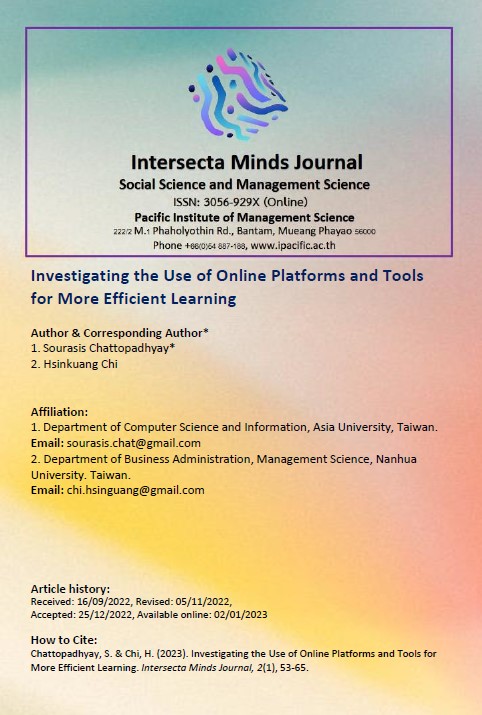
Investigating the Use of Online Platforms and Tools for More Efficient Learning
Keywords:
Remote Learning;, Online platform;, Challenges;, Online Tools;, Education;Abstract
This study looked at the growing availability of online degree programmes at colleges and universities, as well as the benefits of online education for students and teachers. Because online technologies offered students a dynamic way to participate, collaborate, and grow, institutions needed to adapt to a diverse and tech-savvy student population. With the complexity of online platforms, it was easier to provide students with technically competent and pedagogically effective learning experiences. Online education has emerged as a serious contender to more conventional classroom settings, thanks to the proliferation of portable and desktop computers, smartphones, and other electronic devices. It provided chances for learning in an interactive classroom environment where instructors may provide either immediate or delayed comments. Online courses may only be suitable for some students due to differences in aptitude, experience, and learning style. The widespread availability of digitally improved learning materials, such as smartboards, tablets, laptops, simulations, dynamic visualizations, and virtual labs, has propelled information technology to the forefront of educational reform. The Internet of Things has the potential to drastically reduce the expense of obtaining a top-notch education. It was expected that social media would swiftly become an integral part of online education, given its significance in disseminating knowledge and establishing professional connections. Based on the participants' self-confidence and the ease with which they could utilize electronic communication devices, they were well-equipped to handle technical obstacles. Challenges related to devices and internet connectivity included issues with computer and smartphone facilities, restricted internet access, limited funds, and other similar issues.
References
J. Keengwe, M. Bhargava, Mobile learning and integration of mobile technologies in education, Education and Information Technologies 19 (4) (2014) 737–746.
T.A. Vakaliuk, O.M. Spirin, N.M. Lobanchykova, L.A. Martseva, I.V. Novitska, V.V. Kontsedailo, Features of distance learning of cloud technologies for the quarantine organization's educational process, J. Phys. Conf. Ser. 1840 (1) (2021, March) 012051.
G. Emmanuel, A. Sife, Challenges of managing information and communication technologies for education: Experiences from Sokoine National Agricultural Library, International journal of education and development using ICT 4 (3) (2008).
A.J. Cañas, J.W. Coffey, M.J. Carnot, P. Feltovich, R.R. Hoffman, J. Feltovich, J.D. Novak, A summary of literature about the use of concept mapping techniques and technologies for education and performance support, Report to the Chief of Naval Education and Training (2003) 1–108.
A. Karima, %e Role of E-Learning within Educational Institutions and Research Centers - an Exploratory Study of a Sample of Faculty Members, University of Zawiya, Zawiya, Libya, 2019.
Samat, M. F., Awang, N. A., Hussin, S. N. A. & Nawi, F. A. M. (2020). Online Distance Learning Amidst Covid-19 Pandemic Among University Students: A Practicality of Partial Least Squares Structural Equation Modelling Approach. Asian Journal of University Education (AJUE), 16(3), 220-233.
Raheim, M. D. H. (2020). Indonesian University Students' Likes and Dislikes of Emergency Remote Learning during the COVID-19 Pandemic. Asian Journal of University Education (AJUE), 17(1), 1-18.
Abuhassna, H., Al-Rahmi, W. M., Yahya, N., Zakaria, M. A. Z. M., Kosnin, A. Bt. M., & Darwish, M. (2020). Development of a new model on utilizing online learning platforms to improve students’ academic achievements and satisfaction. International Journal of Educational Technology in Higher Education, 17(1), 38. https://doi.org/10.1186/s41239-020-00216-z
Acquaro, P. E. (2021). Investigation Into the Selection of Online Learning Platforms and Tools in Higher Education: In I. R. Management Association (Ed.), Research Anthology on Developing Effective Online Learning Courses (pp. 680–697). IGI Global. https://doi.org/10.4018/978-1-7998-8047-9.ch034
Al-Hashimy, H. N. H., Jinfang, Y., & Hussein, W. N. (2023). Assessing the Effectiveness of Online Learning Platforms in Accounting Education. 10(4).
Almahasees, Z., Mohsen, K., & Amin, M. O. (2021). Faculty’s and Students’ Perceptions of Online Learning During COVID-19. Frontiers in Education, 6, 638470. https://doi.org/10.3389/feduc.2021.638470
Al-Maroof, R. S., Alnazzawi, N., Akour, I. A., Ayoubi, K., Alhumaid, K., AlAhbabi, N. M., Alnnaimi, M., Thabit, S., Alfaisal, R., Aburayya, A., & Salloum, S. (2021). The Effectiveness of Online Platforms after the Pandemic: Will Face-to-Face Classes Affect Students’ Perception of Their Behavioural Intention (BIU) to Use Online Platforms? Informatics, 8(4), 83. https://doi.org/10.3390/informatics8040083
Iqbal, D. H., Chawla, D. U., Mishra, V., & Shaw, J. (2022). E-Classrooms: - Impact of Online Learning platforms on students studying in different schools of India during Covid 19.
Jabbar Alkubaisi, G. A. A., Al-Saifi, N. S., Al-Shidi, A. R., & Al-Shukaili, Z. S. (2021). The Quality of Selected Online Learning Platforms and Their Effect on Education in the Sultanate of Oman. Education Research International, 2021, 1–11. https://doi.org/10.1155/2021/2570377
Mohd Basar, Z., Mansor, A. N., Jamaludin, K. A., & Alias, B. S. (2021). The Effectiveness and Challenges of Online Learning for Secondary School Students – A Case Study. Asian Journal of University Education, 17(3), 119. https://doi.org/10.24191/ajue.v17i3.14514
Rueda-Gómez, K. L., Rodríguez-Muñiz, L. J., & Muñiz-Rodríguez, L. (2023). Factors that mediate the success of the use of online platforms to support learning: The view of university teachers. Education and Information Technologies. https://doi.org/10.1007/s10639-023-11916-0
Downloads
Published
How to Cite
Issue
Section
License
Copyright (c) 2023 Intersecta Minds Journal

This work is licensed under a Creative Commons Attribution-NonCommercial-ShareAlike 4.0 International License.