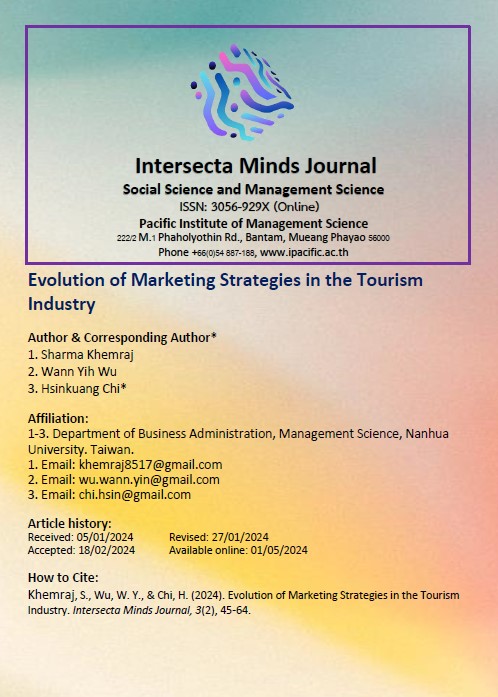
Evolution of Marketing Strategies in the Tourism Industry
Keywords:
Tourism Marketing;, Sustainable Tourism;, Tourism Strategy;, Inclusive Tourism MarketingAbstract
The influence of the tourism sector on global economies has witnessed a significant surge in recent times. In order to meet the expectations of both local and international tourists, as well as to contribute to the national economy, there is an imperative need for enhancements in tourism strategies and plans. Eco-friendly and innovative tourist initiatives are reshaping the local industry, pushing its boundaries to ascertain its capacity to meet international demand without compromising on environmental or regulatory safeguards. An escalating number of businesses catering to tourists are embracing the concept of sustainable tourism. The UN World Tourism Organization defines sustainable tourism as an approach that fully considers its current and future economic, social, and environmental impacts, while addressing the needs of visitors, the industry, the environment, and host communities. In light of these developments and concerns, this present research aims to examine the initiatives and marketing strategies implemented by prominent tourism firms, evaluating their effectiveness in meeting the requirements of both the government and its citizens, and subsequently drawing informed conclusions. In alignment with a country's historical and global values, marketing policies related to the tourism sector should be standardized. Given the substantial size and scope of the tourism industry, it becomes imperative for the marketing plan to be adaptable to ethical, environmental, and financial considerations. The overarching goal of this research is to identify the essential requirements, establish a connection with reality, and ultimately justify the current marketing approach of tourism units by proposing appropriate sustainable growth strategies.
References
community tourism impacts. Annals of tourism research, 32(4), 1056-1076.
Armutcu, B., Tan, A., Amponsah, M., Parida, S., & Ramkissoon, H. (2023). Tourist behaviour: The Role of Digital Marketing and Social Media. Acta Psychologica, 240, 104025. https://doi.org/10.1016/j.actpsy.2023.104025
Baloch, Q. B., Shah, S. N., Iqbal, N., Sheeraz, M., Asadullah, M., Mahar, S., & Khan, A. U. (2023). Impact of Tourism Development Upon Environmental Sustainability: A Suggested Framework for Sustainable Ecotourism. Environmental Science and Pollution Research, 30(3), 5917–5930. https://doi.org/10.1007/s11356-022-22496-w
Becken, S. (2010). The Importance of Climate and Weather for Tourism. Land Environment and People (LEaP) Background Paper, Lincoln University, 4-13.
Buckley, R. C., & Underdahl, S. (2023). Tourism and Environment: Ecology, Management, Economics, Climate, Health, and Politics. Sustainability, 15(21), 15416. https://doi.org/10.3390/su152115416
Council, W. T. & T. (2017). Consumer Demand for Environmental and Social Policies from Travel & AMP; Tourism. In Medium. https://worldtraveltourismcouncil .medium.com/consumer-demand-for-environmental-and-social-policies-from-travel-tourism-f87b16128d03
Font, X., & McCabe, S. (2017). Sustainability and Marketing in Tourism: Its Contexts, Paradoxes, Approaches, Challenges and Potential. Journal of Sustainable Tourism, 25(7), 869–883. https://doi.org/10.1080/09669582.2017.1301721
Gato, M., Dias, Á., Pereira, L., Da Costa, R. L., & Gonçalves, R. (2022). Marketing Communication and Creative Tourism: An Analysis of the Local Destination Management Organization. Journal of Open Innovation: Technology, Market, and Complexity, 8(1), 40. https://doi.org/10.3390/joitmc8010040
Gössling, S., Scott, D., & Hall, C. M. (2020). Pandemics, Tourism and Global Change: a Rapid Assessment of COVID-19. Journal of Sustainable Tourism, 29(1), 1-20.
Malinoshevska, K., & Korzh, M. (2020). Marketing Strategies of Development on the Example of Green Tourism. Three Seas Economic Journal, 1(2), 25–34. https://doi.org/10.30525/2661-5150/2020-2-5
Maulana, I. N. H., Nashiha, D., & Wardah, T. F. (2022). Tourism Management with the Concept of Green Economy to Increase People’s Economic Income During the Covid-19 Pandemic. 7 The ICGSS Sustainable Innovation Legal Policy: Alternative Technology and Green Economy, 4(5).
McLoughin, T. (2023). A Guide to Marketing Sustainable Tourism Services. In WTM Global Hub. https://hub.wtm.com/blog/marketing/a-guide-to-marketing-sustainable-tourism-services/
Pahrudin, P., Liu, L.-W., & Li, S.-Y. (2022). What Is the Role of Tourism Management and Marketing toward Sustainable Tourism? A Bibliometric Analysis Approach. Sustainability, 14(7), 4226. https://doi.org/10.3390/su14074226
Shankar, V., Kalyanam, K., Setia, P., Golmohammadi, A., Tirunillai, S., Douglass, T., & Waddoups, R. (2021). How technology is changing retail. Journal of Retailing, 97(1), 13-27.
Sudha, R. (2020). TOURISM MARKETING [PhD Thesis]. Department of Commerce.
Susilo, S., Istiawati, N. F., Deffinika, I., & Budijanto, B. (2021). Bawean Island Community Survival Strategies During the COVID-19 Pandemics. Journal of Indonesian Social Science and Humanities, 11(1), 43-56.
Velentza, A., & Metaxas, T. (2023). The Role of Digital Marketing in Tourism Businesses: An Empirical Investigation in Greece. Businesses, 3(2), 272–292. https://doi.org/10.3390/businesses3020018
Zhang, H. (2021). Exploration and Analysis of Tourism Marketing Management Innovation Based on Big Data. Journal of Physics: Conference Series, 1744(3), 032086. https://doi.org/10.1088/1742-6596/1744/3/032086
White, M. P., Elliott, L. R., Grellier, J., Economou, T., Bell, S., Bratman, G. N., ... & Fleming, L. E. (2021). Associations Between Green/Blue Spaces and Mental Health Across 18 Countries. Scientific Reports, 11(1), 8903.
Downloads
Published
How to Cite
Issue
Section
License
Copyright (c) 2024 Intersecta Minds Journal

This work is licensed under a Creative Commons Attribution-NonCommercial-ShareAlike 4.0 International License.