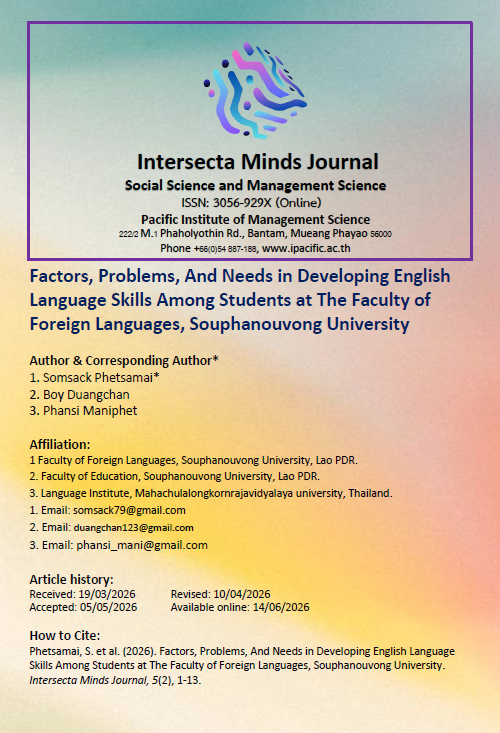
Factors, Problems, And Needs in Developing English Language Skills Among Students at The Faculty of Foreign Languages, Souphanouvong University
Keywords:
English Language Skills, Learning Problems, Student Needs, Tourism Education, Higher EducationAbstract
English plays a vital role as an international language in education, business, tourism, technology, and global communication. For university students, particularly those studying foreign languages, English proficiency is essential for academic achievement and career development. This article examines the factors influencing English language development, the challenges encountered, and the learning needs of students at the Faculty of Foreign Languages, Souphanouvong University, with a focus on the four core language skills: reading, listening, speaking, and writing. Drawing upon relevant theories and previous empirical studies, the article analyzes the determinants of English language learning and identifies common barriers faced by learners in an English as a Foreign Language (EFL) context.
The findings reveal that students experience substantial difficulties related to limited vocabulary, inadequate grammatical knowledge, low confidence in oral communication, weak listening comprehension, and insufficient opportunities for authentic language use. These challenges are shaped by multiple factors, including learner characteristics, instructional approaches, learning resources, technological support, classroom environment, and affective variables. Previous studies conducted at Souphanouvong University further indicate that speaking anxiety and lack of self-confidence remain significant obstacles to effective language acquisition. The analysis also highlights the importance of emotional readiness and self-efficacy in promoting successful language learning outcomes. The study identifies a strong need for communicative learning activities, technology-enhanced instruction, English for Specific Purposes (ESP) programs, authentic learning materials, and increased opportunities for meaningful language practice. The findings contribute to the body of knowledge on EFL learning in higher education by providing a comprehensive understanding of the linguistic, pedagogical, and psychological factors affecting English language development among university students in Laos. The article recommends adopting communicative and learner-centered teaching approaches that integrate the four language skills and emphasize practical language use. Strengthening English proficiency can enhance students’ academic performance, communicative competence, and preparedness for participation in an increasingly globalized workforce.
References
Brown, H. D. (2015). Teaching by principles: An interactive approach to language pedagogy (4th ed.). Pearson Education.
Harmer, J. (2007). The practice of English language teaching (4th ed.). Pearson Longman.
Kaseumsouk, A., Phetsamai, S., Inthavone, B., Vongmanee, V., & Phongsavanh, B. (2024). Enhancing English Speaking Skill Through Video Media: A Case Study of Fourth-Year Students at the Department of Tourism Management, Faculty of Economics and Tourism, Souphanouvong University. Souphanouvong University.
Nunan, D. (2003). Practical English Language Teaching. McGraw-Hill.
Oxford, R. L. (1990). Language Learning Strategies: What Every Teacher Should Know. Heinle & Heinle.
Promchin, C., Pimparat, P. T., Chancharoen, S., & Bodhisatirawaranggoora, P. (2026). Enhancing Emotional Wellness Across Generations Through Tri-Sikkhā. Journal of Buddhist Anthropology, 11(2), 362–376.
Richards, J. C., & Renandya, W. A. (2002). Methodology in Language Teaching: An Anthology of Current Practice. Cambridge University Press.
Richards, J. C., & Rodgers, T. S. (2014). Approaches and Methods in Language Teaching (3rd ed.). Cambridge University Press.
Ur, P. (1996). A Course in Language Teaching: Practice and Theory. Cambridge University Press.
Downloads
Published
How to Cite
Issue
Section
License
Copyright (c) 2026 Intersecta Minds Journal

This work is licensed under a Creative Commons Attribution-NonCommercial-ShareAlike 4.0 International License.