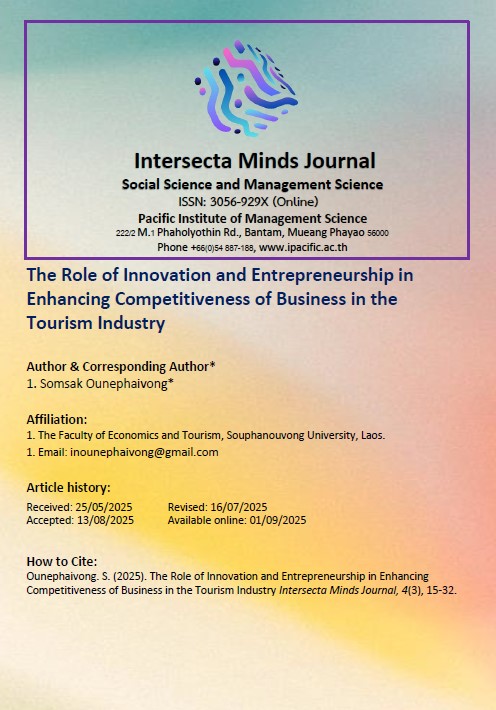
The Role of Innovation and Entrepreneurship in Enhancing Competitiveness of Business in the Tourism Industry
Keywords:
Development, Social Competency, Buddhist, IntegrationAbstract
Social competency has become an essential attribute for effective management in complex and diverse organizational environments. This study aims to examine the development of social competency through the integration of Buddhist principles, proposing a five-factor model grounded in both sociological and Buddhist theoretical perspectives. A quantitative survey design was employed, using a structured questionnaire administered to a sample of 240 respondents drawn from a population of approximately 2,500 employees, determined using Yamane’s sample size formula. Descriptive statistics were used to analyze demographic characteristics, while inferential statistics, including one-way ANOVA and Pearson correlation analysis, were applied to examine relationships among demographic variables and social competency factors. The findings indicate that Buddhist-integrated social competency significantly varies across demographic groups and that all five factors are positively correlated. The study contributes to the growing body of literature on values-based management by demonstrating how Buddhist ethical and psychological principles can enhance social competency development. Practical implications are offered for leadership training and organizational development in culturally diverse contexts.
Downloads
Published
How to Cite
Issue
Section
License
Copyright (c) 2025 Intersecta Minds Journal

This work is licensed under a Creative Commons Attribution-NonCommercial-ShareAlike 4.0 International License.