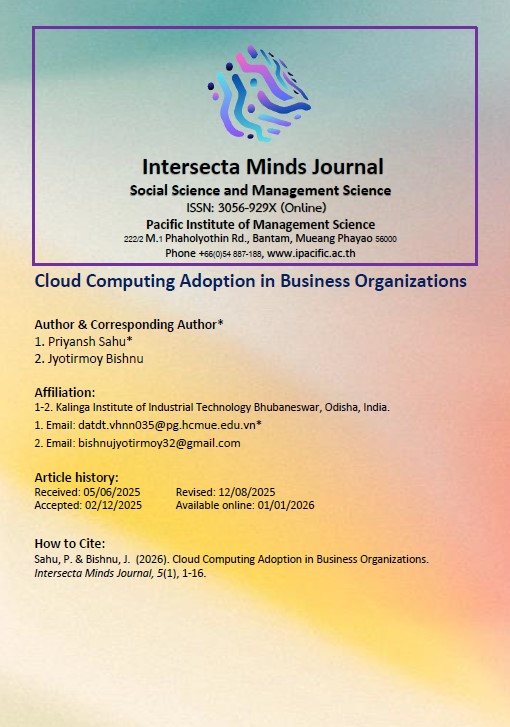
Cloud Computing Adoption in Business Organizations
Keywords:
Cloud Adoption, Business Organizations, Digital TransformationAbstract
Cloud computing has become an essential part of how modern organizations design, deploy, and manage their information technology systems. Over the years, businesses across different sectors have increasingly shifted from traditional on premises infrastructure to cloud based services in order to achieve greater flexibility, scalability, and operational efficiency. This paper examines cloud computing adoption in business organizations using the Technology Organization Environment (TOE) framework, supported by recent large scale industry data. Current statistics indicate that approximately 94% of enterprises worldwide use cloud computing in some form, with 73% adopting hybrid cloud strategies and nearly 80% relying on multiple cloud service providers. While cloud platforms offer several benefits such as reduced capital expenditure, improved scalability, and faster time to market, organizations continue to face challenges related to security risks, cost control, and shortage of skilled professionals. Global public cloud spending is projected to exceed USD 720 billion by 2025, highlighting the growing importance of cloud technologies. The findings of this study emphasize that successful cloud adoption requires a balanced approach that considers technological capabilities, organizational readiness, and environmental influences.
Downloads
Published
How to Cite
Issue
Section
License
Copyright (c) 2026 Intersecta Minds Journal

This work is licensed under a Creative Commons Attribution-NonCommercial-ShareAlike 4.0 International License.