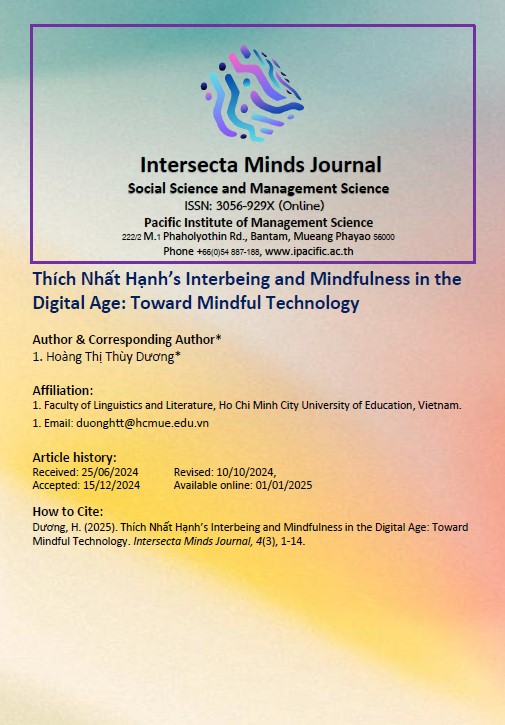
Thích Nhất Hạnh’s Interbeing and Mindfulness in the Digital Age: Toward Mindful Technology
Keywords:
Thích Nhất Hạnh, Interbeing, Mindfulness, Mindful TechnologyAbstract
In today’s digital era, the dominance of the “attention economy” and sophisticated artificial intelligence (AI) algorithms has posed unprecedented challenges to mental health, leading to fragmented attention and digital stress. This paper investigates the application of the teachings of Zen Master Thích Nhất Hạnh, particularly his engaged Buddhist philosophy, to develop an ethical framework and mindful practices for human–technology interaction. Using a qualitative approach – combining textual analysis with theoretical synthesis – the study proposes a “Mindful Technology” model grounded on two core pillars: the concepts of Interbeing and mindfulness. The findings indicate that restructuring the human–machine relationship through the lens of mindfulness not only mitigates the negative impacts of technology but also guides the development of human-centered AI. This paper contributes a novel perspective on applying Buddhist philosophy to digital wellbeing and advancing a global framework for ethical technology education through the Mindful Technology model.
Downloads
Published
How to Cite
Issue
Section
License
Copyright (c) 2025 Intersecta Minds Journal

This work is licensed under a Creative Commons Attribution-NonCommercial-ShareAlike 4.0 International License.