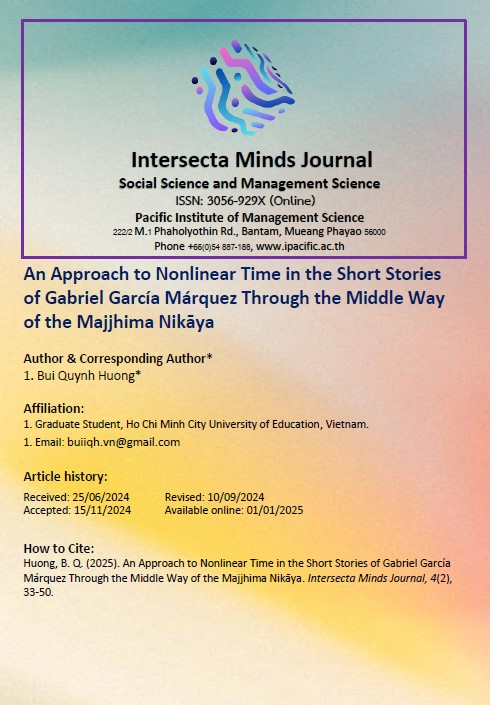
An Approach to Nonlinear Time in the Short Stories of Gabriel García Márquez Through the Middle Way of the Majjhima Nikāya
Keywords:
Buddhist Criticism, Gabriel García Márquez, Majjhima Nikāya, Temporal Fragmentation, The Middle WayAbstract
This research examines the phenomenon of fragmented time in Gabriel García Márquez’s short stories through the lens of the Middle Way (Majjhima Paṭipadā) as presented in the Majjhima Nikāya. Within the works of Márquez’s magical realism, temporal structures no longer operate along a conventional linear axis; instead, they are disrupted, inverted, and repetitive. This study indicates that such non-linearity resonates with Buddhist Middle Way thought a path that transcends two extremes. Utilizing structuralist, comparative, and socio-historical critical methods, the article analyzes fragmented temporal structures as pieces of reality where past, present, and future intersect inseparably. Drawing from the Middle Way perspective in the Majjhima Nikaya, the research interprets the bottlenecks of fragmented time as a consequence of clinging (upādāna) to discrete temporal fragments. Furthermore, it asserts that attaining an awakening to the Emptiness (suññatā) of time is the key to decoding the deconstructive narrative techniques in his works. This study not only opens a new direction in Buddhist literary criticism but also contributes to innovating the pedagogy of Latin American literature in universities, guiding students toward multi-dimensional and practical thinking on non-dual existence.
Downloads
Published
How to Cite
Issue
Section
License
Copyright (c) 2025 Intersecta Minds Journal

This work is licensed under a Creative Commons Attribution-NonCommercial-ShareAlike 4.0 International License.