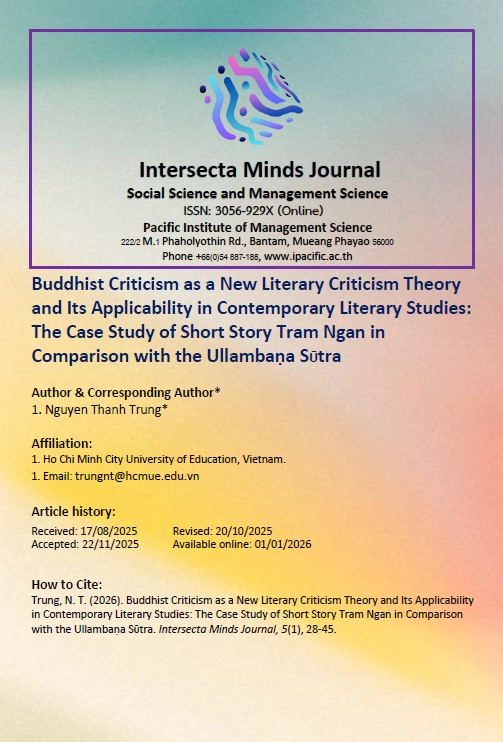
Buddhist Criticism as a New Literary Criticism Theory and Its Applicability in Contemporary Literary Studies: The Case Study of Short Story Tram Ngan in Comparison with the Ullambaṇa SŪtra
Keywords:
Buddhist criticism, Tram Ngan, Ullambana SutraAbstract
This research addresses the limited scope of contemporary Vietnamese literary studies conducted through the framework of Buddhist criticism. The study aims to comparatively analyze the short story Tram Ngan by Ngo Tu Ngan winner of the runner-up prize in the 2022–2024 Literary Newspaper Short Story Competition and the Ullambana Sūtra (Vu Lan Sūtra), in order to demonstrate the interpretive potential of Buddhist critical approaches when applied to both modern literary texts and classical Buddhist scriptures. Employing qualitative research methodology, the study is based on textual analysis and comparative interpretation. The research population consists of literary and religious texts, with the selected sample comprising Tram Ngan as a representative of contemporary Vietnamese short fiction and the Ullambana Sūtra as a foundational Mahayana Buddhist scripture. The primary research tools include close reading, thematic analysis, and Buddhist critical theory, particularly concepts related to suffering (dukkha), compassion (karuṇā), transcendence, and filial piety (filial gratitude). Data are analyzed through interpretive comparison to identify shared and divergent thematic structures and spiritual meanings.
The findings reveal that both Tram Ngan and the Ullambana Sūtra prominently reflect three shared characteristics: tragedy rooted in human suffering, compassion arising from empathetic understanding, and transcendence through moral and spiritual awakening. Notably, the Ullambana Sūtra introduces the explicit dimension of filial piety, which, when applied as an interpretive lens, offers new insights into Tram Ngan, particularly in terms of ethical responsibility and emotional redemption. This study affirms that Buddhist criticism is a valuable and effective approach for illuminating the deeper humanistic and spiritual dimensions of contemporary literature while simultaneously recontextualizing classical Buddhist texts. Ultimately, the research highlights the enduring relevance of Buddhist teachings in interpreting modern human experiences and reinforces the integrative relationship between literature and spiritual philosophy.
Downloads
Published
How to Cite
Issue
Section
License
Copyright (c) 2026 Intersecta Minds Journal

This work is licensed under a Creative Commons Attribution-NonCommercial-ShareAlike 4.0 International License.