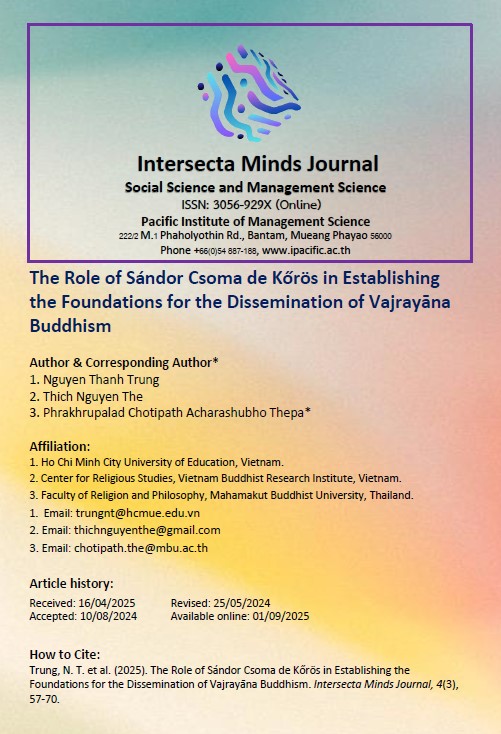
The Role of Sándor Csoma de Kőrös in Establishing the Foundations for the Dissemination of Vajrayāna Buddhism
Keywords:
Sándor Csoma De Kőrös, Vajrayana Buddhism, Tibetan Studies, Philology, Intercultural ExchangeAbstract
This study investigates the intellectual contributions of Sándor Csoma de Kőrös to the understanding, systematization, and dissemination of Vajrayana Buddhism, with particular attention to his role as a non-religious European scholar who bridged Eastern and Western intellectual traditions in the nineteenth century. While Tibetan Buddhism and Vajrayana thought have been widely examined, Csoma’s pioneering philological and translational efforts especially his systematic codification of Tibetan Buddhist terminology remains comparatively underexplored within Buddhist studies scholarship. The research aims to analyze Csoma’s scholarly methodology and assess its impact on the global reception of Vajrayana Buddhism. Employing a qualitative historical-research design, the study utilizes historical-critical analysis, comparative textual study, and philosophical hermeneutics as its principal analytical frameworks. The primary research materials consist of Csoma’s Tibetan-English dictionaries, grammatical treatises, translations of Vajrayana texts, personal correspondences, and contemporaneous academic records. These sources are examined in comparison with traditional Tibetan monastic interpretations to identify methodological innovations and intercultural dynamics. The findings reveal that Csoma developed a rigorous, systematic, and culturally sensitive approach to Buddhist scholarship, combining Western philological precision with deep engagement in Tibetan monastic learning environments. His work not only established foundational tools for Tibetan and Vajrayana studies but also facilitated cross-cultural knowledge transmission without religious proselytization. The study contributes scholarly value by enriching the historiography of Buddhist studies and re-evaluating the role of secular scholars in religious knowledge production. Practically, the findings offer insights for intercultural education, translation studies, and contemporary Vajrayana scholarship, highlighting Csoma de Kőrös’s enduring influence on global Buddhist intellectual history.
Downloads
Published
How to Cite
Issue
Section
License
Copyright (c) 2025 Intersecta Minds Journal

This work is licensed under a Creative Commons Attribution-NonCommercial-ShareAlike 4.0 International License.