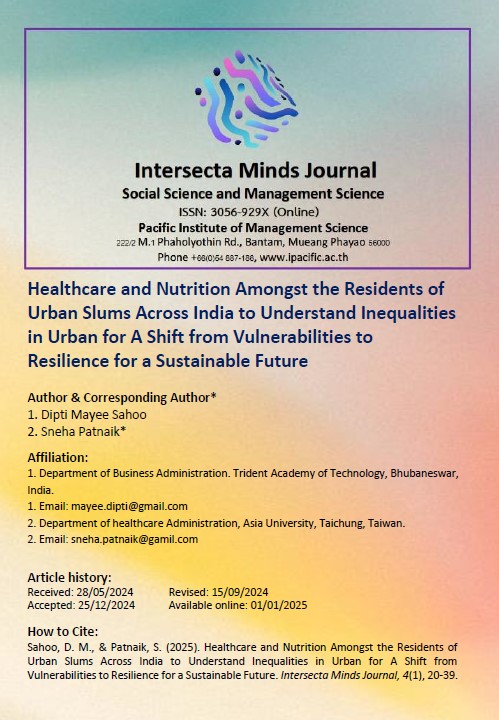
Healthcare and Nutrition Amongst the Residents of Urban Slums Across India to Understand Inequalities in Urban for A Shift from Vulnerabilities to Resilience for a Sustainable Future
Keywords:
Urban Health;, Social policy;, Environmental;, Vulnerability;, Resilience;Abstract
Urbanization, a defining feature of the twentieth and twenty-first centuries, has significantly transformed human settlement patterns, yet its impacts on health and well-being remain insufficiently understood. This study explores the relationship between urbanization and health, particularly in low-income urban areas of developing countries, where rapid urban expansion has led to complex social, environmental, and health challenges. The research aims to analyze the interplay between urban planning, health determinants, and social and environmental policies, highlighting the necessity for an integrated, multi-sectoral approach to urban health. Using a mixed-methods approach, the study incorporates both qualitative and quantitative research methods. The study population includes urban residents from selected low-income areas, with data collected through surveys, structured interviews, and secondary data analysis. The research tools include questionnaires assessing health conditions, environmental quality indicators, and policy evaluations. Statistical analysis, thematic coding, and policy impact assessments are employed to identify key trends and challenges associated with urban health.
The findings indicate that traditional sectoral approaches focused on remedial measures are insufficient to address contemporary urban health issues. While infectious diseases have declined in many urban areas, other health concerns, such as non-communicable diseases, environmental hazards, and socio-economic disparities, remain closely linked to urban living conditions. The study highlights the importance of shifting from conventional biomedical models to a holistic, ecological perspective that incorporates social determinants of health. In response to these challenges, the research advocates for coordinated interventions, such as the Healthy Cities initiative, to promote health and social development at the local level. Key barriers to effective implementation, including policy fragmentation and governance challenges, are discussed. Finally, the study emphasizes the need to move beyond a vulnerability-focused framework and instead adopt resilience-based strategies to enhance urban health outcomes in an increasingly urbanized world.
Downloads
Published
How to Cite
Issue
Section
License
Copyright (c) 2025 Intersecta Minds Journal

This work is licensed under a Creative Commons Attribution-NonCommercial-ShareAlike 4.0 International License.