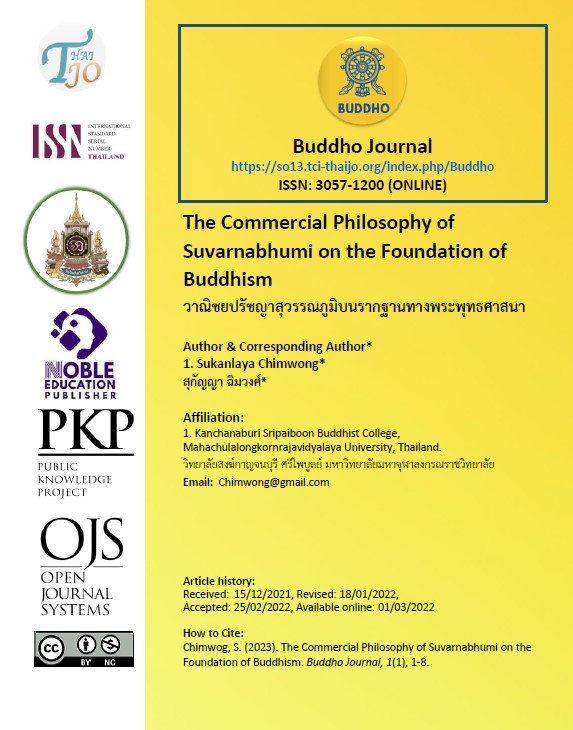
The Commercial Philosophy of Suvarnabhumi on the Foundation of Buddhism
Keywords:
Commercial philosophy, Suvarnabhumi, Buddhism, Economic ethics, Right LivelihoodAbstract
The commercial philosophy of Suvarnabhumi reflects the economic and trade principles of ancient Southeast Asia, which were significantly influenced by Buddhism. This article explores the Buddhist foundations that shaped the economic thought and practices in Suvarnabhumi, analyzing key Buddhist doctrines such as Right Livelihood (Sammā-ājīva), generosity (Dāna), and ethical conduct (Sīla). The study reveals that Buddhism is not merely a path to spiritual liberation but also plays a crucial role in shaping ethical and fair economic practices. The commercial system in Suvarnabhumi was deeply rooted in moral values, promoting sustainable and balanced trade. This research aims to demonstrate that the commercial philosophy of Suvarnabhumi provides valuable insights for establishing a more sustainable and equitable economic system in the modern world.
References
Andaya, B. W., & Andaya, L. Y. (2017). A history of early modern Southeast Asia, 1400–1830. Cambridge University Press.
Chapra, M. U. (2000). The future of economics: An Islamic perspective. Islamic Foundation.
Coedès, G. (1968). The Indianized states of Southeast Asia (S. B. Cowing, Trans.). University of Hawaii Press. (Original work published 1948)
Dhammananda, K. Sri. (1993). How to live without fear and worry. Buddhist Missionary Society.
Hall, D. G. E. (1985). A history of South-East Asia (4th ed.). Macmillan.
Hall, K. R. (2011). A history of early Southeast Asia: Maritime trade and societal development, 100–1500. Rowman & Littlefield.
Harvey, P. (2000). An introduction to Buddhist ethics: Foundations, values and issues. Cambridge University Press.
Miksic, J. N. (2013). Singapore and the Silk Road of the Sea, 1300–1800. NUS Press.
Prayukvong, W. (2005). A Buddhist economic approach to the sufficiency economy. Development, 48(2), 117–120. https://doi.org/10.1057/palgrave.development.1100138
Rahula, W. (1974). What the Buddha taught. Grove Press.
Reid, A. (1993). Southeast Asia in the age of commerce, 1450–1680: Volume 2, Expansion and crisis. Yale University Press.
Schumacher, E. F. (1973). Small is beautiful: Economics as if people mattered. Harper & Row.
Sen, A. (1987). On ethics and economics. Basil Blackwell.
Swearer, D. K. (2010). The Buddhist world of Southeast Asia (2nd ed.). State University of New York Press.
Tarling, N. (Ed.). (1992). The Cambridge history of Southeast Asia: Volume 2, The nineteenth and twentieth centuries. Cambridge University Press.
Weber, M. (1905/2002). The Protestant ethic and the spirit of capitalism (T. Parsons, Trans.). Routledge.
Wheatley, P. (1983). Nagara and commandery: Origins of the Southeast Asian urban traditions. University of Chicago Press.
Additional Files
Published
How to Cite
Issue
Section
License
Copyright (c) 2022 Buddho

This work is licensed under a Creative Commons Attribution-NonCommercial-NoDerivatives 4.0 International License.