About the Journal

Welcome to Buddho Journal, a pioneering interdisciplinary platform where Buddhist wisdom meets contemporary thought. Our mission is to bridge the humanities and social sciences, offering a space for intellectual exploration, scholarly research, and practical applications inspired by Buddhist principles.

At Buddho, we foster innovative dialogues that transcend conventional boundaries. The journal serves as a hub for critical inquiry, creativity, and transformative ideas—integrating Buddhist studies with philosophy, cultural analysis, psychology, education, business, management, and beyond. We explore the social dimensions of modern society through the lens of Buddhist teachings, igniting fresh perspectives and fostering groundbreaking research.

Join us in this scholarly journey as we navigate the evolving intersections of tradition and modernity, insight and innovation, contemplation and action.


Information

Journal Title: BUDDHO

Source Type: Journal

ISSN: 3057-1200 (Online)

Owner: BUDDHO Journal Project, Academic Journal Development Division in Buddhist Studies, Wat Chindit Vihara, Bangkok.

 Publisher: Noble Education Publisher

Country: Thailand

Subject Codes: Buddhist Studies; Arts and Humanities; Social Sciences

Start Year: 2022

Language: English and Thai

Website: https://so13.tci-thaijo.org/index.php/Buddho/index

Editor in Chief:

Asst. Prof. Dr. Phrakhrupalat Chotiphat Acharasupho
Tel: +66 64 694 6539
Email: chotipath.the@gmail.com

Journal Email: buddhist.inn.man@gmail.com


Scope of the Journal:

Buddho Journal, a pioneering interdisciplinary platform where Buddhist wisdom meets contemporary thought. Our mission is to bridge the humanities and social sciences, offering a space for intellectual exploration, scholarly research, and practical applications inspired by Buddhist principles.

At Buddho, we foster innovative dialogues that transcend conventional boundaries. The journal serves as a hub for critical inquiry, creativity, and transformative ideas—integrating Buddhist studies with philosophy, cultural analysis, psychology, education, business, management, and beyond. We explore the social dimensions of modern society through the lens of Buddhist teachings, igniting fresh perspectives and fostering groundbreaking research.


Journal Aims and Objectives:

Bhodho aims to be a space for scholars, researchers, and academics to disseminate their work, share knowledge, and contribute to understanding across diverse topics worldwide.

The aims are:

To promote interdisciplinary research: Bhodho fosters collaboration between different academic disciplines, creating an environment where researchers can explore the intersections of various fields and generate new insights.

The objectives are:

1. To bridge cultural and spiritual divides within Buddhism and interdisciplinary studies:

This journal aims to facilitate dialogue and understanding between different cultures, spiritual traditions, and religions, with a particular focus on Buddhist studies and its connections to interdisciplinary studies. It strives to create a space where diverse worldviews can be explored and discussed.

2. To disseminate knowledge:

Our journal is committed to disseminating knowledge, accepting in-depth and academic articles on various topics within Buddhism. Whether you are a researcher, practitioner, or writer passionate about Buddhism, we invite you to share your knowledge and perspectives with our community. Our platform welcomes diverse interpretations, concepts, and comparative studies exploring the rich traditions of Buddhism.


Key Areas of Interest and Papers acceptation:

1. Theravāda Buddhism

  • Rooted in the Pāli Canon, the earliest Buddhist scriptures
  • Southern and Western Buddhism
  • Predominant in Southeast Asia and Sri Lanka
  • Focuses on achieving Arhatship, the ultimate liberation from Samsara
  • Emphasizes a monastic life dedicated to the cessation of future rebirths
  • Buddhism in Thailand, Sri Lanka, Myanmar, Lose, Cambodia, India, Malay, Indonesia  

2. Mahāyāna Buddhism

  • Root to Akāmā
  • Incorporates newer texts, teachings, and revelations
  • Encourages all beings to attain Buddhahood
  • Advocates compassion as a primary path to Sunyatabhava and Nirvana
  • Early Mahayana schools of thought included the Mādhyamaka, Yogācāra, and Buddha-nature (Tathāgatagarbha)
  • Buddhism in Chinese, Korea, Japan, Vietnam, Taiwan, Mongolia

3. Other Buddhist Traditions

  • Vajrayāna: Known as Mantrayāna, Tantric Buddhism, or Esoteric Buddhism
  • Zen (Chan): A meditative school within Mahāyāna Buddhism
  • Pure Land: A devotional Mahāyāna school focusing on Amitābha Buddha

***Article Decline: Your article is not related to Buddhism at all.

We encourage original research, essays, and reflections on these and other Buddhist traditions. If you have a unique perspective or deep insights to share, we would love to feature your work.


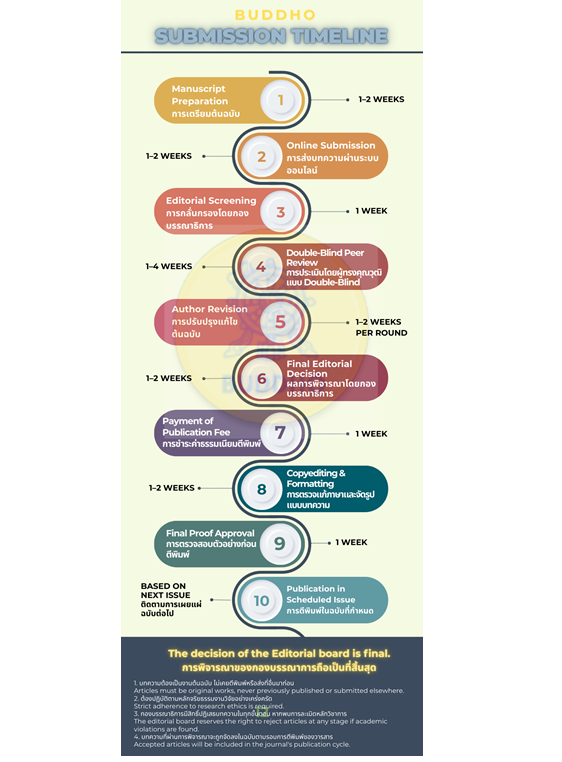
How to Submit

We accept well-researched articles, essays, and opinion pieces that contribute to the understanding of Buddhist philosophy, history, and practice. Submissions should be original, engaging, and accessible to both scholars and general readers.

Submission Guidelines: Authors interested in submitting their work to Buddho should follow the journal's specific submission guidelines, including manuscript formatting, citation style, and peer-review process, which can be found on the journal's website.


Types of journal articles accepted for publishing:

  1. Original Research Articles: These articles present the results of original scientific research, typically following a structured format that includes sections such as introduction, methods, results, and discussion. They contribute new knowledge to a particular field.
  2. Academic Review Articles: Review articles provide a comprehensive overview and analysis of existing research on a particular topic, field, or subject area. They synthesize and discuss existing literature to provide a broad perspective.
  3. Case Studies: Case studies describe specific instances or examples in detail to illustrate a particular phenomenon, problem, or approach. They are often used in various fields, including phycology, business, and education.
  4. Book Reviews: These articles provide critical evaluations of books related to the subject matter of the journal. Book reviews help readers decide whether a particular book is worth reading.

Peer Review Process:

All submissions to Buddho undergo a rigorous peer-review process with 3 specialists to ensure the quality and validity of the research. The journal's editorial board consists of experts from various fields, ensuring a fair and comprehensive evaluation of each submission.

Buddho is committed to advancing scholarly discourse and promoting cross-cultural understanding and collaboration. We invite authors from diverse backgrounds to contribute their research and insights to our journal and be a part of our mission to foster knowledge exchange and exploration of worldviews, with a particular emphasis on Buddhist Studies and relevant innovations.

For more information, submission guidelines, and to explore previous publications, please visit the Buddho journal website at https://so13.tci-thaijo.org/index.php/Buddho/index


Publication Frequency

Scheduled to publish 4 issues per year (Quarterly).

        Issue 1 January-March
        Issue 2 April-June
        Issue 3 July-September
        Issue 4 October-December


Article Publishing Charge (APC):
As an open access journal with no subscription charges, a fee (Article Publishing Charge, APC) is payable by the authors, or their institution or funders, to cover the costs associated with publication. This ensures your article will be immediately and permanently free to access by everyone.

The Article Publishing Charge for this journal is:

Thai Article 4,000 Bath

English Article 5,000 Bath

Bank Account : Krungthai - Branch Suwinthawong 

Branch No. : 5111

Account No. : 663-3-04577-8             

Name : WAT CHINDITH VIHARA

SWIFT Code : KRTHTHBK5111

Payment Conditions

1. For foreign authors, the publication fee shall be paid in Thai Baht (THB) only, calculated according to the Thai exchange rate on the date of payment.

2. The publication fee is payable in a single installment only after the manuscript has successfully passed the peer-review process conducted by three expert reviewers and has received official acceptance for publication from the Editorial Board.

3. Payment must be made exclusively to the account of WAT CHINDITH VIHARA. Detailed payment instructions will be provided only after verification and confirmation by the editorial team, following the successful completion of the three-reviewer evaluation process.

4. After completing the payment, authors are required to upload proof of payment (transfer slip) in the discussion thread within the online journal submission system or direct to the journal email: buddhist.inn.man@gmail.com as official evidence for further processing.


Formatting Guidelines: Preparation of Manuscripts Prior to Submission for Publication Consideration

Authors intending to submit manuscripts to Buddho Journal are required to prepare their papers in accordance with the following structural and formatting guidelines. Compliance with these requirements is essential to ensure a smooth peer-review process and editorial evaluation.

Manuscripts must be prepared in clear academic English and follow a coherent and systematic structure. The components of the article should be arranged in the following order:

Original Research Articles

These articles present the results of original scientific research, typically following a structured format that includes sections such as introduction, methods, results, and discussion. They contribute new knowledge to a particular field.

Make a new submission to the Original Research Articles section.

1

Abstract: The abstract should be concise and encompass the research idea or problem/objectives, research methodology, study population and sample groups, research tools, analysis, and research findings, within a range of 200-300 words.

2

Introduction: This section aims to describe the background and significance of the problem leading to the research. It should highlight research gaps to underscore the necessity of the study.

3

Literature Review and Theoretical Framework: This involves reviewing relevant literature and research, as well as establishing the theoretical framework for the study.

4

Objectives: Present the research objectives and hypotheses.

5

Research Methodology: Outline the components such as research type, study population, sample groups, selection techniques, research tools, research procedures, data collection, and analysis methods.

6

Results: Presentation of Research Findings, Align the presentation of findings with the research objectives or hypotheses.

7

Discussion: Discuss the results in accordance with the objectives, citing relevant research to support the discussed issues and content.

8

Conclusion: Summarize the findings, ensuring they align with the objectives and emphasize the significance of the research.

9

Suggestions and Implementations: Provide suggestions or new knowledge gained from the study, or implementations

Body of Knowledge: from the research, present recommendations for the public, and propose ideas for future research.

10.

References: Ensure that citations within the article and at the end follow the APA 7 format and maintain language appropriateness.

Academic Review Articles

Review articles provide a comprehensive overview and analysis of existing research on a particular topic, field, or subject area. They synthesize and discuss existing literature to provide a broad perspective.

Make a new submission to the Academic Review Articles section.

1.

Abstract: State the significance, results of the study, and knowledge gained from the study, within a range of 200-300 words.

 Keywords: Essential part of producing for readers to discover your article when conducting research 3-5 words. 

2.

Introduction: Explain the background and significance of the issues and concepts to be presented.

3.

Content: Consist of a study of relevant documents and related theories.

1) Presenting details supporting the main issues and concepts.

2) Presenting secondary ideas clearly, correctly, and appropriately.

3) Complete accuracy, linkage, and organization of content.

4.

Conclusion: Comprehensive and consistent with the objectives, useful.

5.

Suggestions and Implementations: Provide suggestions or new knowledge gained from the study, or implementations

Body of Knowledge: from the research, present recommendations for the public, and propose ideas for future research.

6.

References: Ensure that citations within the article and references of the article are correct according to APA 7 format.

7.

Appropriateness of English language use.

Case Studies

Case studies describe specific instances or examples in detail to illustrate a particular phenomenon, problem, or approach. They are often used in various fields, including phycology, religion, business, and education.

Make a new submission to the Case Studies section.

1.

Abstract: A brief summary of the entire case study. Can be narrative (flows as a short story) or structured (with subheadings). A structured abstract is preferred for clarity and consistency, within a range of 200-300 words.

 Keywords: Essential part of producing for readers to discover your article when conducting research 3-5 words. 

2.

Introduction: Provides background on the case and its significance. Places the study in historical, social, or medical context. Mentions any previous similar cases.

3.

Case Presentation: Describes the patient’s complaint, history, and relevant information. Presents examination findings, test results, and diagnostic impressions. Uses a narrative format for clarity and avoids unnecessary details.

4.

Result: Management and Outcome that mentions outlines the treatment plan and actual care provided. Includes duration and frequency of care. Reports the patient’s response and outcome, using objective measures if possible.

5.

Discussion: Analyzes key aspects of the case, including challenges and lessons learned.

Explores possible explanations without needing full scientific justification.

6.

Conclusion: Comprehensive and consistent with the objectives, useful.

7.

Suggestions and Implementations: Provide suggestions or new knowledge gained from the study, or implementations

Body of Knowledge: from the research, present recommendations for the public, and propose ideas for future research.

8.

References: Ensure that citations within the article and references of the article are correct according to APA 7 format.

9.

Appropriateness of English language use.

Book Reviews

These articles provide critical evaluations of books related to the subject matter of the journal. Book reviews help readers decide whether a particular book is worth reading.

1.

Abstract: A brief summary of the entire case study. Can be narrative (flows as a short story) or structured (with subheadings). A structured abstract is preferred for clarity and consistency, within a range of 200-300 words.

Keywords: Essential part of producing for readers to discover your article when conducting research 3-5 words. 

2.

Introduction: Provides background on the case and its significance. Places the study in historical, social, or medical context. Mentions any previous similar Books.

3.

Book Reviews: Offer a critical evaluation of a book related to the journal’s focus.

Summarize: key points, strengths, and weaknesses.

Discuss: its relevance and usefulness for readers.

4.

Conclusion: Comprehensive and consistent with the objectives, useful.

5.

Suggestions and Implementations: Provide suggestions or new knowledge gained from the study, or implementations

Body of Knowledge: from the research, present recommendations for the public, and propose ideas for future research.

6.

References: Ensure that citations within the article and references of the article are correct according to APA 7 format.

7.

Appropriateness of English language use.


Copyright Terms

By submitting a manuscript to Buddho Journal, the author(s) agree to the following copyright terms:

  1. The author(s) grant Buddho Journal exclusive rights for the publication, distribution, and promotion of the submitted manuscript, subject to a Creative Commons Attribution-NonCommercial-NoDerivatives 4.0 International License (CC BY-NC-ND 4.0).

  2. This means that the copyright for the published work will be held by Buddho Journal. The author(s) retain the right to be properly acknowledged and cited as the original creator(s) of the work.

  3. No part of the published manuscript may be reproduced, stored in a retrieval system, or transmitted in any form or by any means, electronic, mechanical, photocopying, recording, or otherwise, without proper acknowledgment and citation of the original publication in Buddho Journal.

  4. Authors may share their published work for personal, non-commercial use, or use it in teaching or research activities, provided that proper attribution is given to Buddho Journal and the author(s), and no alterations or derivative works are created based on the original manuscript.

  5. Any use of the published manuscript for commercial purposes, or the creation of derivative works, requires explicit written permission from Buddho Journal.

  6. Buddho Journal reserves the right to defend and protect the author's copyright interests as it sees fit, including taking legal action in the case of copyright infringement.

By submitting a manuscript to Buddho Journal, the author(s) acknowledge and agree to the terms outlined in this copyright notice. This copyright notice is designed to protect the rights and interests of both the authors and Buddho Journal. 


Publication Ethics and Responsibilities

(In accordance with IRB principles and international standards)

Author Ethics and Responsibilities


  1. Authors must ensure that submitted manuscripts are original works and are not under consideration or published elsewhere.
  2. Authors must avoid plagiarism and properly cite all sources and prior works.

  3. All references, theories, and data must be accurately acknowledged according to academic standards.

  4. Research involving human participants or animals must obtain approval from an Institutional Review Board (IRB) or equivalent ethics committee, and the approval number must be clearly stated in the manuscript.

  5. Authors must disclose all sources of funding and any potential conflicts of interest transparently.

  6. All listed authors must have made significant contributions to the research and approved the final manuscript.

  7. If a significant error is discovered after publication, authors are obligated to promptly notify the editorial board for correction or retraction as appropriate.


Reviewer Ethics and Responsibilities

  1. Reviewers must evaluate manuscripts objectively, fairly, and based solely on academic merit.

  2. Reviewers must maintain confidentiality of the manuscript and must not use unpublished materials for personal benefit.

  3. Reviewers should inform the editorial board of any suspected plagiarism, duplication, or ethical misconduct.

  4. Reviewers must decline the review process if any conflict of interest exists.

  5. Reviewer comments should be constructive, respectful, and aimed at improving the scholarly quality of the manuscript.


Reader Ethics and Responsibilities

  1. Readers should use published materials for academic purposes and cite them appropriately.

  2. Proper citation of articles must be observed in accordance with scholarly standards.

  3. Readers are encouraged to notify the editorial board if any ethical concerns or inaccuracies are identified.

  4. Readers must respect intellectual property rights of authors and the journal.


Ethical Framework and Compliance

The journal adheres to international standards of publication ethics, including Institutional Review Board (IRB) principles, academic integrity guidelines, and globally recognized best practices in scholarly publishing. The journal is committed to transparency, accountability, and the highest standards of research ethics.

Current Issue

Vol. 5 No. 1 (2026): BUDDHO (January-March 2026)
					View Vol. 5 No. 1 (2026): BUDDHO (January-March 2026)
Published: 01-01-2026

Full Issue

View All Issues