ENHANCING TEACHERS’ ARTIFICIAL INTELLIGENCE LITERACY FOR CREATING PERSONALIZED LEARNING INNOVATIONS
Article Sidebar
Main Article Content
Abstract
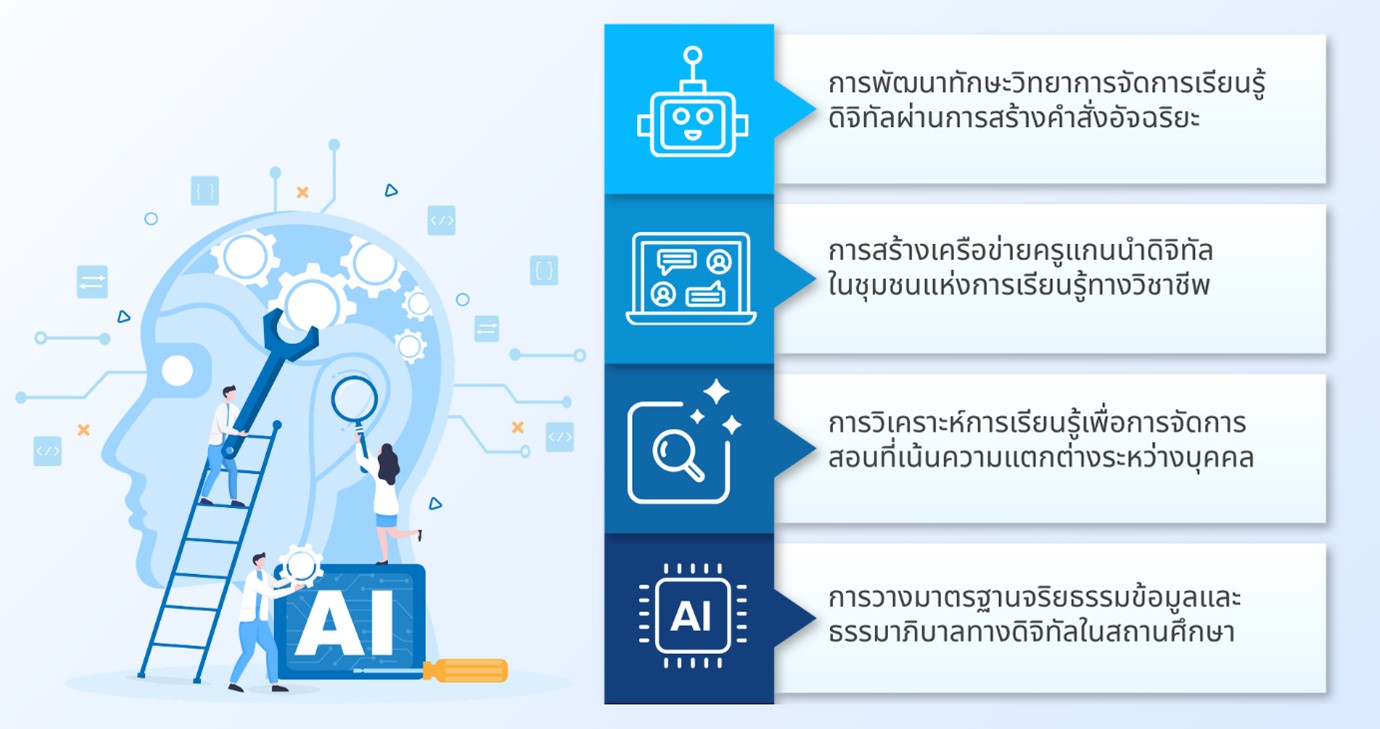
This academic article aims to present the enhancement of teachers’ artificial intelligence (AI) literacy for creating personalized learning innovations. Due to the exponential advancement of information technology, educational management paradigms must shift from a one-size-fits-all approach to learning management that caters to individual needs. Therefore, developing AI literacy is a crucial factor enabling educational personnel to effectively integrate smart tools into their classroom practices. Enhancing such competency requires systematic strategies, including the creation of a learning ecosystem, the driving of a digital professional learning community (PLC), and the promotion of data-driven classroom research. The study concludes that equipping teachers with technological literacy coupled with data governance will foster the creation of educational innovations. These innovations can sustainably develop individual learners’ potential and truly prepare them with the resilience to thrive in the era of digital transformation.
Article Details
References
กระทรวงดิจิทัลเพื่อเศรษฐกิจและสังคม. (2560). แผนพัฒนาดิจิทัลเพื่อเศรษฐกิจและสังคม. กรุงเทพมหานคร: กระทรวงดิจิทัลเพื่อเศรษฐกิจและสังคม.
กระทรวงศึกษาธิการ. (2566). นโยบายและจุดเน้นของกระทรวงศึกษาธิการ ปีงบประมาณ พ.ศ. 2567. กรุงเทพมหานคร: กระทรวงศึกษาธิการ.
ปรัชญนันท์ นิลสุข. (2565). เทคโนโลยีดิจิทัลเพื่อการศึกษาในยุคปัญญาประดิษฐ์. กรุงเทพมหานคร: ศูนย์ผลิตตำราเรียน มหาวิทยาลัยเทคโนโลยีพระจอมเกล้าพระนครเหนือ.
วิจารณ์ พานิช. (2566). การเรียนรู้ในยุคเอไอ: โอกาสและความท้าทายของการศึกษาไทย. กรุงเทพมหานคร: มูลนิธิสดศรี-สฤษดิ์วงศ์.
สำนักงานคณะกรรมการการศึกษาขั้นพื้นฐาน. (2565). แนวปฏิบัติการคุ้มครองข้อมูลส่วนบุคคลของสำนักงานคณะกรรมการการศึกษาขั้นพื้นฐาน. กรุงเทพมหานคร: กระทรวงศึกษาธิการ.
สำนักงานคณะกรรมการข้าราชการครูและบุคลากรทางการศึกษา. (2564). หลักเกณฑ์และวิธีการประเมินตำแหน่งและวิทยฐานะข้าราชการครูและบุคลากรทางการศึกษา. กรุงเทพมหานคร: กระทรวงศึกษาธิการ.
สำนักงานเลขาธิการสภาการศึกษา. (2560). แผนการศึกษาแห่งชาติ พ.ศ. 2560 - 2579. กรุงเทพมหานคร: พริกหวานกราฟฟิค.
สำนักงานเลขาธิการสภาการศึกษา. (2562). แนวทางการพัฒนาสมรรถนะผู้เรียนระดับการศึกษาขั้นพื้นฐาน. กรุงเทพมหานคร: 21 เซ็นจูรี่.
สำนักงานเลขาธิการสภาการศึกษา. (2566). สภาวการณ์การศึกษาไทยในปี 2566: การขับเคลื่อนการเรียนรู้เชิงรุกด้วยเทคโนโลยีดิจิทัล. กรุงเทพมหานคร: กระทรวงศึกษาธิการ.
Equitable Education Fund. (2023, March 1). SkillsFuture for educators: A professional development roadmap for teachers in Singapore. https://en.eef.or.th/2023/03/01/skillsfuture-for-educators-a-professional-development-roadmap-for-teachers-in-singapore/
Holmes, W., Bialik, M., & Fadel, C. (2019). Artificial intelligence in education: Promises and implications for teaching and learning. Boston: Center for Curriculum Redesign.
Kong, S. C., Cheung, W. M., & Zhang, G. (2023). Evaluating an artificial intelligence literacy programme for teachers: A multi-dimensional analysis. Computers and Education: Artificial Intelligence, 4, 100126.
Long, D., & Magerko, B. (2020). What is AI Literacy? Competencies and design considerations. Proceedings of the 2020 CHI Conference on Human Factors in Computing Systems.
Luckin, R. (2018). Machine learning and human intelligence: The future of education in the 21st century. London: UCL IOE Press.
Ministry of Education, Singapore. (2024). EdTech Masterplan 2030: Transformative learning in the age of AI. Singapore: MOE.
National AI Office (Singapore). (2023). National AI Strategy 2.0: AI for the Public Good for Singapore and the World. Singapore: Smart Nation and Digital Government Office.
Ng, D. T. K., Leigh, M., Su, J., & Chu, S. K. W. (2021). A review of AI literacy in K-12 education. Computers and Education: Artificial Intelligence, 2, 100033.
UNESCO. (2021). AI and education: Guidance for policy-makers. Paris: United Nations Educational, Scientific and Cultural Organization.
UNESCO. (2024). AI competency framework for teachers. Paris: United Nations Educational, Scientific and Cultural Organization.
