THE EFFECTS OF USING GAMIFICATION-BASED BOARD GAME ON ABILITY TO ANALYZE AND APPLY VALUES FROM THE LITERATURE MONGKOL SUT KHAM CHAN AMONG GRADE 10 STUDENTS
Keywords:
Literary Learning, Gamification, Education Board GameAbstract
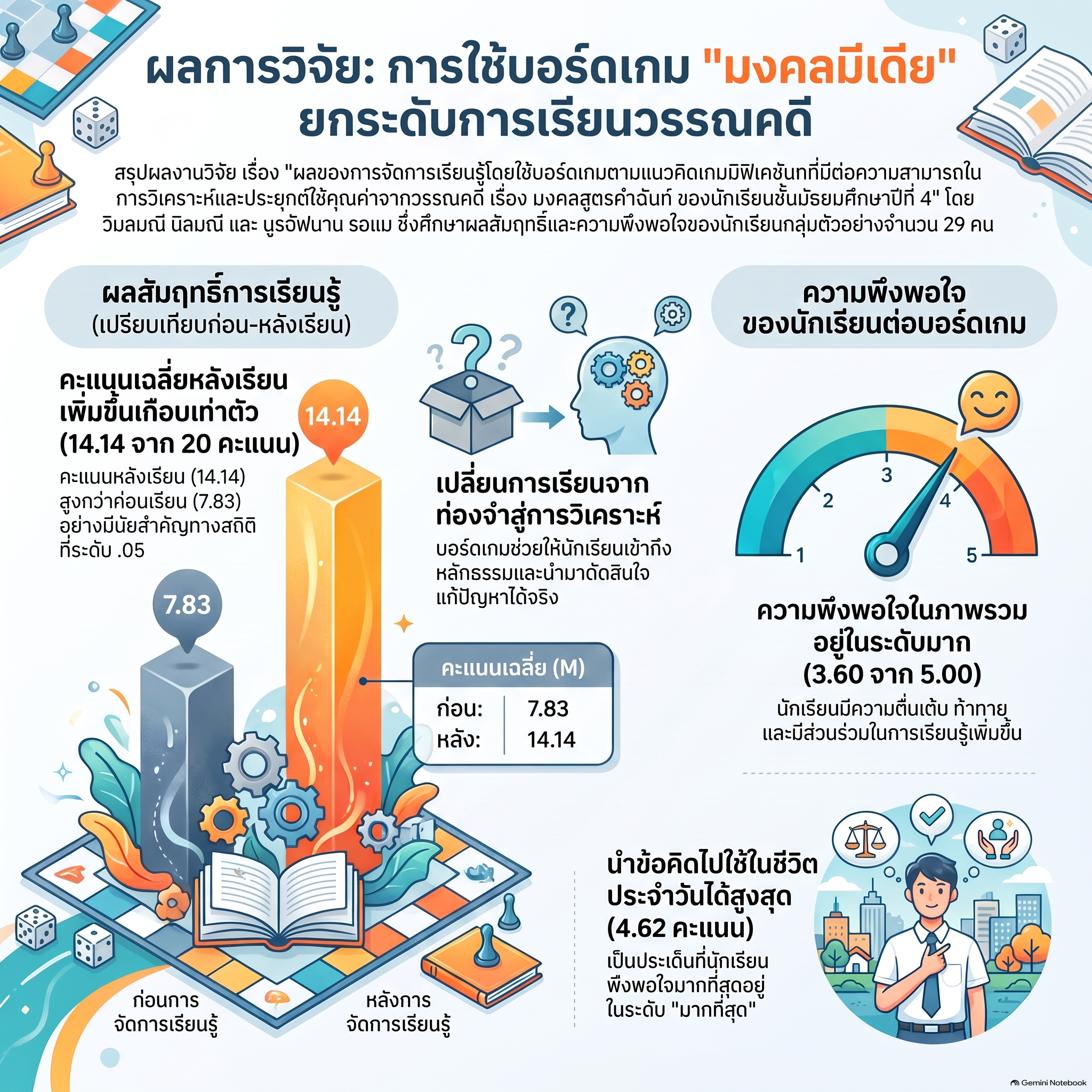
The purposes of this research were to (1) compare the ability of grade 10 students to analyze and apply values from the literature, Mongkhon Sut Kham Chan, before and after learning through a gamification-based board game, and (2) study the students' satisfaction with the use of the gamification-based board game. The sample, selected through simple random sampling, consisted of 29 grade 10 students at Narathiwat School during the 2025 academic year. The research instruments included the board game “Mongkol media : life value creation game” gamification-based lesson plans, a test measuring the ability to analyze and apply values from the literature, and a satisfaction questionnaire on the gamification-based board game learning management. The findings revealed that (1) the students' ability to analyze and apply values from the literature, Mongkhon Sut Kham Chan, after learning with the gamification-based board game was higher than before the intervention at a statistical significance level of .05, and (2) the students' satisfaction with the gamification-based board game was at a high level (M = 3.60, SD = 0.44) with the highest-rated aspect being their increased knowledge and understanding in analytical reading.
References
กัญช์ อินทรโกเศศ. (2568). การศึกษาด้วยวิธีการเกมิฟิเคชั่น: พฤติกรรม บุคลิกภาพ และผลการเรียนรู้. วารสารวิชาการ มหาวิทยาลัยหอการค้าไทย มนุษยศาสตร์และสังคมศาสตร์, 45(2), 132-155.
จันทร์จิรา หาวิชา. (2567). กระบวนการพัฒนาหนังสืออิเล็กทรอนิกส์วรรณกรรมเยาวชนร่วมกับการจัดการเรียนรู้โดยใช้แนวคิดเกมมิฟิเคชันเพื่อส่งเสริมความสามารถในการอ่านวิเคราะห์ของนักเรียนชั้นมัธยมศึกษาตอนปลาย. วารสารราชภัฏสุราษฎร์ธานี, 12(2), 65-94.
ชยารักษ์ แก้วมณี, ชลธิชา หอมฟุ้ง, และไชยยศ ไพวิทยศิริธรรม. (2568). การพัฒนาบอร์ดเกมการศึกษาวรรณคดีไทยเพื่อส่งเสริมผลสัมฤทธิ์ทางการเรียนวรรณคดีไทยสำหรับนักเรียนชั้นมัธยมศึกษาปีที่ 6. วารสารศึกษาศาสตร์ มหาวิทยาลัยศิลปากร, 23(1), 161-180.
ชวนพิศ อัตเนตร์, จิรศุภา ปล่องทอง, และนริศรา อินทร์ทอง. (2567). การพัฒนาผลสัมฤทธิ์ทางการเรียนการวิเคราะห์คุณค่าด้านวรรณศิลป์ เรื่อง บทพากย์โขนชุดบทพากย์เอราวัณ ของนักเรียนชั้นมัธยมศึกษาปีที่ 3 โดยการใช้เกมมิฟิเคชั่น. วารสารวิชาการมหาวิทยาลัยราชภัฎเพชรบุรี, 14(2), 137-143.
ฐิติกานต์ แก้ววิเศษ. (2565). การพัฒนาแนวการจัดการเรียนรู้วิชาภาษาไทยแบบเชิงรุกโดยใช้วรรณคดีเป็นฐาน เพื่อส่งเสริมความสามารถของนักเรียนในศตวรรษที่ 21 สำหรับนักเรียนระดับชั้นมัธยมศึกษาปีที่ 1. วารสารวิชาการและวิจัยสังคมศาสตร์, 17(3), 67-80.
บุญชม ศรีสะอาด. (2554). การวิจัยเบื้องต้น (พิมพ์ครั้งที่ 7). โรงพิมพ์สุวีริยาสาส์น.
ประจักษ์ น้อยเหนื่อย, และมาเรียม นิลพันธุ์. (2564). การพัฒนารูปแบบการจัดการเรียนรู้วรรณคดีไทยตามแนวคิด Active Learning เพื่อส่งเสริมความสามารถในการแก้ปัญหาเชิงสร้างสรรค์ และความซาบซึ้งในวรรณคดีไทยของนักเรียนระดับชั้นมัธยมศึกษาตอนปลาย. วารสารวิจัยและพัฒนาหลักสูตร, 11(2), 138-157.
ภานุวัฒน์ เพชรรัตน์, และอัมพร วัจนะ. (2565). การพัฒนาบทเรียนออนไลน์โดยใช้รูปแบบการจัดการเรียนรู้แบบห้องเรียนกลับด้านตามแนวคิดเกมิฟิเคชั่นเพื่อเสริมสร้างความสามารถในการแก้ปัญหาของนักเรียนมัธยมศึกษาปีที่ 4 ในวิชาฟิสิกส์ เรื่องแรงและกฎการเคลื่อนที่ของนิวตัน. วารสารการบริหารนิติบุคคลและนวัตกรรมท้องถิ่น, 8(10), 171-183.
มานิตา สาเหล้, และกิ่งกาญจน์ บูรณสินวัฒนกูล. (2567). การพัฒนาความสามารถในการอ่านอย่างมีวิจารณญาณ ของนักเรียนชั้นมัธยมศึกษาปีที่ 6 ด้วยการจัดการเรียนรู้โดยใช้คำถามแบบ QUEST ร่วมกับเทคนิคเกมมิฟิเคชัน. วารสารเพื่อการพัฒนาสังคมและชุมชน, 11(3), 103-118.
โยธิน ไกรษร, ทรงภพ ขุนมธุรส, จุฑารัตน์ เกตุปาน, และน้ำทิพย์ องอาจวาณิชย์. (2567). การศึกษาสภาพปัญหาของการจัดการเรียนการสอนภาษาบาลีสันสกฤตในภาษาไทยและแนวทางการประยุกต์ใช้แนวคิดวัฏจักรการจัดการเรียนรู้และสตรีมศึกษาเพื่อส่งเสริมความสามารถการอ่านวรรณคดีพระพุทธศาสนาเชิงวิเคราะห์. Journal of Roi Kaensarn Academi, 9(8), 354-367.
ศิริพร เปรมปรีดิ์. (2564). การพัฒนาความสามารถในการวิเคราะห์วรรณคดีไทยโดยใช้การจัดการเรียนรู้ร่วมมือแบบเกมิฟิเคชันสำหรับนักเรียนชั้นมัธยมศึกษาปีที่ 6 [การค้นคว้าอิสระปริญญามหาบัณฑิตไม่ได้ตีพิมพ์]. มหาวิทยาลัยนเรศวร.
Bostvironnois, A., Le Page, C., Gunnell, Y., & Mialhe, F. (2026). Exploring agricultural strategies among Maasai pastoralists undergoing rangeland subdivision in Amboseli (Kenya): Insights from a role-playing board game. Agricultural Systems, 236, 1-15. https://doi.org/10.1016/j.agsy.2026.104745
Christopoulos, A., & Mystakidis, S. (2023). Gamification in education. Encyclopedia, 3(1), 1223-1243. https://doi.org/10.3390/encyclopedia3040089
Noda, S., Shirotsuki, K., & Nakao, M. (2019). The effectiveness of intervention with board games: A systematic review. BioPsychoSocial Medicine, 13(1), 1-22. https://doi.org/10.1186/s13030-019-0164-1
Smith, E., & Golding, L. (2018). Use of board games in higher education literature review. MSOR Connections, 16(2), 24-29. https://doi.org/10.21100/msor.v16i2.624
Downloads
Published
How to Cite
Issue
Section
Categories
License
Copyright (c) 2026 Faculty of Education, Srinakharinwirot university

This work is licensed under a Creative Commons Attribution-NonCommercial-NoDerivatives 4.0 International License.


