DEVELOPMENT OF ACTIVITIES PACKAGE BASED ON GIBBS’ REFLECTIVE CYCLE WITH PERMA PRINCIPLES TO ENHANCE RESILIENCE OF LOWER SECONDARY STUDENTS
Keywords:
Activities Package, Gibbs’ Reflective Cycle, Perma, ResilienceAbstract
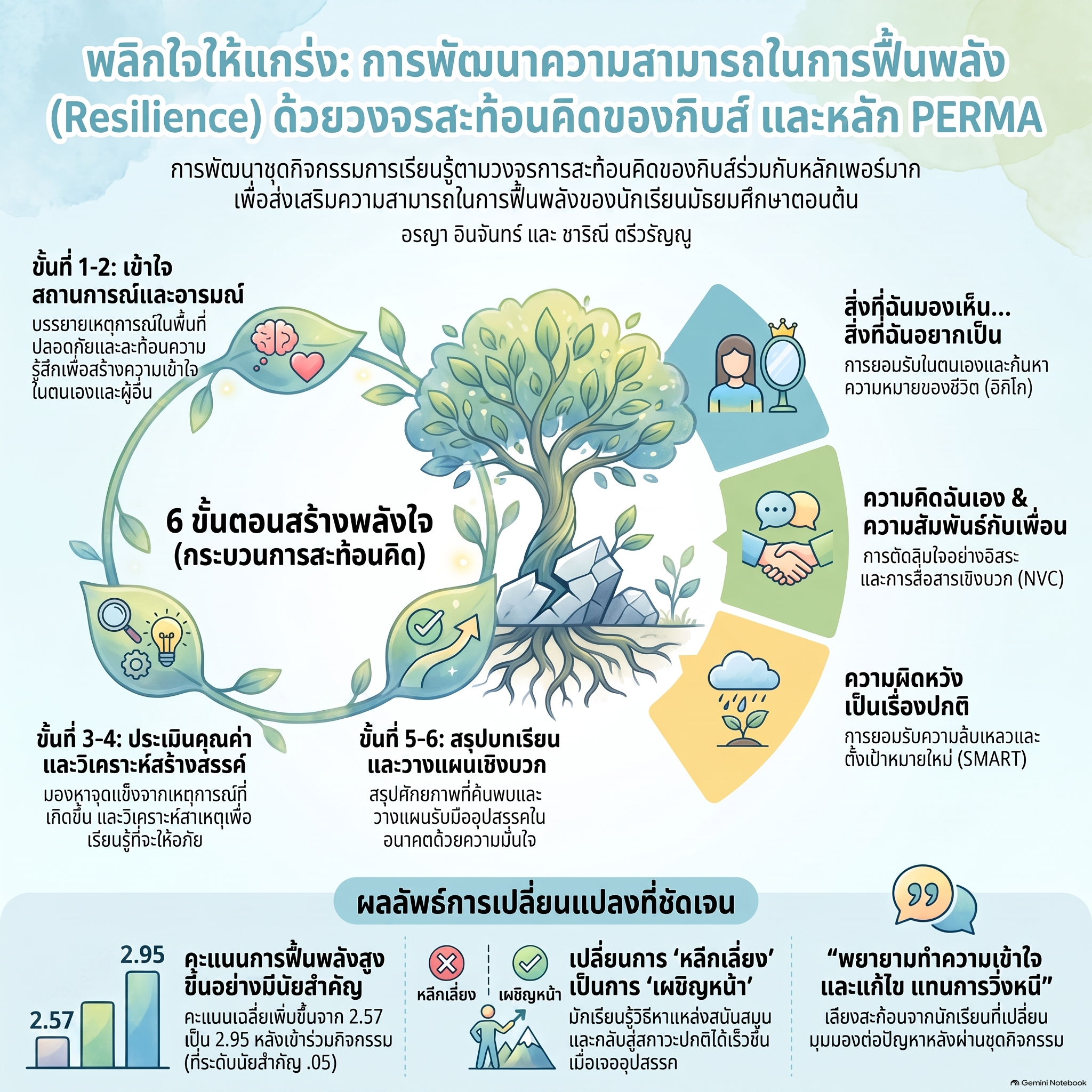
This research and development study aimed to develop and investigate the effects of a learning activities package based on Gibbs’ Reflective Cycle with PERMA to enhance resilience of lower secondary students. The target group consisted of 12 ninth-grade students. The research instruments included: (1) the developed learning activity package, (2) a resilience assessment form, (3) interview forms, and (4) reflective journals. The findings revealed that the developed learning activity package consisted of four activities designed to encourage students to confront challenging life situations ranging from the personal to the community level. Each activity comprised six steps: (1) describing events within a positive environment, (2) reflecting on feelings demonstrating self-awareness and understanding of others, (3) evaluating outcomes through recognition of self-worth, (4) creatively analyzing situations, (5) drawing conclusions from events by reflecting on personal abilities and characteristics, and (6) planning strategies to cope with situations through positive perspectives. Furthermore, the findings from the implementation of the learning activity package revealed that: 2.1) the students’ mean resilience scores after participating in the learning activities were significantly higher than those prior to participation at the .05 level; and 2.2) the students changed from avoiding difficult situations to becoming more willing to understand challenges, recognize coping strategies, and confront adverse situations with greater confidence.
References
กรมสุขภาพจิต. (2563). เปลี่ยนร้ายกลายเป็นดี RQ พลังสุขภาพจิต. สำนักวิชาการสุขภาพจิต กรมสุขภาพจิต กระทรวงสาธารณสุข.
ญาณิศา พึ่งเกตุ, และอรชุลี นิราศรพ. (2569). ผลของโปรแกรมสร้างเสริมความเข้มแข็งทางใจโดยประยุกต์แนวคิดแบบแผนความเชื่อด้านสุขภาพร่วมกับการเรียนรู้โดยใช้กรณีศึกษาเป็นฐานของนักเรียนมัธยมศึกษาตอนต้น. วารสารวิชาการมหาวิทยาลัยการกีฬาแห่งชาติ, 18(1), 143-158.
ธนาภรณ์ เนียมกลั่น. (2560). การเสริมสร้างความสามารถในการฟื้นพลังของนักเรียนระดับอาชีวศึกษาโดยใช้โปรแกรมฝึกการกำกับอารมณ์ [วิทยานิพนธ์ปริญญามหาบัณฑิต, จุฬาลงกรณ์มหาวิทยาลัย]. Chula ETD.
แพรวนภา เรียงริลา, ดนุลดา จามจุรี, มนตรี แย้มกสิกร, และสุนีย์ เหมะประสิทธิ์. (2563). การพัฒนากรอบสมรรถนะการปฏิบัติการสอนในสถานศึกษาสำหรับนักศึกษาครู. วารสารสันติศึกษาปริทรรศน์ มจร, 8(4), 1367–1379.
ภูมิศรัณย์ ทองเลี่ยมนาค. (2565). คุยเรื่องทิศทางการศึกษาปี 65 กับ ดร.ภูมิศรัณย์ ทองเลี่ยมนาค.
มะลิวรรณ วงษ์ขันธ์, พัชรินทร์ นินทจันทร์, และโสภิณ แสงอ่อน. (2558). ปัจจัยที่มีความสัมพันธ์กับความแข็งแกร่งในชีวิตในวัยรุ่น. วารสารการพยาบาลจิตเวชและสุขภาพจิต, 29(1), 57-75.
รสวันต์ อารีมิตร. (2555). พัฒนาการด้านจิตใจและสังคมของวัยรุ่น. ใน วิโรจน์ อารีกุล, ศิริไชย หงส์สงวนศรี, สุริยเดว ทรีปาตี, บุญยิ่ง มานะบริบูรณ์, รสวันต์ อารีมิตร, จิราภรณ์ ประเสริฐวิทย์, และคณะ (บ.ก.), พัฒนาการและการเจริญเติบโตของวัยรุ่น: Practical points in adolescent health care (หน้า 19-22). เอ-พลัส พริ้น.
รัชนก อุ้ยเฉ้ง. (2566). แนวทางการเสริมสร้างความสามารถในการฟื้นพลังทางการศึกษาของนักเรียนมัธยมศึกษาภายใต้ภาวะวิกฤต [วิทยานิพนธ์ปริญญามหาบัณฑิต, จุฬาลงกรณ์มหาวิทยาลัย]. Chula ETD.
สุธิดา พลพิพัฒน์พงศ์, นุจรี ไชยมงคล, และดวงใจ วัฒนสินธุ์. (2561). ความคิดฆ่าตัวตายในวัยรุ่นและปัจจัยที่เกี่ยวข้อง. วารสารคณะพยาบาลศาสตร์มหาวิทยาลัยบูรพา, 26(1), 40–49.
Arif, & Mirza. (2017). Effectiveness of an intervention program in fostering academic resilience of students at risk of failure at secondary school level. Bulletin of Education and Research, 39(1), 251–264.
Bandura, A. (1977). Self-efficacy: Toward a unifying theory of behavioral change. Psychological Review, 84(2), 191–215.
Ben Salah, A., DeAngelis, B. N., & al’Absi, M. (2023). Uncertainty and psychological distress during COVID-19: What about protective factors? Curr Psychol, 42, 21470–21477.
Benard, B. (1996). Resilience in action: Bouncing back from risk and adversity: Ideas for youth family and communities.
Fang, S., Barker, E., Arasaratnam, G., Lane, V., Rabinovich, D., Panaccio, A., ... Doucerain, M. M. (2025). Resilience, stress, and mental health among university students: A test of the resilience portfolio model. Stress and Health, 41(2).
Fergus, S., & Zimmerman, M. A. (2005). Adolescent resilience: A framework for understanding healthy development in the face of risk. Annual Review of Public Health, 26(1), 399–419.
Fredricks, J. A., Blumenfeld, P. C., & Paris, A. H. (2004). School engagement: Potential of the concept, state of the evidence. Review of Educational Research, 74(1), 59–109.
Gibbs, G. (1988). Learning by doing: A guide to teaching and learning methods. Further Education Unit.
Grotberg, E. (1995). A guide to promoting resilience in children: Strengthening the human spirit. Early Childhood Development: Practice and Reflections, 8, 7–10.
Kim, S., & Low, F. (2024). Promoting resilience in children and young people.
Lauterbach, & Becker. (1996). Caring for self: Becoming a self-reflective nurse.
Lazarus, R. S., & Folkman, S. (1984). Stress, appraisal, and coping. Springer Publishing Company.
Llistosella, M. (2023). Effectiveness of resilience-based interventions in schools for adolescents: A systematic review and meta-analysis. Frontiers in Psychology, 17(1), 1–21.
Masten, A. S., Best, K. M., & Garmezy, N. (1990). Resilience and development: Contributions from the study of children who overcome adversity. Development and Psychopathology, 2, 425–444.
Norrish, J. M., Williams, P., O’Connor, M., & Robinson, J. (2013). An applied framework for positive education. International Journal of Wellbeing, 3(2), 147–161.
Seligman, M. E. P. (2011). Flourish: A visionary new understanding of happiness and well-being. Atria Books.
Slaby, R. G., & Guerra, N. G. (1988). Cognitive mediators of aggression in adolescent offenders: 1. Assessment. Developmental Psychology, 24, 580–588.
UNICEF. (2022, August 31). UNICEF and Thailand’s Department of Mental Health have highlighted serious concerns regarding the mental health of children and adolescents, emphasizing the urgent need to strengthen and expand mental health services. https://www.unicef.org/thailand/th/press-releases/
Zhang, L., Chen, X., & Wan, H. (2025). Effects of a personalized PERMA-based intervention on the mental health of junior high school students: A randomized clinical trial. Frontiers in Psychology, 16, Article 1535744. https://doi.org/10.3389/fpsyg.2025.1535744
Downloads
Published
How to Cite
Issue
Section
Categories
License
Copyright (c) 2026 Faculty of Education, Srinakharinwirot university

This work is licensed under a Creative Commons Attribution-NonCommercial-NoDerivatives 4.0 International License.


