GUIDELINES FOR ENHANCING TEACHERS’ INNOVATION OF SCHOOLS UNDER KHON KAEN PRIMARY EDUCATIONAL SERVICE AREA OFFICE 4
Keywords:
guidelines for strengthening, teacher innovativenessAbstract
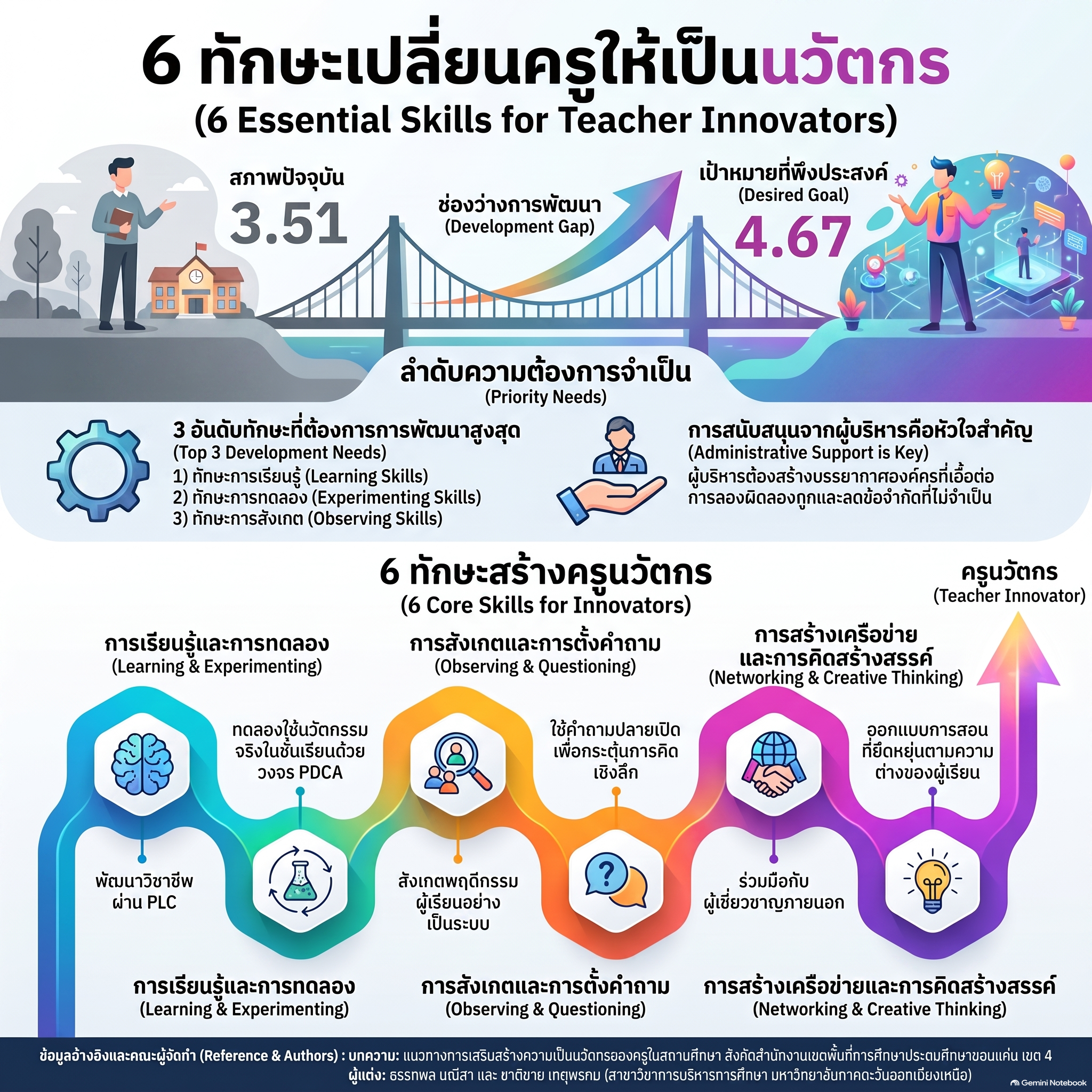
The purposes of this research were: 1) to examine the current state, the desired state, and the priority needs for enhancing teacher innovativeness in schools under the KhonKaen Primary Educational Service Area Office 4; and 2) to examine guidelines for enhancing teacher innovativeness in schools under the KhonKaen Primary Educational Service Area Office 4. This study employed a mixed-methods research design. The sample consisted of 319 participants, including 34 school administrators and 285 teachers, selected through stratified random sampling based on Yamane’s formula. The research instruments included a five-point Likert scale questionnaire with a content validity index of 1.00 for all items and a reliability coefficient of 0.98, a semi-structured interview with three experts, and an evaluation form used by seven experts to assess the appropriateness, feasibility, and usefulness of the proposed guidelines. Data were analyzed using frequency, percentage, mean, standard deviation, priority needs index, content analysis, median, and interquartile range. The findings revealed that : 1) the current state of enhancing teachers’ innovativeness was overall at a high level ( = 3.51) whereas the desirable state was overall at the highest level (
= 4.67) with the priority needs ranked by importance as follows: 1.learning skills, 2.experimenting skills, 3.observing skills, 4.questioning skills, 5.networking skills, and 6.creative thinking skills. 2) The guidelines for enhancing teacher innovativeness consisted of six dimensions with a total of 31 approaches: learning skills (5 approaches), experimenting skills (6 approaches), observing skills (4 approaches), questioning skills (5 approaches), networking skills (6 approaches), and creative thinking skills (5 approaches). The evaluation results indicated that the appropriateness, feasibility, and usefulness of all proposed guidelines were at the highest level.
References
จักรพันธ์ รอดฤทธิ์. (2566). แนวทางการส่งเสริมทักษะการคิดเชิงนวัตกรรมของครูโรงเรียนสังกัดสำนักงานเขตพื้นที่การศึกษาประถมศึกษาพิจิตร เขต 1 [วิทยานิพนธ์ปริญญามหาบัณฑิต, มหาวิทยาลัยนเรศวร].
จุฑามาศ ศรีจันทร์. (2563). แนวทางการพัฒนาแนวปฏิบัติที่เป็นเลิศ (Best Practice) ในการจัดการเรียนรู้ของครูสังกัดสำนักงานเขตพื้นที่การศึกษาประถมศึกษาขอนแก่น เขต 4 [วิทยานิพนธ์ปริญญามหาบัณฑิต, มหาวิทยาลัยขอนแก่น].
ธีรพงษ์ แสงประดิษฐ์. (2562). ความต้องการจำเป็นในการพัฒนาสมรรถนะการจัดการเรียนรู้เชิงรุกและนวัตกรรมของครูสังกัดสำนักงานเขตพื้นที่การศึกษามัธยมศึกษา เขต 18. วารสารวิจัยและสารสนเทศ สพฐ., 2(2), 45–58.
นงลักษณ์ วิริยะพงษ์. (2563). รูปแบบการพัฒนาความเป็นนวัตกรของครูสังกัดสำนักงานเขตพื้นที่การศึกษาประถมศึกษา. วารสารวิชาการมหาวิทยาลัยราชภัฏมหาสารคาม, 14(2), 185–198.
นพรัตน์ แสงทอง. (2565). ความต้องการจำเป็นในการพัฒนาสมรรถนะดิจิทัลและทักษะนวัตกรรมของครูในสถานศึกษา สังกัดสำนักงานเขตพื้นที่การศึกษามัธยมศึกษา. วารสารศิลปากรศึกษาศาสตร์, 14(2), 345–360.
นฤมล เสาเฉลียว. (2565). แนวทางการพัฒนาทักษะนวัตกรของครูสังกัดสำนักงานเขตพื้นที่การศึกษาประถมศึกษา [วิทยานิพนธ์ปริญญามหาบัณฑิต, มหาวิทยาลัยนครพนม].
วิชัย วงษ์ใหญ่. (2562). การโค้ชเพื่อรู้นวัตกรรม. ศูนย์นวัตกรรมการหลักสูตรและการเรียนรู้.
วิไลลักษณ์ ปัดถา. (2562). แนวทางการพัฒนาความเป็นนวัตกรของครูสังกัดสำนักงานเขตพื้นที่การศึกษามัธยมศึกษา เขต 23. วารสารมนุษยศาสตร์และสังคมศาสตร์ มหาวิทยาลัยราชภัฏสกลนคร, 10(2), 75–88.
สุกัญญา แช่มช้อย. (2562). การบริหารสถานศึกษาในยุคดิจิทัล. สำนักพิมพ์แห่งจุฬาลงกรณ์มหาวิทยาลัย.
สุพัตรา ธรรมรักษา. (2561). รูปแบบการพัฒนาครูเพื่อเสริมสร้างสมรรถนะด้านนวัตกรรมการจัดการเรียนรู้ [วิทยานิพนธ์ปริญญาดุษฎีบัณฑิต, มหาวิทยาลัยสยาม].
สำนักงานคณะกรรมการพัฒนาการเศรษฐกิจและสังคมแห่งชาติ. (2560). ยุทธศาสตร์ชาติ (พ.ศ. 2561–2580). สำนักงานคณะกรรมการพัฒนาการเศรษฐกิจและสังคมแห่งชาติ.
สำนักงานเขตพื้นที่การศึกษาประถมศึกษาขอนแก่น เขต 4. (2568). แผนปฏิบัติการประจำปี พ.ศ. 2568. สำนักงานเขตพื้นที่การศึกษาประถมศึกษาขอนแก่น เขต 4.
สำนักงานนวัตกรรมแห่งชาติ. (2562). คู่มือการจัดการนวัตกรรมสำหรับผู้บริหารองค์กร. สำนักงานนวัตกรรมแห่งชาติ (องค์การมหาชน).
สำนักงานเลขาธิการสภาการศึกษา. (2559). การขับเคลื่อนนโยบายตามของยุทธศาสตร์ชาติ (พ.ศ. 2561–2580). สำนักงานเลขาธิการสภาการศึกษา.
สำนักงานเลขาธิการสภาการศึกษา. (2560). รายงานการวิจัยเรื่องคุณลักษณะและสมรรถนะสำคัญของครูในศตวรรษที่ 21. กระทรวงศึกษาธิการ.
อดุลย์ วังศรีคูณ. (2564). การศึกษากับการพัฒนาคนไทยในศตวรรษที่ 21. วารสารมนุษยศาสตร์และสังคมศาสตร์ มหาวิทยาลัยราชภัฏพิบูลสงคราม, 15(1), 1–14.
Christensen, T. (2015). The 5 traits of successful innovators, according to science. 99U. Retrieved December 24, 2020, from http://99u.com/workbook/21113/the-5-traits-ofsuccessful-innovators-according-to-science
Gauca, O. (2015). Educational innovators: Competencies and challenges. Procedia - Social and Behavioral Sciences, 180, 1107–1112.
Yamane, T. (1973). Statistics: An introductory analysis (3rd ed.). Harper & Row.
Downloads
Published
How to Cite
Issue
Section
Categories
License
Copyright (c) 2026 Faculty of Education, Srinakharinwirot university

This work is licensed under a Creative Commons Attribution-NonCommercial-NoDerivatives 4.0 International License.


