QUALITY CULTURE AFFECTING HIGH-PERFORMANCE ORGANIZATION OF SCHOOLS UNDER NAKHON PHANOM PRIMARY EDUCATIONAL SERVICE AREA OFFICE 2
Abstract
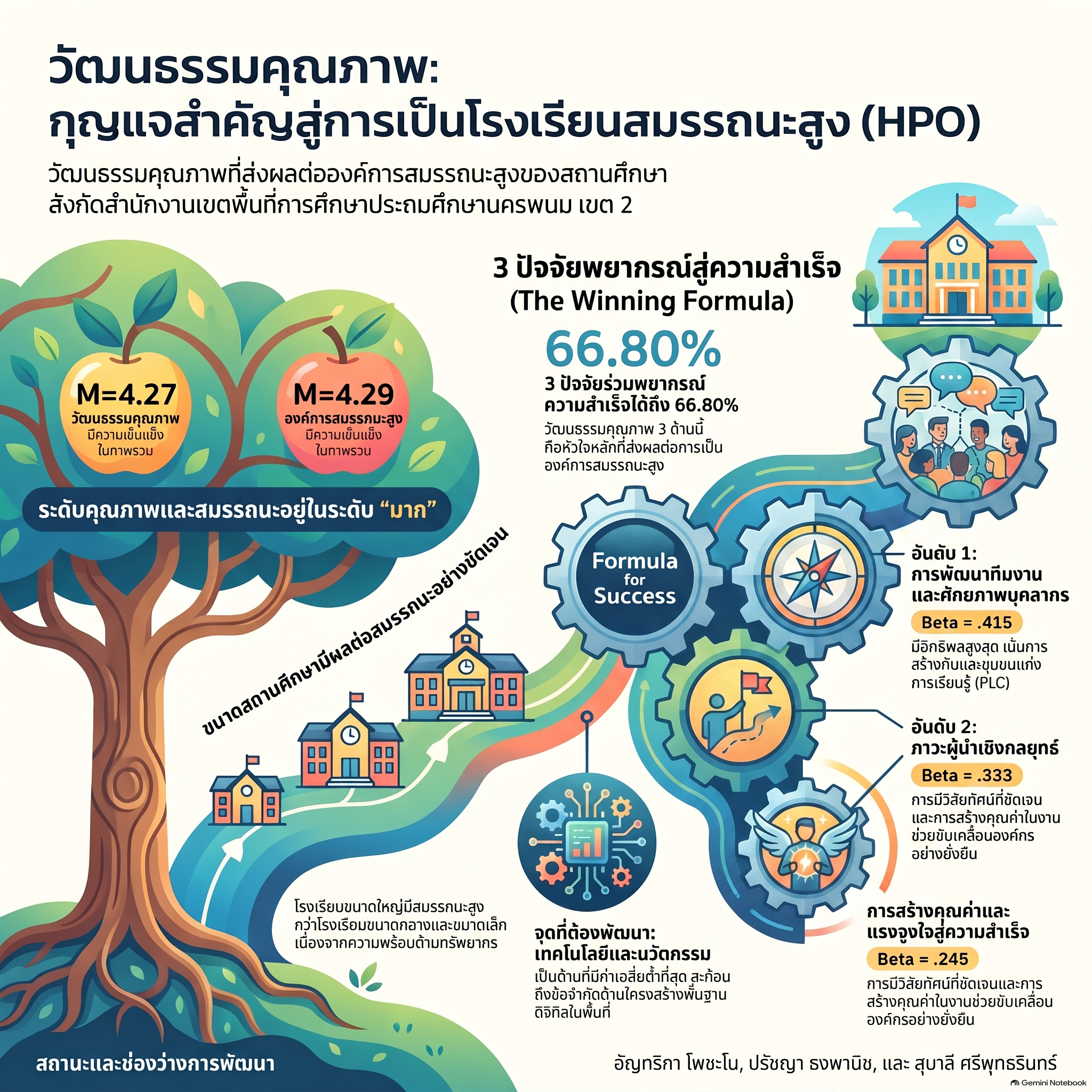
The purposes of this research were to: 1) examine the levels of quality culture and high-performance organization of schools, 2) compare quality culture and high-performance organization classified by position and school size, and 3) investigate the quality culture affecting the high-performance organization of schools under the Nakhon Phanom Primary Educational Service Area Office 2. The sample group consisted of 265 school administrators and teachers, obtained through stratified random sampling. The research instrument was a rating scale questionnaire with a total reliability coefficient of .90. Data were analyzed using descriptive statistics, the t-test, one-way ANOVA, and stepwise multiple regression analysis. The findings revealed that: 1) Overall, the quality culture and the high-performance organization of the schools were at a high level. 2) There were no significant differences in opinions between administrators and teachers. However, schools of different sizes showed statistically significant differences in high-performance organization at the .05 level, with large-sized schools having a higher mean score than medium and small-sized schools, respectively. 3) Three dimensions of quality culture—namely, team development and personnel potential, strategic leadership, and value creation and motivation for success—could jointly predict the high-performance organization with an explanatory power of 66.80% (R²= .668) at the .01 level of statistical significance.
References
กรรณาภรณ์ สินประสงค์. (2564). รูปแบบวัฒนธรรมคุณภาพของสถานศึกษาอาชีวศึกษาเอกชน [วิทยานิพนธ์ปรัชญาดุษฎีบัณฑิต, มหาวิทยาลัยศิลปากร].
ดาวรุวรรณ ถวิลการ. (2564). รูปแบบการพัฒนาวัฒนธรรมคุณภาพของโรงเรียนขนาดเล็กในภาคตะวันออกเฉียงเหนือ. สำนักงานรับรองมาตรฐานและประเมินคุณภาพการศึกษา (องค์การมหาชน).
รินทร์ลภัส ศักดิ์ชัยวัฒนา. (2565). การพัฒนาโมเดลความสัมพันธ์เชิงสาเหตุที่ส่งผลต่อการเป็นองค์กรสมรรถนะสูงของโรงเรียนมัธยมศึกษา สังกัดสำนักงานคณะกรรมการการศึกษาขั้นพื้นฐาน [ดุษฎีนิพนธ์ปริญญาการศึกษาดุษฎีบัณฑิต, มหาวิทยาลัยศรีนครินทรวิโรฒ].
วินุลาศ เจริญชัย, นพคุณ คุณาชีวะ, บุศรา นิยมเวช, และ สัญญา เคณาภูมิ. (2565). การสังเคราะห์องค์ประกอบองค์การสมรรถนะสูง. Journal of Modern Learning Development, 7(2), 438-454. https://so06.tcithaijo.org/index.php/jomld/article/download/251939/172183/943082
สมคิด สกุลสถาปัตย์. (2563). กลยุทธ์การสร้างวัฒนธรรมคุณภาพในการบริหารจัดการสถานศึกษาขั้นพื้นฐาน. วารสารศึกษาศาสตร์ มมร, 8(1), 277-293. https://ojs.mbu.ac.th/index.php/edj/article/view/671/667
สมพงษ์ เชือกพรม. (2565). ภาวะผู้นำเชิงนวัตกรรมที่ส่งผลต่อการเป็นองค์การสมรรถนะสูงของโรงเรียนสังกัดสำนักการศึกษาเมืองพัทยา จังหวัดชลบุรี [วิทยานิพนธ์ครุศาสตรมหาบัณฑิต, มหาวิทยาลัยราชภัฏราชนครินทร์].
สุกัญญา พรมอารักษ์. (2567). โมเดลความสัมพันธ์เชิงสาเหตุของปัจจัยที่ส่งผลต่อองค์กรสมรรถนะสูงของโรงเรียนสังกัดสำนักงานเขตพื้นที่การศึกษาประถมศึกษาในภาคตะวันออกเฉียงเหนือ [ดุษฎีนิพนธ์ปรัชญาดุษฎีบัณฑิต, มหาวิทยาลัยราชภัฏสกลนคร].
สุวิมล ว่องวาณิช. (2560). การวิจัยปฏิบัติการในชั้นเรียน (พิมพ์ครั้งที่ 19). สำนักพิมพ์แห่งจุฬาลงกรณ์มหาวิทยาลัย.
สำนักงานคณะกรรมการการศึกษาขั้นพื้นฐาน. (2565). แผนพัฒนาการศึกษาขั้นพื้นฐาน (พ.ศ. 2566 – 2570) ของสำนักงานคณะกรรมการการศึกษาขั้นพื้นฐาน. กระทรวงศึกษาธิการ.
สำนักงานเขตพื้นที่การศึกษาประถมศึกษานครพนม เขต 2. (2566). แผนพัฒนาการศึกษาขั้นพื้นฐาน พ.ศ. 2566-2570.
Al-Dhaafri, H. S., & Alosani, M. S. (2024). The role of leadership, continuous improvement and benchmarking on organizational performance: The mediating mechanism of EOC. Benchmarking: An International Journal. Advance online publication. https://doi.org/10.1108/BIJ-04-2024-0321
Anwar, R. W. (2023, August 9). What is quality culture? Key characteristics and benefits. LinkedIn. https://www.linkedin.com/pulse/what-quality-culture-key-characteristics-benefits-raja-waheed-anwar-
Bendermacher, G. W. G., Oude Egbrink, M. G., Wolfhagen, I. H. A. P., & Dolmans, D. H. (2017). Unraveling quality culture in higher education: A realist review. Higher Education, 73, 39-60. https://doi.org/10.1007/s10734-015-9979-2
Cameron, K. S., & Quinn, R. E. (1999). Diagnosing and changing organizational culture: Based on the competing values framework. Addison-Wesley.
Cozzolino, A., & Rothaermel, F. T. (2018). Discontinuities, competition, and cooperation: Competitive dynamics between incumbents and entrants. Strategic Management Journal, 39(12), 3053–3085. https://doi.org/10.1002/smj.2776
de Waal, A. A. (2007). The characteristics of a high performance organization. Business Strategy Series, 8(3), 179–185. https://doi.org/10.1108/17515630710684178
Dejanović, A., Lukić Nikolić, J., & Miljuš, G. (2024). Analysis of the degree of quality culture development. International Journal for Quality Research, 18(4), 1055–1070. https://doi.org/10.24874/ijqr18.04-09
Hair, J. F., Babin, B. J., Anderson, R. E., & Black, W. C. (2019). Multivariate data analysis (8th ed.). Pearson Prentice.
Iqbal, S., Ashfaq, T., Azlan Bin Taib, C., & Rizal Razalli, M. (2023). The effect of quality culture on service quality of public and private universities: A comparative analysis. PLOS ONE, 18(4), Article e0283679. https://doi.org/10.1371/journal.pone.0283679
Khan, K., Khan, Q., Jamil, S. H., & Akbar, S. (2024). A study on high performance organization framework and organization performance: Lens of dynamic capability theory. Cogent Business & Management, 11(1), Article 2285415. https://doi.org/10.1080/23311975.2023.2285415
Kohan, N., Ahmady, S., Zarezadeh, Y., & Teymourlouy, S. A. A. (2024). Twelve tips for establishing an effective quality assurance system for medical schools. Acta Medica Iranica, 62(3). https://doi.org/10.18502/acta.v62i3.17111
Maltz, A. C., Shenhar, A. J., & Reilly, R. R. (2003). Beyond the balanced scorecard: Refining the search for organizational success measures. Long Range Planning, 36, 187-204. https://doi.org/10.1016/S0024-6301(02)00165-6
Navarro, G., & Naranjo, G. (2025). Quality culture, quality management, and organizational performance: A structural model for the manufacturing sector. Sustainability, 17, Article 3934. https://doi.org/10.3390/su17093934
Stalmeijer, R. E., Brown, M. E. L., & O'Brien, B. C. (2024). How to discuss transferability of qualitative research in health professions education. The Clinical Teacher, 21(6), Article e13762. https://doi.org/10.1111/tct.13762
van Krieken, R. (2023). Quality culture in higher education [White paper]. Hobeon. https://www.hobeon.nl/system/files/inline/Whitepaper%20Quality%20culture_0.pdf
Zhang, Y., Xiong, P., Rong, S., Frost, M., & Zhou, W. (2024). Knowledge management of MNCs in the post-COVID era: The role of cultural intelligence and knowledge-oriented leadership. Journal of Knowledge Management, 28(8), 2141–2168. https://doi.org/10.1108/JKM-03-2023-0189
Downloads
Published
How to Cite
Issue
Section
Categories
License
Copyright (c) 2026 Faculty of Education, Srinakharinwirot university

This work is licensed under a Creative Commons Attribution-NonCommercial-NoDerivatives 4.0 International License.


