THE DEVELOPMENT OF A CHINESE LEARNING MANAGEMENT MODEL BASED ON ACTIVITY-BASED LEARNING AND THE SQ6R METHOD TO ENHANCE READING COMPREHENSION AND ANALYTICAL THINKING SKILLS OF EIGHT GRADE STUDENTS
Keywords:
Develop of Chinese Learning Management Model, Reading Comprehension Skills, Analytical Thinking Skills, Activity-Based Learning and the SQ6R methodAbstract
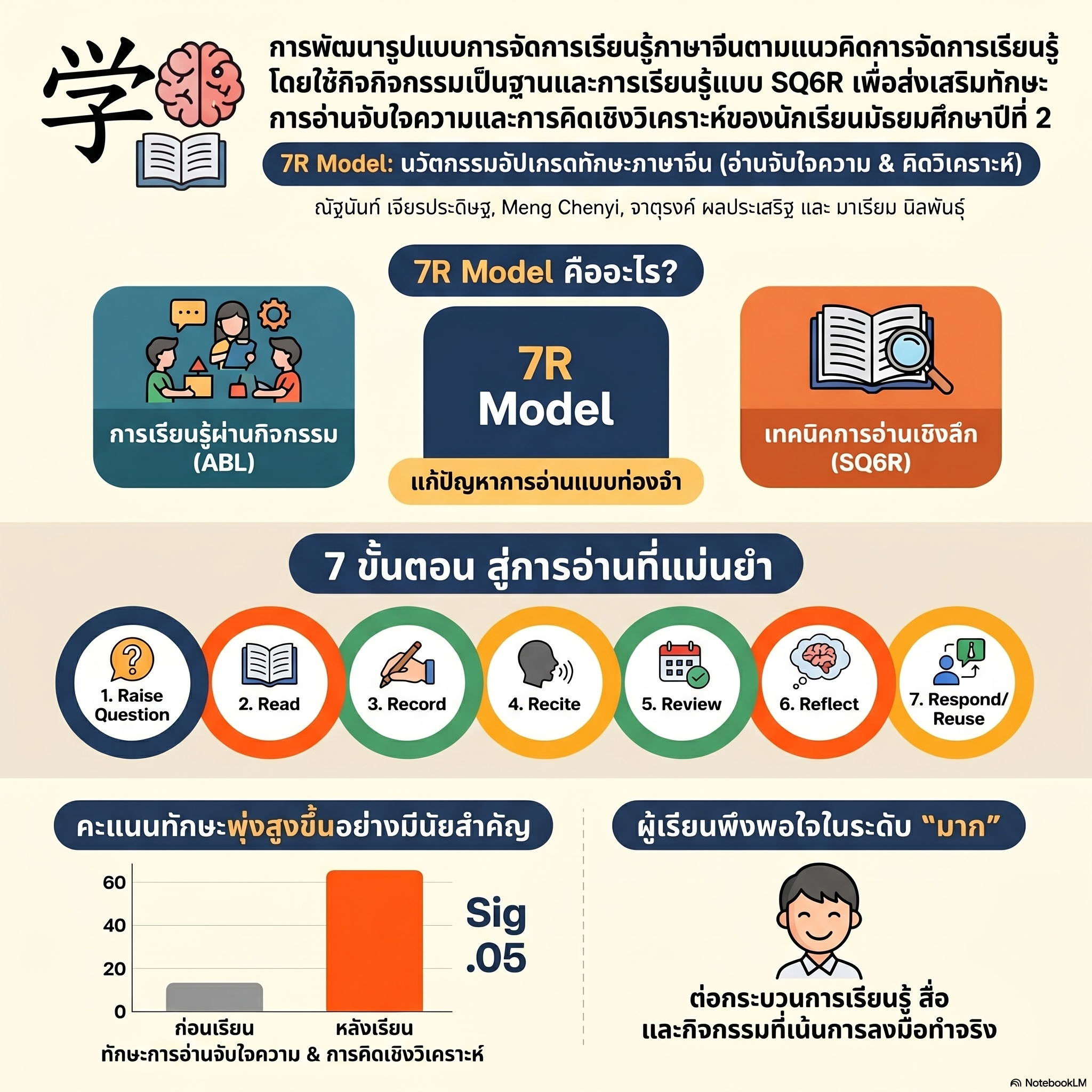
The objectives of this research were: 1) to develop a Chinese language learning management model based on the concepts of Activity-Based Learning and the SQ6R method to enhance reading comprehension and analytical thinking skills of Eight Grade students; 2) To examine the effectiveness of the Chinese language learning management model based on the concepts of Activity-Based Learning and the SQ6R method. The target group consisted of 21 Eight Grade students enrolled in the trilingual special program who studied Chinese at the Demonstration School of Silpakorn University (Secondary Division) during the first semester of the 2025 academic year. The sample was selected using purposive sampling. The research instruments included: the developed learning management model and its user manual, a pre- and post-test on reading comprehension and analytical thinking skills, and a student satisfaction questionnaire. The research findings revealed that: 1) The developed learning management model, named the 7R Model, consisted of five components: principles, objectives, procedures, supporting factors, and assessment and evaluation. The model was found to be appropriate and complete for implementation with the target group. The effectiveness of the model was as follows: 2.1) The Eight Grade students’ post-test scores in reading comprehension were significantly higher than their pre-test scores. 2.2) The Eight Grade students’ post-test scores in analytical thinking were significantly higher than their pre-test scores. 2.3) The students’ satisfaction with the implementation of the model was at a high level.
References
ทิศนา แขมมณี. (2562). ศาสตร์การสอน: องค์ความรู้เพื่อการจัดกระบวนการเรียนรู้ที่มีประสิทธิภาพ (พิมพ์ครั้งที่ 27). สำนักพิมพ์แห่งจุฬาลงกรณ์มหาวิทยาลัย.
มาเรียม นิลพันธุ์. (2558). วิธีวิจัยทางการศึกษา (พิมพ์ครั้งที่ 8). โรงพิมพ์มหาวิทยาลัยศิลปากร.
สำนักงานคณะกรรมการการศึกษาแห่งชาติ. (2542). พระราชบัญญัติการศึกษาแห่งชาติ พ.ศ. 2542. https://www.moe.go.th/พ.ร.บ.การศึกษาแห่งชาติ-พ.ศ-2542/
Al Odwan, T. A. A.-H. (2012). The effect of the directed reading thinking activity through cooperative learning on English secondary stage students’ reading comprehension in Jordan. International Journal of Humanities and Social Science, 2(16), 143-151.
Anderson, A. (1997). Learning strategies in physical education: Self-talk, imagery, and goal-setting. Journal of Physical Education, Recreation & Dance, 68(5), 30–35. https://doi.org/10.1080/07303084.1997.10604941
Arend, M. (2011). There’s a hippo on my stoep: Constructions of language teaching and English second language learning in the New National Senior Certificate. Per Linguam, 27(1), 1–10. https://doi.org/10.5785/27-1-11
Cantrell, R. (1999). Employee engagement and organizational commitment: The journal of burnout: Cases of Thailand and Indonesia. International Journal of Evaluation and Business Communication, 36(3), 285–298.
Dewey, J. (1938). Experience and education. Collier Books.
Duke, N. K., & Pearson, P. D. (2002). Effective practices for developing reading comprehension. In A. E. Farstrup & S. J. Samuels (Eds.), What research has to say about reading instruction (3rd ed., pp. 205–242). International Reading Association.
Durkin, K. (1993). Developmental social psychology: From infancy to old age. Blackwell.
Flavell, J. H. (1979). Metacognition and cognitive monitoring: A new area of cognitive-developmental inquiry. American Psychologist, 34(10), 906–911. https://doi.org/10.1037/0003-066X.34.10
Freiberg, H. J., & Driscoll, A. (2005). Universal teaching strategies (4th ed.). Pearson/Allyn & Bacon.
Horsburgh, J. S. (2014). Managing a community shared vocabulary for hydrologic observations. Environmental Modelling & Software, 52, 1–12. https://doi.org/10.1016/j.envsoft.2013.10.015
Joyce, B., Weil, M., & Calhoun, E. (2009). Models of teaching (8th ed.). Allyn & Bacon.
National Institute of Child Health and Human Development. (2000). Report of the National Reading Panel: Teaching children to read: An evidence-based assessment of the scientific research literature on reading and its implications for reading instruction (NIH Publication No. 00-4769). U.S. Government Printing Office.
Prastowo, S., Kurniawan, A., & Hidayat, R. (2023). Teachers' work life, mental health, and job [ระบุชื่อบทความฉบับเต็มหากมีต่อ]. [ระบุชื่อวารสาร].
Pressley, M. (2000). What should comprehension instruction be the instruction of? In M. L. Kamil, P. B. Mosenthal, P. D. Pearson, & R. Barr (Eds.), Handbook of reading research (Vol. 3, pp. 545–560). Erlbaum.
Purnomo, T., Prastowo, T., & Aldiono, M. (2022). Profile of problem-solving ability in junior high school students on global warming lesson material. IJORER: International Journal of Recent Educational Research, 4(3), 355–364. https://doi.org/10.46245/ijorer.v4i3.314
Remler, D. K., & Van Ryzin, G. G. (2011). Research methods in practice: Strategies for description and causation. SAGE Publications.
Robinson, F. P. (1961). Effective study. Harper & Brothers.
Downloads
Published
How to Cite
Issue
Section
Categories
License
Copyright (c) 2026 Faculty of Education, Srinakharinwirot university

This work is licensed under a Creative Commons Attribution-NonCommercial-NoDerivatives 4.0 International License.


