THE IMPLEMENTING MODEL-CENTERED INSTRUCTION SEQUENCE AND GUIDED INQUIRY TO PROMOTE SCIENTIFIC EXPLANATION ABILITY ON POLYMER OF GRADE 12 STUDENTS
Keywords:
model-centered instruction sequence (MIS), guided inquiry, scientific explanation abilityAbstract
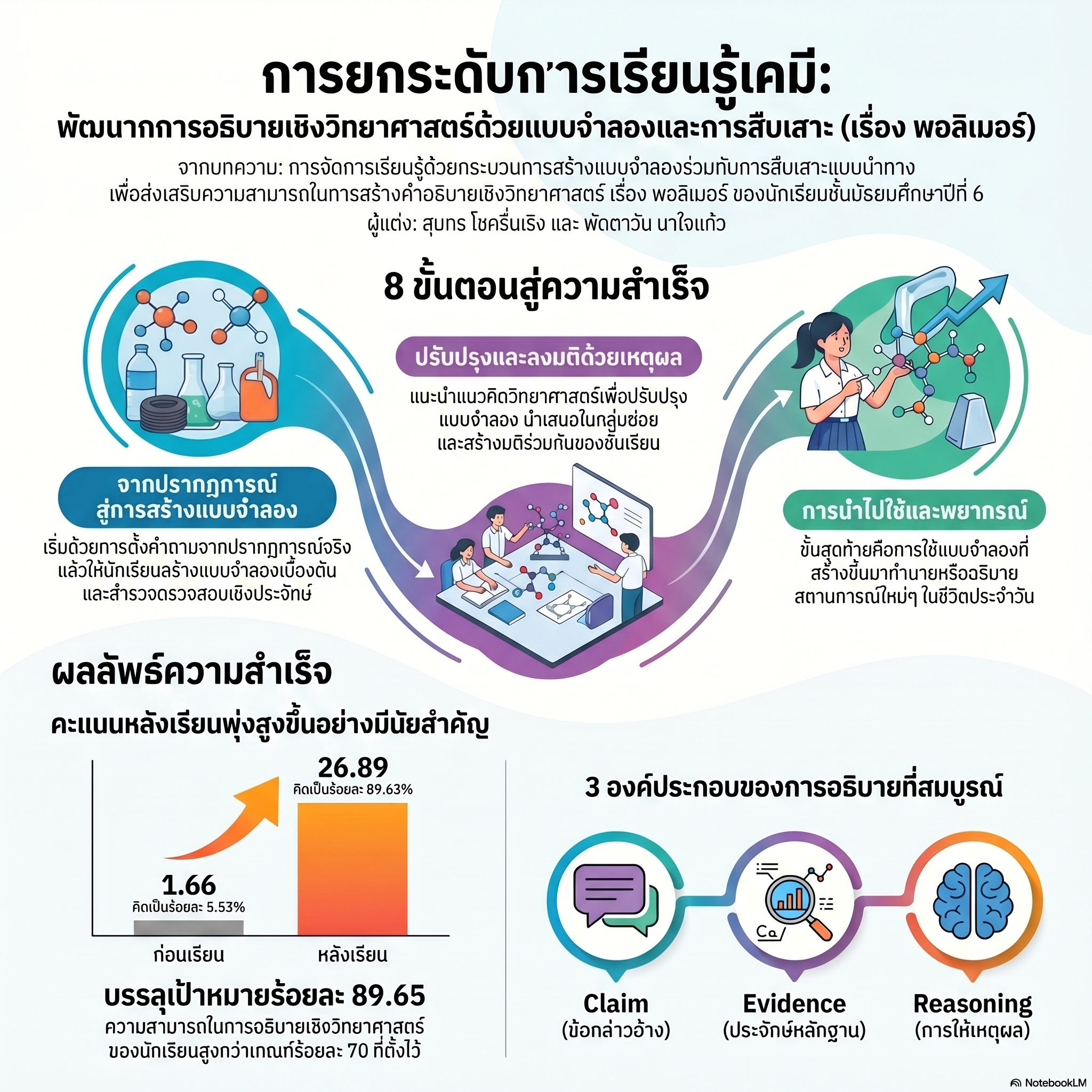
This study aimed to: compare twelfth grade students’ ability in scientific explanations on polymer before and after learning using model-centered instruction sequence (MIS) and guided inquiry and compare twelfth grade students’ ability in scientific explanation on polymer after learning with the criteria of 70%. The samples consisted of 38 twelfth Grade Students at a large-sized secondary school in the second semester of 2024 academic year, under Sakol Nakorn Secondary Educational Service Area, obtained by cluster random sampling technique. The research instruments included 5 lesson plans and 15 open-ended questions of scientific explanation ability test. The data were analyzed by mean, percentage, standard deviation, t-test for dependent sample and one sample t-test. The findings of this research were as follows: 1) Twelfth grade students demonstrated significantly scientific explanation ability after learning (x̄ = 26.89, S.D. = 2.16) higher than before learning (x̄ = 1.66, S.D. = 3.07) with statistical significance at the .01 level. 2) Twelfth grade students demonstrated significantly scientific explanation ability after learning (x̄ = 26.89, S.D. = 2.16, equivalent to 89.65%) higher than the criteria of 70% with statistical significance at the .01 level
References
กมลวรรณ กันยาประสิทธิ์. (2558). 5 คุณลักษณะสำคัญของการสืบเสาะหาความรู้. สืบค้นเมื่อ 17 มีนาคม 2567, จาก http://sciedcenter.swu.ac.th/Portals/25/Documents/News/5%20Essential%20feature%20of%20inquiry_Kamonwan.pdf?timestamp=1434440007462
กระทรวงศึกษาธิการ. (2552). หลักสูตรแกนกลางการศึกษาขั้นพื้นฐาน พุทธศักราช 2551. กรุงเทพฯ: โรงพิมพ์ชุมนุมสหกรณ์การเกษตรแห่งประเทศไทย.
โรงเรียนคำตากล้าราชประชาสงเคราะห์. (2566). รายงานการประเมินตนเองของสถานศึกษา โรงเรียนคำตากล้าราชประชาสงเคราะห์. สกลนคร: โรงเรียนฯ.
นภาไลย์ ต๊ะเสาร์ และ สุทธิดา จํารัส. (2564). ผลของการจัดการเรียนรู้สืบเสาะหาความรู้ร่วมกับการใช้อินโฟกราฟิกที่มีต่อความสามารถในการสร้างคําอธิบายเชิงวิทยาศาสตร์ของนักเรียนกลุ่มชาติพันธุ์. วารสารวิทยาศาสตร์และวิทยาศาสตร์ศึกษา, 4(2), 190–203.
พัทธ์ธีรา รัตนพันธุ์ และ กัญญารัตน์ โคจร. (2566). การจัดกิจกรรมการเรียนรู้โดยใช้แบบจำลองเป็นฐานผ่านระบบออนไลน์ที่มีต่อการสร้างคําอธิบายทางวิทยาศาสตร์ เรื่องเคมีไฟฟ้า ของนักเรียนชั้นมัธยมศึกษาปีที่ 5. วารสารศึกษาศาสตร์ มหาวิทยาลัยศิลปากร, 21(1), 231.
มิ่งมุก สุทธิกิตติพงศ์. (2562). การพัฒนาความสามารถการสร้างคำอธิบายทางวิทยาศาสตร์เรื่องสมบัติของสารของนักเรียนชั้นมัธยมศึกษาปีที่ 4 โดยใช้การจัดการเรียนรู้แบบสืบเสาะเป็นฐาน (5E) (วิทยานิพนธ์ปริญญาศึกษาศาสตรมหาบัณฑิต). มหาวิทยาลัยรังสิต.
สถาบันส่งเสริมการสอนวิทยาศาสตร์และเทคโนโลยี. (2566). การแถลงข่าวผลการประเมิน PISA 2022. สืบค้นเมื่อ 12 มิถุนายน 2567, จาก http://pisathailand.ipst.ac.th/news-21/
Baek, H., Buck, G., & Towns, M. H. (2011). Engaging elementary students in scientific modeling: The MoDeLS fifth-grade approach and findings. In C. V. Schwarz & C. Passmore (Eds.), Models and modeling: Cognitive tools for scientific enquiry (pp. 195–218). Dordrecht: Springer.
Berland, L. K., & Reiser, B. J. (2009). Making sense of argumentation and explanation. Science Education, 93(1), 26–55.
Gebre, E. (2018). Learning with multiple representations: Infographics as cognitive tools for authentic learning in science literacy. Canadian Journal of Learning and Technology, 44(1), 1–24.
Johnson-Laird, P. N. (1983). Mental models: Toward a cognitive science of language, inference, and consciousness (6th ed.). Cambridge, MA: Harvard University Press.
Kuhn, L., & Reiser, B. (2005, April). Students constructing and defending evidence-based scientific explanations. Paper presented at the Annual Meeting of the National Association for Research in Science Teaching, Dallas, TX.
McNeill, K. L., Lizotte, D. J., Krajcik, J., & Marx, R. W. (2006). Supporting students’ construction of scientific explanations by fading scaffolds in instructional materials. Journal of the Learning Sciences, 15(2), 153–191.
Meela, P., & Artdej, R. (2017). Model based inquiry and scientific explanation: Promoting meaning-making in classroom. Journal of Education Naresuan University, 19(3), 1–15. (in Thai)
Metz, K. E. (2000). Young children’s inquiry in biology: Building the knowledge bases to empower independent inquiry. In J. Minstrell & E. H. van Zee (Eds.), Inquiring into inquiry learning and teaching in science (pp. 371–404). Washington, DC: American Association for the Advancement of Science.
Reiser, B. J., Berland, L. K., & Kenyon, L. (2012). Engaging students in the scientific practice of explanation and argumentation. Science and Children, 49(8), 8–13.
Ruiz-Primo, M. A., Li, M., Ayala, C. C., & Shavelson, R. J. (2008). Testing one premise of scientific inquiry in science classrooms: A study that examines students’ scientific explanation (CRESST Report 733). Los Angeles, CA: University of California, National Center for Research on Evaluation, Standards, and Student Testing (CRESST).
Sampson, V., & Clark, D. B. (2009). The impact of collaboration on the outcomes of scientific argumentation. Science Education, 93(3), 448–484.
Schwarz, C. V., Reiser, B. J., Davis, E. A., Kenyon, L., Acher, A., Fortus, D., Shwartz, Y., Hug, B., & Krajcik, J. (2009). Developing a learning progression for scientific modeling: Making scientific modeling accessible and meaningful for learners. Journal of Research in Science Teaching, 46(6), 632–654.
Downloads
Published
How to Cite
Issue
Section
Categories
License
Copyright (c) 2025 Faculty of Education, Srinakharinwirot university

This work is licensed under a Creative Commons Attribution-NonCommercial-NoDerivatives 4.0 International License.


