โมเดลปฏิสัมภิทา 4–BANI–RAAT สำหรับการบริหารการศึกษาในยุคปัญญาประดิษฐ์
Article Sidebar
Main Article Content
บทคัดย่อ
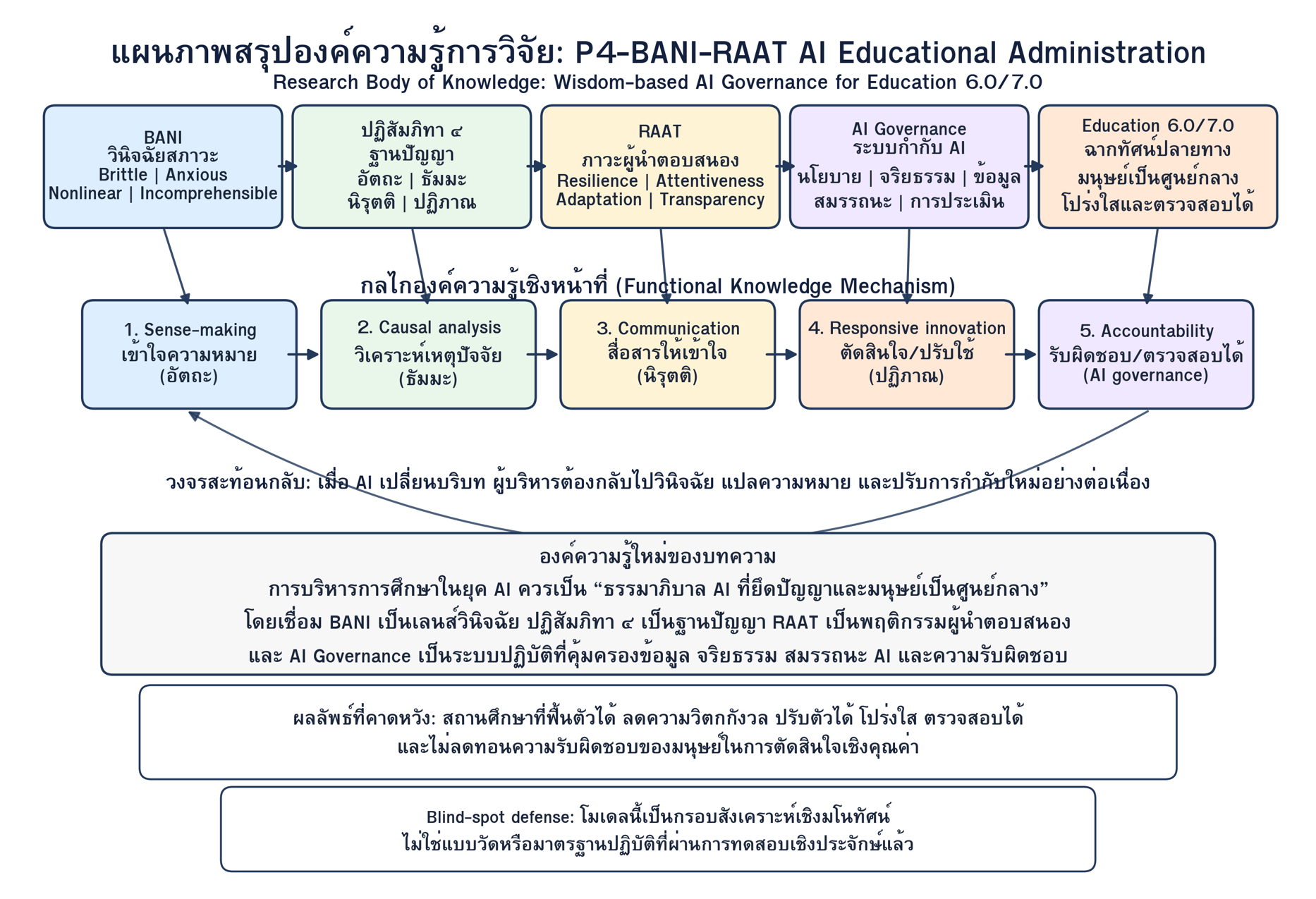
บทความวิชาการเชิงแนวคิดนี้สังเคราะห์กรอบการบริหารการศึกษาในยุคปัญญาประดิษฐ์ โดยเชื่อมโยงหลักปฏิสัมภิทา 4 กับกรอบ BANI และ RAAT เพื่อพัฒนาโมเดลที่มีฐานคิดด้านปัญญาและธรรมาภิบาลสำหรับผู้บริหารสถานศึกษาในช่วงเปลี่ยนผ่านสู่การศึกษาอนาคต บทความมิได้เสนอให้ Education 6.0/7.0 เป็นมาตรฐานสากลที่มีนิยามตายตัว หากใช้เป็นฉากทัศน์เชิงอนาคตสำหรับพิจารณาความท้าทายด้านเทคโนโลยี จริยธรรม ข้อมูล ความโปร่งใส และความรับผิดชอบของมนุษย์ในการใช้ปัญญาประดิษฐ์ วัตถุประสงค์ของบทความประกอบด้วย 1) วิเคราะห์ความสัมพันธ์เชิงมโนทัศน์ระหว่างปฏิสัมภิทา 4, BANI และ RAAT ในบริบทการบริหารการศึกษาที่ขับเคลื่อนด้วยปัญญาประดิษฐ์ 2) สังเคราะห์กรอบธรรมาภิบาลปัญญาประดิษฐ์ที่ยึดมนุษย์เป็นศูนย์กลาง และ 3) นำเสนอโมเดลเชิงองค์ความรู้สำหรับผู้บริหารสถานศึกษา วิธีการศึกษามุ่งสังเคราะห์เอกสารแบบบูรณาการจากแหล่งข้อมูลปฐมภูมิ ทุติยภูมิ และตติยภูมิ ทั้งภาษาไทยและภาษาต่างประเทศ ครอบคลุมเอกสารพุทธศาสตร์ กฎหมายและนโยบายการศึกษาไทย แนวทางธรรมาภิบาลปัญญาประดิษฐ์ของไทยและสากล ตลอดจนวรรณกรรมด้าน BANI, RAAT, Artificial Intelligence in Education และอนาคตศึกษา ผลการสังเคราะห์สะท้อนว่า BANI เป็นเลนส์วินิจฉัยสภาวะแวดล้อมของสถานศึกษาในยุคปัญญาประดิษฐ์ โดยทำให้เห็นความเปราะบาง ความวิตกกังวล ความไม่เป็นเส้นตรง และความเข้าใจได้ยากของระบบการศึกษา ส่วน RAAT ช่วยแปลงการวินิจฉัยดังกล่าวเป็นการตอบสนองเชิงผู้นำ ได้แก่ ความยืดหยุ่น การใส่ใจ การปรับตัว และความโปร่งใส ขณะที่ปฏิสัมภิทา 4 เป็นฐานปัญญาแตกฉานสำหรับการแปลความหมาย วิเคราะห์เหตุปัจจัย สื่อสาร และตัดสินใจอย่างทันการณ์ บทความจึงเสนอโมเดล P4–BANI–RAAT AI Educational Administration โดยยืนยันว่า ปัญญาประดิษฐ์ควรทำหน้าที่เป็นโครงสร้างพื้นฐานเพื่อเสริมศักยภาพมนุษย์ ความเสมอภาค และความรับผิดชอบเชิงคุณค่า มิใช่กลไกทดแทนวิจารณญาณและความรับผิดชอบของผู้บริหารสถานศึกษา
Article Details
เอกสารอ้างอิง
กระทรวงการอุดมศึกษา วิทยาศาสตร์ วิจัยและนวัตกรรม และกระทรวงดิจิทัลเพื่อเศรษฐกิจและสังคม. (2565). แผนปฏิบัติการด้านปัญญาประดิษฐ์แห่งชาติเพื่อการพัฒนาประเทศไทย (พ.ศ. 2565–2570). แหล่งที่มา https://www.ai.in.th/wp-content/uploads/2022/12/20220726-AI.pdf สืบค้นเมื่อ 6 มีนาคม 2569.
กระทรวงศึกษาธิการ. (2568). คู่มือการใช้ AI สำหรับครู นักเรียน โรงเรียนและผู้ปกครองในประเทศไทย พ.ศ. 2568. แหล่งที่มา https://www.moe.go.th/e-book/คู่มือการใช้-ai-สพฐ/ สืบค้นเมื่อ 6 มีนาคม 2569.
พระพรหมคุณาภรณ์ (ป. อ. ปยุตฺโต). (2551). พจนานุกรมพุทธศาสน์ ฉบับประมวลศัพท์. พิมพ์ครั้งที่ 11. กรุงเทพมหานคร: เอส อาร์ พริ้นติ้ง แมสโปรดักส์.
พระภาวนามังคลาจารย์ ธนมงคล นาประกอบ, พระมหาสมบูรณ์ ทองแก้ว, และสมชัย ศรีนอก. (2566). ปฏิสัมภิทา 4: แนวทางการประยุกต์ใช้ในการเผยแผ่พระพุทธศาสนา. วารสารนวัตกรรมการจัดการศึกษาและการวิจัย, 5(5), 1155–1160.
พระราชบัญญัติการศึกษาแห่งชาติ (ฉบับที่ 4) พ.ศ. 2562. (2562, 1 พฤษภาคม). ราชกิจจานุเบกษา, 136(57 ก), 49–53.
มหาจุฬาลงกรณราชวิทยาลัย. (2539). พระไตรปิฎกฉบับภาษาไทย ฉบับมหาจุฬาลงกรณราชวิทยาลัย. กรุงเทพมหานคร: โรงพิมพ์มหาจุฬาลงกรณราชวิทยาลัย.
สำนักงานพัฒนาธุรกรรมทางอิเล็กทรอนิกส์. (2566). Thailand’s AI governance guideline for executive. ศูนย์ธรรมาภิบาลปัญญาประดิษฐ์ (AI Governance Center). แหล่งที่มา https://www.etda.or.th/getattachment/Our-Service/AIGC/Research-and-Recommendation/Thailand%E2%80%99s-AI-Governance-Guideline-for-Executive_2023.pdf.aspx?lang=th-TH สืบค้นเมื่อ 6 มีนาคม 2569.
สำนักงานพัฒนาธุรกรรมทางอิเล็กทรอนิกส์. (2567). Generative AI governance guideline for organizations. ศูนย์ธรรมาภิบาลปัญญาประดิษฐ์ (AI Governance Center). แหล่งที่มา https://library.ipst.ac.th/wp-content/uploads/2024/10/GenerativeAIGovernanceGuideline_Vol1_AIGC.pdf สืบค้นเมื่อ 6 มีนาคม 2569.
สำนักงานเลขาธิการสภาการศึกษา. (2560). แผนการศึกษาแห่งชาติ พ.ศ. 2560–2579. สกศ. แหล่งที่มา https://www.onec.go.th/index.php/book/BookView/1540 สืบค้นเมื่อ 6 มีนาคม 2569.
สำนักงานเลขาธิการสภาการศึกษา. (2563). AI เพื่อพัฒนาการเรียนรู้. สกศ. แหล่งที่มา https://backoffice.onec.go.th/uploads/Book/1805-file.pdf สืบค้นเมื่อ 6 มีนาคม 2569.
สำนักงานเลขาธิการสภาการศึกษา. (2567). การประยุกต์ใช้ AI ในการจัดการเรียนรู้: ตัวอย่างแนวปฏิบัติของต่างประเทศ. สกศ. แหล่งที่มา https://www.onec.go.th/th.php/book/BookView/2104 สืบค้นเมื่อ 6 มีนาคม 2569.
Asirit, L. B. L. (2023). Investigating the interplay of RAAT leadership qualities in shaping school leadership competence in the BANI landscape. International Journal of Educational Management and Development Studies, 4(4), 186–215.
Cascio, J. (2020). Facing the age of chaos. Medium. from https://medium.com/@cascio/facing-the-age-of-chaos-b00687b1f51d Retrieved March 6, 2026.
Cascio, J. (2025). BANI 2025: An overview. Medium. from https://medium.com/@cascio/bani-2025-an-overview-575d92026fe1 Retrieved March 6, 2026.
Hwang, G. J., Xie, H., Wah, B. W., & Gašević, D. (2020). Vision, challenges, roles and research issues of artificial intelligence in education. Computers and Education: Artificial Intelligence, 1, Article 100001. from https://doi.org/10.1016/j.caeai.2020.100001 Retrieved March 6, 2026.
International Commission on the Futures of Education. (2021). Reimagining our futures together: A new social contract for education. UNESCO. from https://doi.org/10.54675/ASRB4722 Retrieved March 6, 2026.
Jaakkola, E. (2020). Designing conceptual articles: Four approaches. AMS Review, 10(1–2), 18–26. https://doi.org/10.1007/s13162-020-00161-0
Luckin, R., Holmes, W., Griffiths, M., & Forcier, L. B. (2016). Intelligence unleashed: An argument for AI in education. Pearson Education. from https://oro.open.ac.uk/50104/ Retrieved March 6, 2026.
Lynn, M. R. (1986). Determination and quantification of content validity. Nursing Research, 35(6), 382–386.
Miao, F., & Cukurova, M. (2024). AI competency framework for teachers. UNESCO. from https://doi.org/10.54675/ZJTE2084 Retrieved March 6, 2026.
Miao, F., & Holmes, W. (2023). Guidance for generative AI in education and research. UNESCO. from https://doi.org/10.54675/EWZM9535 Retrieved March 6, 2026.
Miao, F., Holmes, W., Huang, R., & Zhang, H. (2021). AI and education: Guidance for policy-makers. UNESCO. from https://doi.org/10.54675/PCSP7350 Retrieved March 6, 2026.
Miao, F., Shiohira, K., & Lao, N. (2024). AI competency framework for students. UNESCO. from https://doi.org/10.54675/JKJB9835 Retrieved March 6, 2026.
OECD. (2024). OECD AI principles. Organisation for Economic Co-operation and Development. from https://www.oecd.org/en/topics/sub-issues/ai-principles.html Retrieved March 6, 2026.
Popenici, S. A. D., & Kerr, S. (2017). Exploring the impact of artificial intelligence on teaching and learning in higher education. Research and Practice in Technology Enhanced Learning, 12, Article 22. from https://doi.org/10.1186/s41039-017-0062-8 Retrieved March 6, 2026.
Rovinelli, R. J., & Hambleton, R. K. (1976). On the use of content specialists in the assessment of criterion-referenced test item validity. ERIC. from https://files.eric.ed.gov/fulltext/ED121845.pdf Retrieved March 6, 2026.
Shukla, P., Singh, V., Sonwani, S., Dixit, M., & Gupta, S. (2025). A review of the evolution of educational frameworks: Pedagogy 1.0 to 7.0. International Journal for Research Trends and Innovation, 10(9), b119–b137.
Snyder, H. (2019). Literature review as a research methodology: An overview and guidelines. Journal of Business Research, 104, 333–339.
Torraco, R. J. (2005). Writing integrative literature reviews: Guidelines and examples. Human Resource Development Review, 4(3), 356–367.
UNESCO. (2019). Beijing consensus on artificial intelligence and education. from https://unesdoc.unesco.org/ark:/48223/pf0000368303 Retrieved March 6, 2026.
UNESCO. (2022). Recommendation on the ethics of artificial intelligence. from https://www.unesco.org/en/articles/recommendation-ethics-artificial-intelligence Retrieved March 6, 2026.
Zawacki-Richter, O., Marín, V. I., Bond, M., & Gouverneur, F. (2019). Systematic review of research on artificial intelligence applications in higher education: Where are the educators? International Journal of Educational Technology in Higher Education, 16, Article 39. https://doi.org/10.1186/s41239-019-0171-0
