ENHANCING TEACHERS’ LEARNING MANAGEMENT COMPETENCY FOR 21ST CENTURY LEARNER DEVELOPMENT BASED ON VUḌḌHI-DHAMMA
Article Sidebar
Main Article Content
Abstract
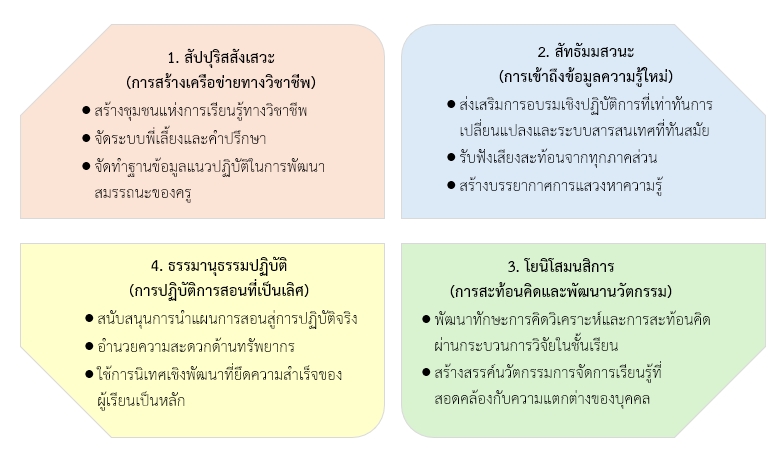
This academic article aims to present the enhancement of teachers’ learning management competency for developing 21st-century learners based on the four Vuḍḍhi-dhamma principles. Due to rapid changes in the modern world, educational management must shift from merely transmitting content knowledge to developing essential life skills. To successfully elevate educational quality, it is essential to develop six areas of teachers’ competencies: learning management; learner development; classroom management; analysis, synthesis, and research for learner development; teacher leadership; and building relationships and collaboration with the community. This development ensures that teachers can effectively organize active learning activities that respond to learners’ 21st-century skills (the 3Rs and 8Cs). Integrating the four Vuḍḍhi-dhamma principles comprising Sappurisasamseva, Saddhammassavana, Yonisomanasikara, and Dhammanudhammapatipatti as a foundation for competency enhancement enables teachers to establish a process of seeking knowledge from good friends (Kalyanamitta). Furthermore, it fosters attentive listening and critical filtering of information, logical and analytical reflection, and the ability to apply knowledge to instructional practices that align with learners’ contexts and real-life situations. The enhancement of teachers’ learning management competency encompasses building professional networks, accessing new knowledge, engaging in reflection and innovation development, and demonstrating excellent teaching practices. Ultimately, this approach cultivates the intellectual and ethical stability of Thai teachers, directly contributing to the sustainable development of learners who possess desirable characteristics and are well-prepared to face future challenges.
Article Details
References
กระทรวงศึกษาธิการ. (2542). พระราชบัญญัติการศึกษาแห่งชาติ พ.ศ. 2542. กรุงเทพมหานคร: พริกหวานกราฟฟิค.
พระธรรมปิฎก (ป. อ. ปยุตฺโต). (2546). พจนานุกรมพุทธศาสน์ ฉบับประมวลธรรม. กรุงเทพมหานคร: เอส.อาร์. พริ้นติ้ง แมส โปรดักส์.
วิจารณ์ พานิช. (2555). วิถีสร้างการเรียนรู้เพื่อศิษย์ ในศตวรรษที่ 21. กรุงเทพมหานคร: มูลนิธิสดศรี-สฤษดิ์วงศ์.
สำนักงานคณะกรรมการการศึกษาขั้นพื้นฐาน. (2553). คู่มือการประเมินสมรรถนะครู สำนักงานคณะกรรมการการศึกษาขั้นพื้นฐาน. กรุงเทพมหานคร: กระทรวงศึกษาธิการ.
สำนักงานเลขาธิการสภาการศึกษา. (2560). แผนการศึกษาแห่งชาติ พ.ศ. 2560 - 2579. กรุงเทพมหานคร: พริกหวานกราฟฟิค.
สำนักงานเลขาธิการสภาการศึกษา. (2562). แนวทางการพัฒนาสมรรถนะผู้เรียนระดับการศึกษาขั้นพื้นฐาน. กรุงเทพมหานคร: 21 เซ็นจูรี่.
Barber, M., & Mourshed, M. (2007). How the world’s best-performing school systems come out on top. London: McKinsey & Company.
Boyatzis, R. E. (1982). The competent manager: A model for effective performance. New York: John Wiley & Sons.
McClelland, D. C. (1973). Testing for competence rather than for “intelligence”. American Psychologist, 28(1), 1-14.
Office of the Education Council. (2562). The study of competency-based education system. Bangkok: Prikwan Graphic.
Spencer, L. M., & Spencer, S. M. (1993). Competence at work: Models for superior performance. New York: John Wiley & Sons.
Trilling, B., & Fadel, C. (2009). 21st century skills: Learning for life in our times. John Wiley & Sons.
