CRISIS LEADERSHIP FOR MANAGING CHALLENGES IN EDUCATIONAL INSTITUTIONS WITH AN APPROACH THROUGH THE PRINCIPLES OF BRAHMAVIHĀRA 4
Article Sidebar
Main Article Content
Abstract
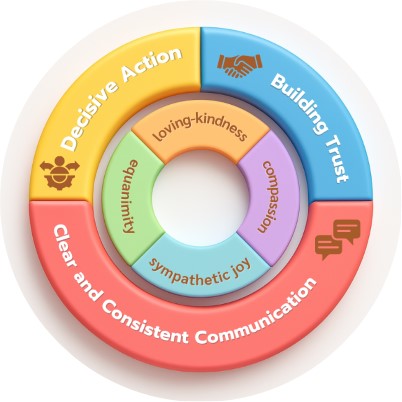
This academic article aims to analyze and propose a conceptual framework integrating the Brahmavihāra 4 (the Four Sublime States) with Crisis Leadership for educational administrators managing contemporary challenges. The synthesis of knowledge reveals that crisis leadership consists of three core components: Clear and Consistent Communication, Decisive Action, and Building Trust, which constitute essential external behaviors. The principles of Brahmavihāra 4-Metta (loving-kindness), Karuna (compassion), Mudita (sympathetic joy), and Upekkha (equanimity) -can serve as the foundational internal states that drive these behaviors with efficacy and humanity. Specifically, Metta builds preventative relationships and trust; Karuna fuels decisive, compassionate action; Mudita sustains morale during crises; and Upekkha provides an anchor of fairness and wisdom in decision-making. The proposed integrated framework highlights a path for developing educational leaders who balance the science of management and the art of human connection, thereby fostering educational institutions as resilient learning communities capable of recovering from any crisis.
Article Details
References
กรมสุขภาพจิต. (2564). รายงานสถานการณ์ผลกระทบด้านสุขภาพจิตจากสถานการณ์ระบาดของโรคโควิด-19 ในบุคลากรทางการศึกษา. นนทบุรี: กระทรวงสาธารณสุข.
มหาจุฬาลงกรณราชวิทยาลัย. (2539). พระไตรปิฎกภาษาไทยฉบับมหาจุฬาลงกรณราชวิทยาลัย. กรุงเทพมหานคร: โรงพิมพ์มหาจุฬาลงกรณราชวิทยาลัย.
สมชาติ กิจยรรยง. (2562). อิทธิพลของภาวะผู้นำตามหลักพรหมวิหาร 4 ที่ส่งผลต่อความผูกพันต่อองค์กรของพนักงาน. วารสารการจัดการสมัยใหม่, 17(1), 103-116.
Boin, A., 't Hart, P., & McConnell, A. (2008). Crisis management: A critical perspective. Journal of Contingencies and Crisis Management, 16(4), 182-191.
Boin, A., & 't Hart, P. (2022). Public leadership in times of crisis: A framework for analysis. Public Administration Review, 82(4), 653-659.
Coombs, W. T. (2019). Ongoing crisis communication: Planning, managing, and responding. 5th ed. SAGE Publications.
Fiske, S. T., Cuddy, A. J. C., & Glick, P. (2007). Universal dimensions of social cognition: Warmth and competence. Trends in Cognitive Sciences, 11(2), 77–83.
James, E. H., & Wooten, L. P. (2010). Leading under pressure: From surviving to thriving before, during, and after a crisis. Routledge.
Klein, G. A. (1998). Sources of power: How people make decisions. MIT Press.
Smith, J. A., & Johnson, R. B. (2023). Navigating the infodemic: School leadership strategies for combating misinformation. Educational Leadership Press.
Worline, M. C., & Dutton, J. E. (2017). Awakening compassion at work: The quiet power that elevates people and organizations. Berrett-Koehler Publishers.
