“PUTHAWĪ KASINA” THE METHOD OF GUIDING THE MIND INTO MEDITATION
Article Sidebar
Main Article Content
Abstract
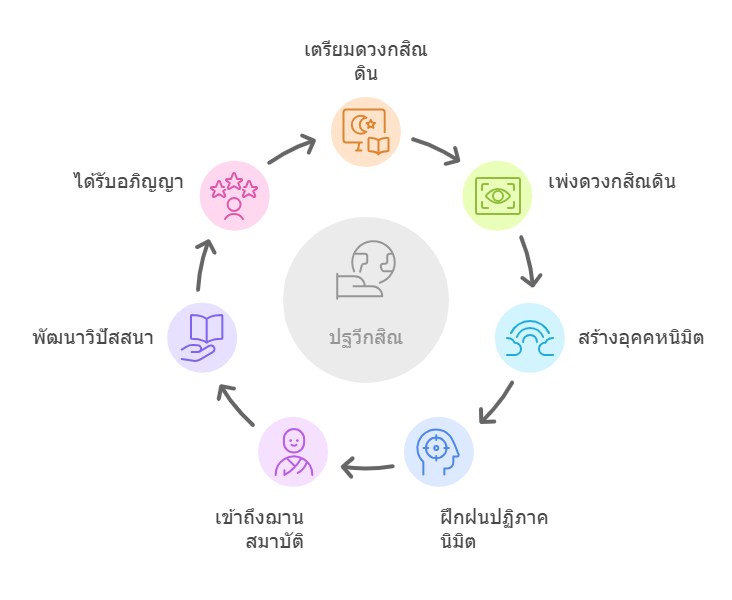
This article presents Puthawī Kasina, a form of Samatha (tranquility) meditation. It is classified as the first of the ten kasinas and one of the forty traditional meditation subjects. The practice aims to train the mind to achieve tranquility and stability, cultivating deep concentration by using the earth element as a tool for focused gazing to unify the mind. This practice is intended to overcome the Five Hindrances and attain the states of Jhānic absorption (jhāna), which serves as a firm foundation for the development of wisdom (Vipassanā), aiming for the ultimate goal of liberation. The process begins with gazing at a meticulously prepared earth disc, the parikamma-nimitta (preparatory sign), until a memorized image, the uggaha-nimitta (learning sign), can be recalled even with the eyes closed. Subsequently, the practitioner continues to cultivate this mental sign until it transforms into a purified, luminous, and malleable image, the paṭibhāga-nimitta (counterpart sign). Sustained focus on this counterpart sign leads to the attainment of the various stages of jhāna. The benefits of practicing Puthawī Kasina include a mind that becomes powerful, stable, and unwavering like the earth itself. It serves as a crucial foundation to build upon for the development of Vipassanā meditation. Furthermore, practitioners who achieve a high level of mastery may develop supernormal abilities (Abhiññā) related to the earth element, such as manifesting solid or soft ground at will. Thus, Puthawī Kasina is a truly profound and systematic method for training the mind for the development of both concentration and wisdom.
Article Details
References
มหาจุฬาลงกรณราชวิทยาลัย. (2539). พระไตรปิฎกภาษาไทยฉบับมหาจุฬาลงกรณราชวิทยาลัย. กรุงเทพมหานคร: โรงพิมพ์มหาจุฬาลงกรณราชวิทยาลัย.
มหาจุฬาลงกรณราชวิทยาลัย. (2535). พระไตรปิฎกภาษาบาลีฉบับมหาจุฬาเตปิฎก 2500. กรุงเทพมหานคร: โรงพิมพ์มหาจุฬาลงกรณราชวิทยาลัย.
ธนิต อยู่โพธิ์. (2531). วิปัสสนานิยม. กรุงเทพมหานคร: กรมศิลปากร.
พระอุปติสสะ. (2538). วิมุตติมรรค. แปลโดย พระราชวรมุนี (ประยูร ธมฺมจิตฺโต) และคณะ. กรุงเทพมหานคร: ศยาม.
พระธรรมปิฎก. (2533). พจนานุกรมพุทธศาสน์ ฉบับประมวลศัพท์. กรุงเทพมหานคร: โรงพิมพ์มหาจุฬาลงกรณราชวิทยาลัย.
จรูญ วรรณกสิณานนท์. (2547). กสิณ กรรมฐานที่ทรงพลัง. กรุงเทพมหานคร: หจก.ไตรรงค์การพิมพ์.
พระธรรมปิฎก. (2538). พจนานุกรมพุทธศาสน์ ฉบับประมวลธรรม. กรุงเทพมหานคร:โรงพิมพ์มหาจุฬาลงกรณราชวิทยาลัย.
อภิราษฎ์ ปรีชาจารย์. (2546). ศึกษาวิเคราะห์ สมถยานิกะ ในการปฏิบัติกรรมฐานอันมีกสิณ 10 เป็นอารมณ์. วิทยานิพนธ์พุทธศาสตรมหาบัณฑิต. มหาวิทยาลัยมหาจุฬาลงกรณราชวิทยาลัย.
พระพุทธัตตเถระ. (2549). อภิธัมมาวตาร. แปลโดย พระคันธสาราภิวงศ์. กรุงเทพมหานคร: ห้างหุ้นส่วนจำกัด.
