
แนวทางการบริหารสถานศึกษา เพื่อขับเคลื่อนหลักสูตรฐานสมรรถนะของโรงเรียนมัธยมศึกษานำร่องในพื้นที่นวัตกรรมการศึกษาจังหวัดจันทบุรี
คำสำคัญ:
การบริหารสถานศึกษา, หลักสูตรฐานสมรรถนะ, พื้นที่นวัตกรรมการศึกษาบทคัดย่อ
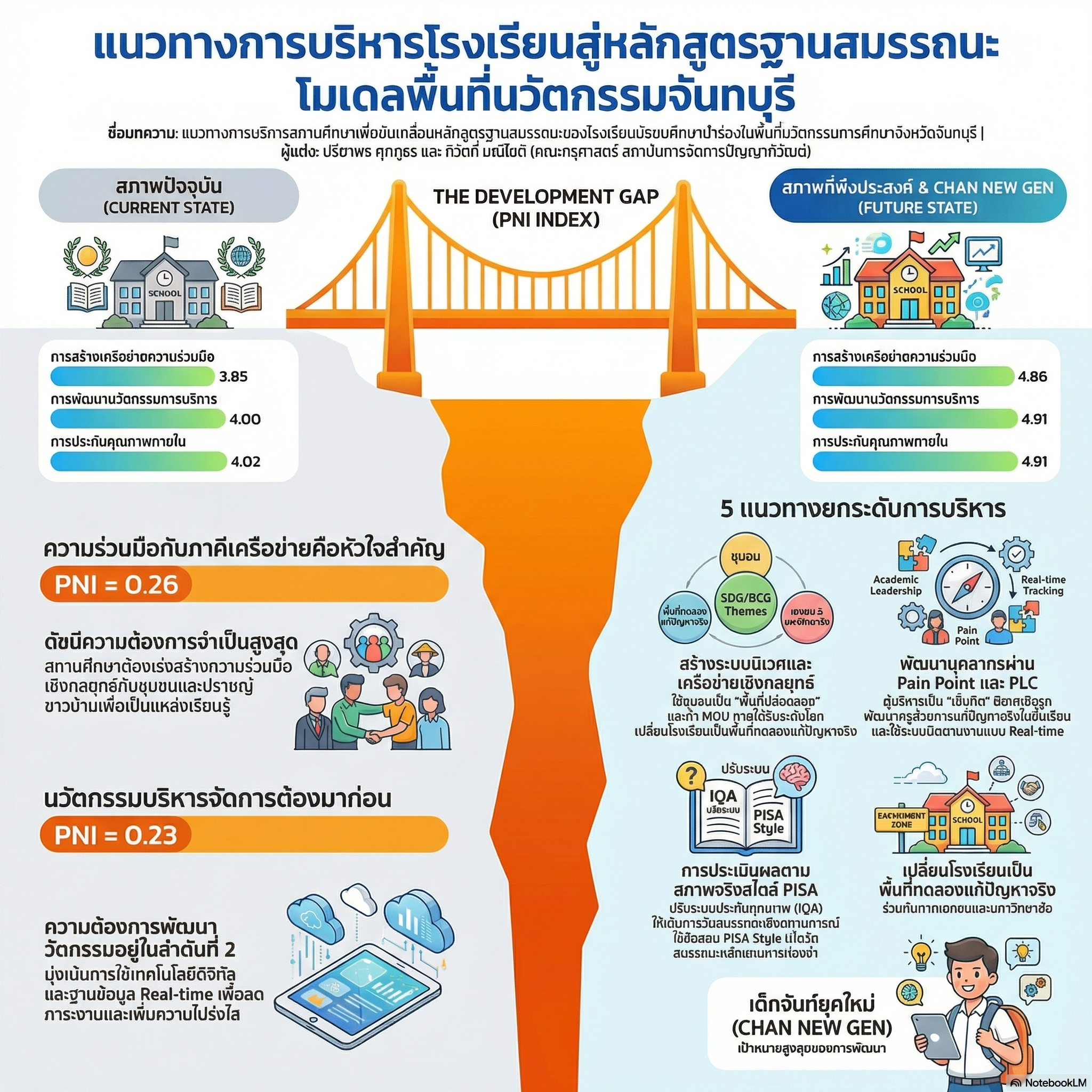
การวิจัยนี้มีวัตถุประสงค์เพื่อ 1) ศึกษาสภาพปัจจุบัน สภาพที่พึงประสงค์และวิเคราะห์ลำดับความต้องการจำเป็น และ 2) เสนอแนวทางการบริหารสถานศึกษาเพื่อขับเคลื่อนหลักสูตรฐานสมรรถนะของโรงเรียนมัธยมศึกษานำร่องในพื้นที่นวัตกรรมการศึกษาจังหวัดจันทบุรี ใช้ระเบียบวิธีวิจัยแบบผสมผสาน แบ่งเป็น ระยะที่ 1 การวิจัยเชิงปริมาณ กลุ่มตัวอย่างคือครู 285 คน โดยการสุ่มแบบแบ่งชั้น เครื่องมือคือแบบสอบถาม วิเคราะห์ข้อมูลด้วยค่าเฉลี่ย ส่วนเบี่ยงเบนมาตรฐาน และดัชนี PNImodified ระยะที่ 2 การวิจัยเชิงคุณภาพ ประกอบด้วยผู้ให้ข้อมูลสำคัญจำนวน 5 คน เลือกแบบเจาะจง คืออาจารย์มหาวิทยาลัย ศึกษานิเทศก์ ผู้บริหาร และครู เก็บข้อมูลด้วยการสัมภาษณ์เชิงลึกและวิเคราะห์ข้อมูลด้วยการวิเคราะห์เนื้อหา ผลการวิจัยพบว่า: 1) สภาพปัจจุบันของการบริหารสถานศึกษาเพื่อขับเคลื่อนหลักสูตรฐานสมรรถนะอยู่ในระดับมาก ขณะที่สภาพที่พึงประสงค์อยู่ในระดับมากที่สุด และลำดับความต้องการจำเป็นที่มีค่าดัชนีสูงสุด 2 ลำดับแรก คือ ด้านการสร้างเครือข่ายความร่วมมือกับผู้เกี่ยวข้อง รองลงมาคือ ด้านการพัฒนานวัตกรรมการบริหารจัดการ 2) แนวทางการบริหารสถานศึกษาเพื่อขับเคลื่อนหลักสูตรฐานสมรรถนะประกอบด้วย 5 ด้าน ได้แก่ (1) ด้านการจัดชั้นเรียนและสภาพแวดล้อมภายในสถานศึกษาที่เอื้อต่อการเรียนรู้ : ออกแบบห้องเรียนยืดหยุ่นรองรับ Active Learning และเทคโนโลยีทันสมัย (2) ด้านการพัฒนาผู้บริหาร ครู และบุคลากรในสถานศึกษา : ใช้กลไก PLC และพัฒนาครูผ่านปัญหาจริง (Pain point) (3) ด้านการสร้างเครือข่ายความร่วมมือกับผู้เกี่ยวข้อง : สร้างความร่วมมือเชิงกลยุทธ์และจัดทำ MOU กับชุมชน (4) ด้านการประกันคุณภาพการศึกษาภายในสถานศึกษา : พัฒนาระบบประเมินตามสภาพจริงอิงฐานสมรรถนะโดยใช้ข้อสอบ PISA Style และ (5) ด้านการพัฒนานวัตกรรมการบริหารจัดการศึกษา : ใช้เทคโนโลยีดิจิทัลและฐานข้อมูลสารสนเทศ Real – Time สร้างนวัตกรรมที่ตอบโจทย์บริบทพื้นที่นวัตกรรมการศึกษาจังหวัดจันทบุรี
เอกสารอ้างอิง
กระทรวงศึกษาธิการ. (2565). กรอบหลักสูตรแกนกลางการศึกษาขั้นพื้นฐาน พุทธศักราช 2564. สำนักงานคณะกรรมการการศึกษาขั้นพื้นฐาน กระทรวงศึกษาธิการ.
คณะอนุกรรมการด้านวิชาการในคณะกรรมการขับเคลื่อนพื้นที่นวัตกรรมการศึกษา. (2566). คู่มือการจัดทำหลักสูตรสถานศึกษาฐานสมรรถนะ. มูลนิธิสยามกัมมาจล.
นงลักษณ์ วิรัชชัย และสุวิมล ว่องวาณิช. (2550). การวิจัยและการประเมินผลการเรียนรู้ตามแนวทฤษฎี. สำนักพิมพ์จุฬาลงกรณ์มหาวิทยาลัย.
พัชรี ทองคำสุก และอัญชลี ธรรมวิธีกุล. (2565). การบริหารสถานศึกษาในยุควิถีใหม่เพื่อขับเคลื่อนหลักสูตรสถานศึกษาฐานสมรรถนะ. วารสารวิชาการศึกษา, 3(2), 45-58.
สำนักงานคณะกรรมการการศึกษาขั้นพื้นฐาน. (2566). รายงานสรุปผลการนำร่องใช้หลักสูตรสถานศึกษาฐานสมรรถนะในพื้นที่นวัตกรรมการศึกษา. กระทรวงศึกษาธิการ.
Barrett, P., Davies, F., Zhang, Y., & Barrett, L. (2015). The impact of classroom design on pupils' learning: Final results of a holistic, multi-level analysis. Building and Environment, 89, 118-133. https://doi.org/10.1016/j.buildenv.2015.02.013
Bea, S., & Jin, G. (2024). Process-based assessment as a key approach to competency-based curriculum in higher education. Assessment & Evaluation in Higher Education, 49(2), 156-172.
Byers, T., Mahat, M., Liu, K., Knock, A., & Imms, W. (2018). A systematic review of the effects of learning environments on student learning outcomes. University of Melbourne.
Carracedo, J. P., Alvarez, J. L., Noain, M. T. P., & Ramos, A. S. (2018). Competency maps: An effective model to integrate professional competencies across the curriculum. Journal of Computer Assisted Learning, 34(5), 572-585.
Dadheech, A. (2018). Academic leadership in school management: A visionary approach. Journal of Educational Management, 12(4), 210-225.
Gervais, J. (2016). The operational definition of competency‐based education. The Journal of Competency-Based Education, 1(2), 98-106. https://doi.org/10.1002/cbe2.1011
Hu, W. C., Chang, S. C., & Tseng, C. H. (2016). Competency-based innovative curriculum model and its impact on student development. International Journal of Information and Education Technology, 6(8), 612-617.
Iwu, C. G., Gwija, S. A., Benedict, H. O., & Tengeh, R. K. (2021). Entrepreneurship education, curriculum and lecturer-competency as antecedents of student entrepreneurial intention. The International Journal of Management Education, 19(1), Article 100431. https://doi.org/10.1016/j.ijme.2019.03.007
Kang, Y. (2024). Supporting instructional systems for competency-based curriculum design: Focusing on the relationship between competencies and learning objectives. Journal of Curriculum and Evaluation, 27(1), 45-68.
Kim, S. (2021). Competency-based curriculum reform for global citizenship education. Journal of Global Education and Research, 5(1), 12-28.
Krejcie, R. V., & Morgan, D. W. (1970). Determining sample size for research activities. Educational and Psychological Measurement, 30(3), 607-610. https://doi.org/10.1177/001316447003000308
Krishnasamy, M. N., Matore, M. E. E. M., & Khairani, A. Z. (2022). The development of teacher professional identity in competency-based curriculum: A systematic review. Educational Research Review, 36, Article 100450.
McClelland, D. C. (1973). Testing for competence rather than for "intelligence." American Psychologist, 28(1), 1–14. https://doi.org/10.1037/h0034092
Otieno, A. C. (2020). Digital literacy integration in competency-based curriculum: Preparing learners for the digital age. Global Journal of Social Sciences, 19, 1-12.
Shahid, K., Usman, A., Afzal, M., & Gilani, S. A. (2022). Knowledge, attitude and practice towards competency-based education and assessment among nursing faculty in Pakistan. BMC Nursing, 21(1), Article 311.
Somprach, K., Tang, K. W., & Popunsak, P. (2019). Professional Learning Community (PLC) as a tool for teacher professional development in Thailand. International Journal of Higher Education, 8(5), 18-29.
Suthammanon, S., Pholkerd, P., & Kittisupamongkol, P. (2024). Strategic career pathway design through competency-based approach. Journal of Vocational Education, 15(1), 34-48.
UNESCO-IBE. (2019). Competency-based curriculum. UNESCO International Bureau of Education.
Van Melle, E., Hall, A. K., Karwowska, A., Caverzagie, K., Reiter, H., Snell, L., Sucharew, H., Thoma, B., & Iobst, W. (2019). A core components framework for evaluating implementation of competency-based medical education. Academic Medicine, 94(7), 1002-1009. https://doi.org/10.1097/acm.0000000000002743
Voronov, A. A., & Vorobyev, S. D. (2023). Development of a competency-based curriculum by the example of Russia. Education and Information Technologies, 28, 1295-1309.
World Bank, UNESCO, & UNICEF. (2021). The state of the global education crisis: A path to recovery. Authors.
ดาวน์โหลด
เผยแพร่แล้ว
รูปแบบการอ้างอิง
ฉบับ
ประเภทบทความ
หมวดหมู่
สัญญาอนุญาต
ลิขสิทธิ์ (c) 2026 คณะศึกษาศาสตร์ มหาวิทยาลัยศรีนครินทรวิโรฒ

อนุญาตภายใต้เงื่อนไข Creative Commons Attribution-NonCommercial-NoDerivatives 4.0 International License.


