
GUIDELINES FOR SCHOOL MANAGEMENT TO DRIVE THE COMPETENCY – BASED CURRICULUM IN PILOT SECONDARY SCHOOLS IN THE EDUCATIONAL INNOVATION AREA OF CHANTHABURI PROVINCE
Keywords:
School Management, Competency-Based Curriculum, Education Innovation ZoneAbstract
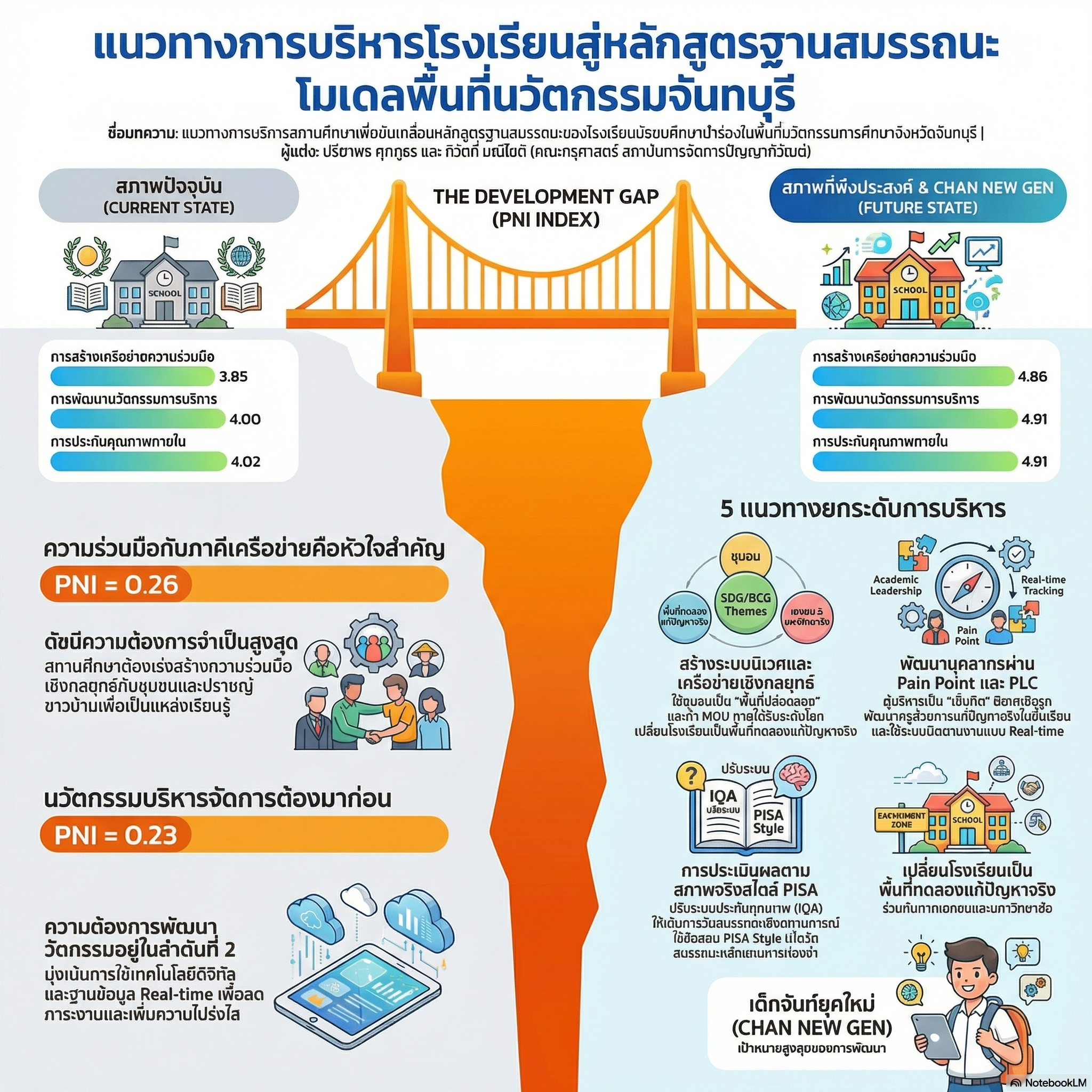
The objectives of this mixed-methods research were: 1) to study the current and desirable states and analyze the priority of needs; and 2) to propose school management guidelines for driving the competency-based curriculum in pilot secondary schools within the Chanthaburi Educational Innovation Area, The study was conducted in two phases. Phase 1 involved quantitative research with a sample of 285 teachers selected through stratified random sampling. The research instrument was a questionnaire, and data were analyzed using mean, standard deviation, and the PNImodified index, Phase 2 consisted of qualitative research with 5 key informants selected through purposive sampling, including university professors, educational supervisors, school administrators, and teachers. Data were collected via in-depth interviews and analyzed using content analysis. The research findings revealed that: 1) the current state of school management for driving the competency-based curriculum was at a high level, while the desirable state was at the highest level. The top two priority needs with the highest indices were partnership networking with stakeholders, followed by the development of educational management innovation 2) The school management guidelines for driving the competency-based curriculum comprised five aspects: (1) Classroom and Learning Environment Management: designing flexible classrooms to support Active Learning and modern technology; (2) Personnel Development: utilizing Professional Learning Community (PLC) mechanisms and developing teachers through actual pain points; (3) Partnership Networking: fostering strategic collaborations and establishing MOUs with the community; (4) Internal Quality Assurance: developing authentic, competency-based assessment systems using PISA Style tests; and (5) Educational Management Innovation: utilizing digital technology and real-time information databases to create innovations that respond to the specific context of the Chanthaburi Educational Innovation Area.
References
กระทรวงศึกษาธิการ. (2565). กรอบหลักสูตรแกนกลางการศึกษาขั้นพื้นฐาน พุทธศักราช 2564. สำนักงานคณะกรรมการการศึกษาขั้นพื้นฐาน กระทรวงศึกษาธิการ.
คณะอนุกรรมการด้านวิชาการในคณะกรรมการขับเคลื่อนพื้นที่นวัตกรรมการศึกษา. (2566). คู่มือการจัดทำหลักสูตรสถานศึกษาฐานสมรรถนะ. มูลนิธิสยามกัมมาจล.
นงลักษณ์ วิรัชชัย และสุวิมล ว่องวาณิช. (2550). การวิจัยและการประเมินผลการเรียนรู้ตามแนวทฤษฎี. สำนักพิมพ์จุฬาลงกรณ์มหาวิทยาลัย.
พัชรี ทองคำสุก และอัญชลี ธรรมวิธีกุล. (2565). การบริหารสถานศึกษาในยุควิถีใหม่เพื่อขับเคลื่อนหลักสูตรสถานศึกษาฐานสมรรถนะ. วารสารวิชาการศึกษา, 3(2), 45-58.
สำนักงานคณะกรรมการการศึกษาขั้นพื้นฐาน. (2566). รายงานสรุปผลการนำร่องใช้หลักสูตรสถานศึกษาฐานสมรรถนะในพื้นที่นวัตกรรมการศึกษา. กระทรวงศึกษาธิการ.
Barrett, P., Davies, F., Zhang, Y., & Barrett, L. (2015). The impact of classroom design on pupils' learning: Final results of a holistic, multi-level analysis. Building and Environment, 89, 118-133. https://doi.org/10.1016/j.buildenv.2015.02.013
Bea, S., & Jin, G. (2024). Process-based assessment as a key approach to competency-based curriculum in higher education. Assessment & Evaluation in Higher Education, 49(2), 156-172.
Byers, T., Mahat, M., Liu, K., Knock, A., & Imms, W. (2018). A systematic review of the effects of learning environments on student learning outcomes. University of Melbourne.
Carracedo, J. P., Alvarez, J. L., Noain, M. T. P., & Ramos, A. S. (2018). Competency maps: An effective model to integrate professional competencies across the curriculum. Journal of Computer Assisted Learning, 34(5), 572-585.
Dadheech, A. (2018). Academic leadership in school management: A visionary approach. Journal of Educational Management, 12(4), 210-225.
Gervais, J. (2016). The operational definition of competency‐based education. The Journal of Competency-Based Education, 1(2), 98-106. https://doi.org/10.1002/cbe2.1011
Hu, W. C., Chang, S. C., & Tseng, C. H. (2016). Competency-based innovative curriculum model and its impact on student development. International Journal of Information and Education Technology, 6(8), 612-617.
Iwu, C. G., Gwija, S. A., Benedict, H. O., & Tengeh, R. K. (2021). Entrepreneurship education, curriculum and lecturer-competency as antecedents of student entrepreneurial intention. The International Journal of Management Education, 19(1), Article 100431. https://doi.org/10.1016/j.ijme.2019.03.007
Kang, Y. (2024). Supporting instructional systems for competency-based curriculum design: Focusing on the relationship between competencies and learning objectives. Journal of Curriculum and Evaluation, 27(1), 45-68.
Kim, S. (2021). Competency-based curriculum reform for global citizenship education. Journal of Global Education and Research, 5(1), 12-28.
Krejcie, R. V., & Morgan, D. W. (1970). Determining sample size for research activities. Educational and Psychological Measurement, 30(3), 607-610. https://doi.org/10.1177/001316447003000308
Krishnasamy, M. N., Matore, M. E. E. M., & Khairani, A. Z. (2022). The development of teacher professional identity in competency-based curriculum: A systematic review. Educational Research Review, 36, Article 100450.
McClelland, D. C. (1973). Testing for competence rather than for "intelligence." American Psychologist, 28(1), 1–14. https://doi.org/10.1037/h0034092
Otieno, A. C. (2020). Digital literacy integration in competency-based curriculum: Preparing learners for the digital age. Global Journal of Social Sciences, 19, 1-12.
Shahid, K., Usman, A., Afzal, M., & Gilani, S. A. (2022). Knowledge, attitude and practice towards competency-based education and assessment among nursing faculty in Pakistan. BMC Nursing, 21(1), Article 311.
Somprach, K., Tang, K. W., & Popunsak, P. (2019). Professional Learning Community (PLC) as a tool for teacher professional development in Thailand. International Journal of Higher Education, 8(5), 18-29.
Suthammanon, S., Pholkerd, P., & Kittisupamongkol, P. (2024). Strategic career pathway design through competency-based approach. Journal of Vocational Education, 15(1), 34-48.
UNESCO-IBE. (2019). Competency-based curriculum. UNESCO International Bureau of Education.
Van Melle, E., Hall, A. K., Karwowska, A., Caverzagie, K., Reiter, H., Snell, L., Sucharew, H., Thoma, B., & Iobst, W. (2019). A core components framework for evaluating implementation of competency-based medical education. Academic Medicine, 94(7), 1002-1009. https://doi.org/10.1097/acm.0000000000002743
Voronov, A. A., & Vorobyev, S. D. (2023). Development of a competency-based curriculum by the example of Russia. Education and Information Technologies, 28, 1295-1309.
World Bank, UNESCO, & UNICEF. (2021). The state of the global education crisis: A path to recovery. Authors.
Downloads
Published
How to Cite
Issue
Section
Categories
License
Copyright (c) 2026 Faculty of Education, Srinakharinwirot university

This work is licensed under a Creative Commons Attribution-NonCommercial-NoDerivatives 4.0 International License.


