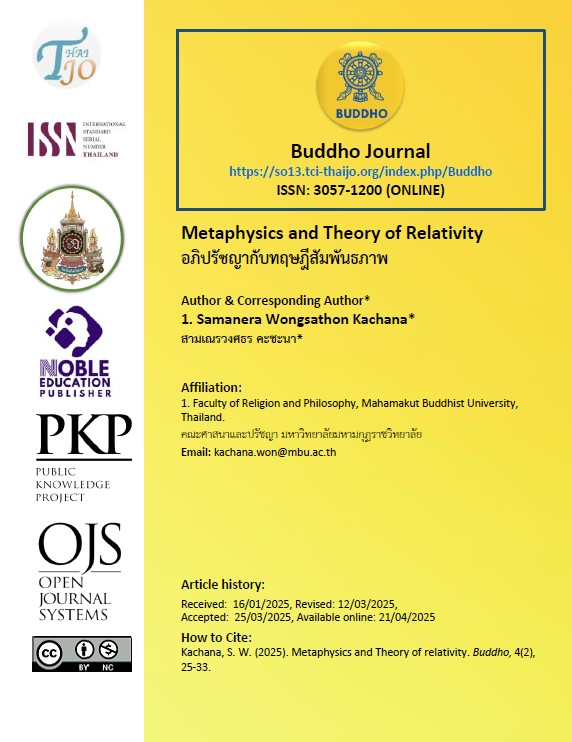
Metaphysics and Theory of Relativity
Keywords:
Metaphysics, Theory of RelativityAbstract
The theory of relativity, developed by Albert Einstein in the early 20th century, challenged traditional understandings of time and space by proposing that time and space are not absolute but are relative to reference frames and the mass-energy conditions in the universe. Philosophical doubts regarding the nature of time and spacetime have sparked debates in multiple directions, especially concerning the reality of time, which may either be merely an experiential structure of human perception or something
References
Allori, V. (2023). Scientific realism and the reality of the wave function. Cambridge University Press.
Dainton, B. (2010). Time and Space (2nd ed.). Acumen.
Einstein, A. (1916). The Foundation of the General Theory of Relativity. Annalen der Physik.
Fraser, J. D., & Vickers, P. (2021). Scientific realism and the quantum. Oxford University Press.
Huggett, N., & Wüthrich, C. (2022). The Emergent Spacetime Perspective. In D. Lehmkuhl, G. Fletcher, & C. Smeenk (Eds.), The Routledge Companion to the Philosophy of Physics (pp. 675–688). Routledge.
Loux, M. J., & Crisp, T. M. (2023). Metaphysics: A contemporary introduction (4th ed.). Routledge.
Newton, I. (1687). Philosophiæ Naturalis Principia Mathematica.
Petkov, V. (2021). Relativity and the nature of spacetime (4th ed.). Springer.
Putnam, H. (1967). Time and Physical Geometry. The Journal of Philosophy, 64(8), 240–247. https://doi.org/10.2307/2024493
Rindler, W. (2006). Relativity: Special, general, and cosmological (2nd ed.). Oxford University Press.
Rovelli, C. (2021). Helgoland: Making Sense of the Quantum Revolution. Riverhead Books.
Shields, C. (2021). Aristotle. In E. N. Zalta (Ed.), The Stanford Encyclopedia of Philosophy (Fall 2021 Edition). https://plato.stanford.edu/entries/aristotle/
Skow, B. (2015). Objective becoming. Oxford University Press.
Additional Files
Published
How to Cite
Issue
Section
License
Copyright (c) 2025 Buddho

This work is licensed under a Creative Commons Attribution-NonCommercial-NoDerivatives 4.0 International License.