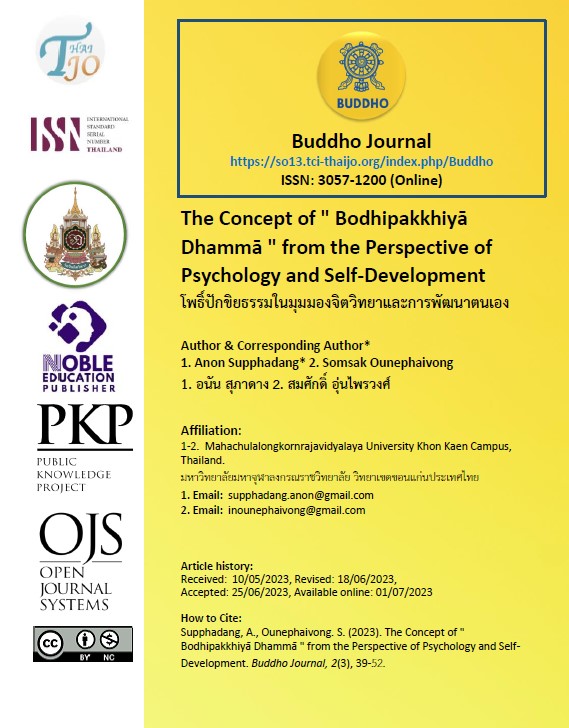
โพธิ์ปักขิยธรรมในมุมมองจิตวิทยาและการพัฒนาตนเอง
คำสำคัญ:
โพธิ์ปักขิยธรรม, จิตวิทยา, การพัฒนาตนเองบทคัดย่อ
โพธิ์ปักขิยธรรม หรือ " Bodhipakkhiyā Dhammā " เป็นหลักธรรมในพระพุทธศาสนาที่กล่าวถึงการฝึกฝนและพัฒนาจิตใจเพื่อให้เกิดความหลุดพ้นจากความทุกข์ยาก โดยเน้นการฝึกจิตที่มีความสม่ำเสมอและมีระเบียบวินัย ในบทความนี้จะนำเสนอการตีความ "โพธิ์ปักขิยธรรม" ผ่านมุมมองของจิตวิทยาและการพัฒนาตนเอง โดยการเชื่อมโยงหลักการดังกล่าวกับทฤษฎีและแนวทางในการพัฒนาศักยภาพของบุคคลในสังคมยุคใหม่ มุมมองจิตวิทยาจะนำเสนอการพัฒนาอารมณ์ ความคิด และพฤติกรรมผ่านการฝึกฝนและการเรียนรู้ ในขณะที่การพัฒนาตนเองจะเชื่อมโยงกับการเติบโตอย่างต่อเนื่องและการเข้าถึงศักยภาพสูงสุดของบุคคล นอกจากนี้ยังพิจารณาถึงความสำคัญของการนำ "โพธิ์ปักขิยธรรม" มาใช้ในชีวิตประจำวันเพื่อลดความเครียดและเสริมสร้างความเป็นสุขที่ยั่งยืน
เอกสารอ้างอิง
ขุนเขา, จ. (2553). การพัฒนาตนเองผ่านอิทธิบาท 4 (พิมพ์ครั้งที่ 2). กรุงเทพฯ: สำนักพิมพ์มนุษย์.
บุญภาค, ม. (2566). การพัฒนาจิตใจผ่านการฝึกสติในชีวิตประจำวัน. กรุงเทพฯ: สำนักพิมพ์ธรรมสาร. เครือวัลย์, ก. (2564). แนวทางการฝึกสติในการพัฒนาตนเอง. เชียงใหม่: สำนักพิมพ์สมาธิ. นิลกาภิ, จ. (2565). การพิจารณาเวทนาและผลต่อการพัฒนาตนเอง. นครราชสีมา: สำนักพิมพ์ธัมมะ. วิษณุ, ก. (2564). การใช้ธรรมในการเผชิญปัญหาชีวิต. กรุงเทพฯ: สำนักพิมพ์ธรรมบรรณาการ.
พระพรหมคุณาภรณ์. (2551). แนวทางการพัฒนาจิตใจเพื่อความสงบและสันติสุข. กรุงเทพฯ: สำนักพิมพ์มหาจุฬาลงกรณราชวิทยาลัย.
พระไพศาล วิสาโล. (2553). การประยุกต์ใช้โพธิ์ปักขิยธรรมในชีวิตประจำวัน. กรุงเทพฯ: ธรรมสภา.
วัดพระธรรมกาย. (2559). วิธีการฝึกจิตและการพัฒนาคุณธรรม. ปทุมธานี: วัดพระธรรมกาย.
พรหมวิสุทธิ์, ก. (2557). การพัฒนาคุณภาพชีวิตด้วยอิทธิบาท 4 (พิมพ์ครั้งที่ 1). เชียงใหม่: สำนักพิมพ์เสมอ.
สุรพล, ศ. (2555). การฝึกฝนจิตใจเพื่อพัฒนาตนเอง. กรุงเทพฯ: สำนักพิมพ์พลังคิด.
ธนกร, จ. (2559). ปัญญาและการพัฒนาตนเองตามหลักอิทธิบาท 4. กรุงเทพฯ: สำนักพิมพ์วิชาการ.
Baer, R. A. (2003). Mindfulness training as a clinical intervention: A conceptual and empirical review. Clinical Psychology: Science and Practice, 10(2), 125-143.
Beck, J. S. (2011). Cognitive behavior therapy: Basics and beyond. Guilford Press.
Bhikkhu Bodhi. (2000). The connected discourses of the Buddha: A translation of the Samyutta Nikaya. Wisdom Publications.
Bodhi, B. (2000). The Noble Eightfold Path: Way to the End of Suffering. Buddhist Publication Society.
Bodhi, B. (2005). The Noble Eightfold Path: Way to the End of Suffering. Buddhist Publication Society.
Brown, K. W., & Ryan, R. M. (2003). The benefits of being present: Mindfulness and its role in psychological well-being. Journal of Personality and Social Psychology, 84(4), 822–848.
Csikszentmihalyi, M. (1990). Flow: The psychology of optimal experience. Harper & Row.
Deci, E. L., & Ryan, R. M. (2000). The "what" and "why" of goal pursuits: Human needs and the self-determination of behavior. Psychological Inquiry, 11(4), 227-268.
Goleman, D. (1995). Emotional intelligence: Why it can matter more than IQ. Bantam Books.
Goldstein, J. (2002). One Dharma: The Emerging Western Buddhism. HarperCollins.
Gethin, R. (1998). The Foundations of Buddhism. Oxford University Press.
Hayes, S. C., Strosahl, K. D., & Wilson, K. G. (1999). Acceptance and commitment therapy: An experiential approach to behavior change. Guilford Press.
Kabat-Zinn, J. (1990). Full Catastrophe Living: Using the Wisdom of Your Body and Mind to Face Stress, Pain, and Illness. Delacorte Press.
Kabat-Zinn, J. (1990). Full Catastrophe Living: Using the Wisdom of Your Body and Mind to Face Stress, Pain, and Illness. Delta.
Rahula, W. (1974). What the Buddha Taught. Grove Press.
Seligman, M. E. P., & Csikszentmihalyi, M. (2000). Positive psychology: An introduction. American Psychologist, 55(1), 5-14.
Sujato, B. (2010). A history of mindfulness: How mindfulness became mainstream. Wisdom Publications.
Sutton, J. (2013). The psychology of religion: An empirical approach. Wiley-Blackwell.
Tang, Y. Y., Hölzel, B. K., & Posner, M. I. (2015). The neuroscience of mindfulness meditation. Nature Reviews Neuroscience, 16(4), 213–225.
Thanissaro, B. (1997). The Noble Eightfold Path: The Way to the End of Suffering. Dhamma Dana Publications.
ไฟล์ประกอบ
เผยแพร่แล้ว
รูปแบบการอ้างอิง
ฉบับ
ประเภทบทความ
สัญญาอนุญาต
ลิขสิทธิ์ (c) 2023 ฺBuddho

อนุญาตภายใต้เงื่อนไข Creative Commons Attribution-NonCommercial-NoDerivatives 4.0 International License.