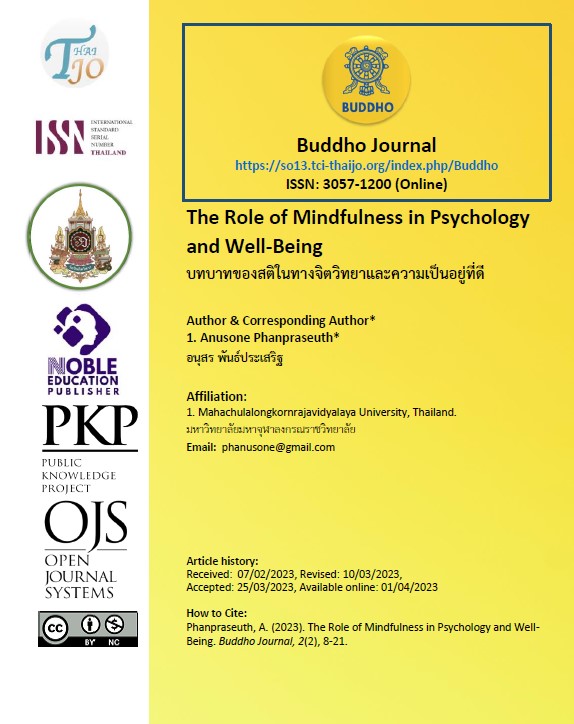
The Role of Mindfulness in Psychology and Well-Being
Keywords:
Mindfulness, Psychology, Well-beingAbstract
In recent years, there has been increasing interest in enhancing psychological well-being through various approaches, with mindfulness being one of the most widely studied. Mindfulness is the process of being consciously aware of the present moment without judgment. A growing body of research suggests that mindfulness can significantly contribute to psychological well-being by reducing stress, improving emotional regulation, and enhancing subjective well-being. This paper aims to explore the role of mindfulness in fostering psychological well-being by reviewing relevant theories, empirical studies, and underlying psychological and neurobiological mechanisms. Findings indicate that mindfulness enhances self-awareness and positive decision-making while decreasing tendencies toward negative emotional responses such as anxiety and depression. Additionally, mindfulness practice has been linked to structural and functional changes in the brain, particularly in the prefrontal cortex and amygdala, which play crucial roles in emotion regulation. Furthermore, this article discusses practical applications of mindfulness in daily life and its integration into clinical, educational, and organizational settings to improve individual and collective well-being. The findings highlight mindfulness as an effective tool for promoting mental health and overall well-being at both personal and societal levels.
References
Adler, R. B., Rosenfeld, L. B., & Proctor, R. F. (2018). Interplay: The process of interpersonal communication (14th ed.). Oxford University Press.
American Psychological Association. (2020). Stress effects on the body. Retrieved from https://www.apa.org/topics/stress/body
Baer, R. A. (2003). Mindfulness training as a clinical intervention: A conceptual and empirical review. Clinical Psychology: Science and Practice, 10(2), 125-143.
Baer, R. A., Smith, G. T., Hopkins, J., Krietemeyer, J., & Toney, L. (2006). Using self-report assessment methods to explore facets of mindfulness. Assessment, 13(1), 27-45.
Bishop, S. R., Lau, M., Shapiro, S., Carlson, L., Anderson, N. D., Carmody, J., ... & Devins, G. (2004). Mindfulness: A proposed operational definition. Clinical Psychology: Science and Practice, 11(3), 230-241.
Brown, K. W., & Ryan, R. M. (2003). The benefits of being present: Mindfulness and its role in psychological well-being. Journal of Personality and Social Psychology, 84(4), 822-848.
Brown, K. W., Ryan, R. M., & Creswell, J. D. (2007). Mindfulness: Theoretical foundations and evidence for its salutary effects. Psychological Inquiry, 18(4), 211-237.
Cohen, S., & Wills, T. A. (1985). Stress, social support, and the buffering hypothesis. Psychological Bulletin, 98(2), 310-357.
Davidson, R. J., Kabat-Zinn, J., Schumacher, J., Rosenkranz, M., Muller, D., Santorelli, S. F., ... & Sheridan, J. F. (2003). Alterations in brain and immune function produced by mindfulness meditation. Psychosomatic Medicine, 65(4), 564-570.
Davis, M. H. (1994). Empathy: A social psychological approach. Westview Press.
Gazzaley, A., & Rosen, L. D. (2016). The distracted mind: Ancient brains in a high-tech world. MIT Press.
Goleman, D. (1995). Emotional intelligence: Why it can matter more than IQ. Bantam Books.
Gu, J., Strauss, C., Bond, R., & Cavanagh, K. (2015). How do mindfulness-based interventions work? A systematic review and meta-analysis of mediation studies. Clinical Psychology Review, 37, 1-12.
Hillman, C. H., Erickson, K. I., & Kramer, A. F. (2008). Be smart, exercise your heart: Exercise effects on brain and cognition. Nature Reviews Neuroscience, 9(1), 58-65.
Hofmann, S. G., Sawyer, A. T., Witt, A. A., & Oh, D. (2010). The effect of mindfulness-based therapy on anxiety and depression: A meta-analytic review. Journal of Consulting and Clinical Psychology, 78(2), 169-183.
Hölzel, B. K., Carmody, J., Vangel, M., Congleton, C., Yerramsetti, S. M., Gard, T., & Lazar, S. W. (2011). Mindfulness practice leads to increases in regional brain gray matter density. Psychiatry Research: Neuroimaging, 191(1), 36-43.
Jha, A. P., Stanley, E. A., Kiyonaga, A., Wong, L., & Gelfand, L. (2010). Examining the protective effects of mindfulness training on working memory capacity and affective experience. Emotion, 10(1), 54-64.
Kabat-Zinn, J. (1990). Full catastrophe living: Using the wisdom of your body and mind to face stress, pain, and illness. Delta.
Kabat-Zinn, J. (1994). Wherever you go, there you are: Mindfulness meditation in everyday life. Hyperion.
Kabat-Zinn, J. (2003). Mindfulness-based interventions in context: Past, present, and future. Clinical Psychology: Science and Practice, 10(2), 144-156.
Kahneman, D. (2011). Thinking, fast and slow. Farrar, Straus and Giroux.
Keng, S. L., Smoski, M. J., & Robins, C. J. (2011). Effects of mindfulness on psychological health: A review of empirical studies. Clinical Psychology Review, 31(6), 1041-1056.
Mikulincer, M., & Shaver, P. R. (2016). Attachment in adulthood: Structure, dynamics, and change (2nd ed.). Guilford Press.
Rahim, M. A. (2011). Managing conflict in organizations (4th ed.). Transaction Publishers.
Robbins, S. P., & Judge, T. A. (2019). Organizational behavior (18th ed.). Pearson.
Salmon, P. (2001). Effects of physical exercise on anxiety, depression, and sensitivity to stress: A unifying theory. Clinical Psychology Review, 21(1), 33-61.
Smith, M. A., & Merwin, R. M. (2021). Exercise and stress resilience: An overview of neurobiological mechanisms. Current Psychiatry Reports, 23(3), 17-25.
Tang, Y. Y., Hölzel, B. K., & Posner, M. I. (2015). The neuroscience of mindfulness meditation. Nature Reviews Neuroscience, 16(4), 213-225.
Taylor, S. E. (2011). Social support: A review. In S. T. Fiske, D. T. Gilbert, & G. Lindzey (Eds.), Handbook of Social Psychology (5th ed., pp. 189-214). Wiley.
Tversky, A., & Kahneman, D. (1974). Judgment under uncertainty: Heuristics and biases. Science, 185(4157), 1124-1131.
Zeidan, F., Johnson, S. K., Diamond, B. J., David, Z., & Goolkasian, P. (2010). Mindfulness meditation improves cognition: Evidence of brief mental training. Consciousness and Cognition, 19(2), 597-605.
Additional Files
Published
How to Cite
Issue
Section
License
Copyright (c) 2023 Buddho

This work is licensed under a Creative Commons Attribution-NonCommercial-NoDerivatives 4.0 International License.