
Pha Mhi Ban Khwao Lai Dao Lom Duean Yab Dok Sabaeng: From Royal Court-Presented Sompak Rank Textiles to the Bun Duean Six Ritual Tradition
Article Sidebar
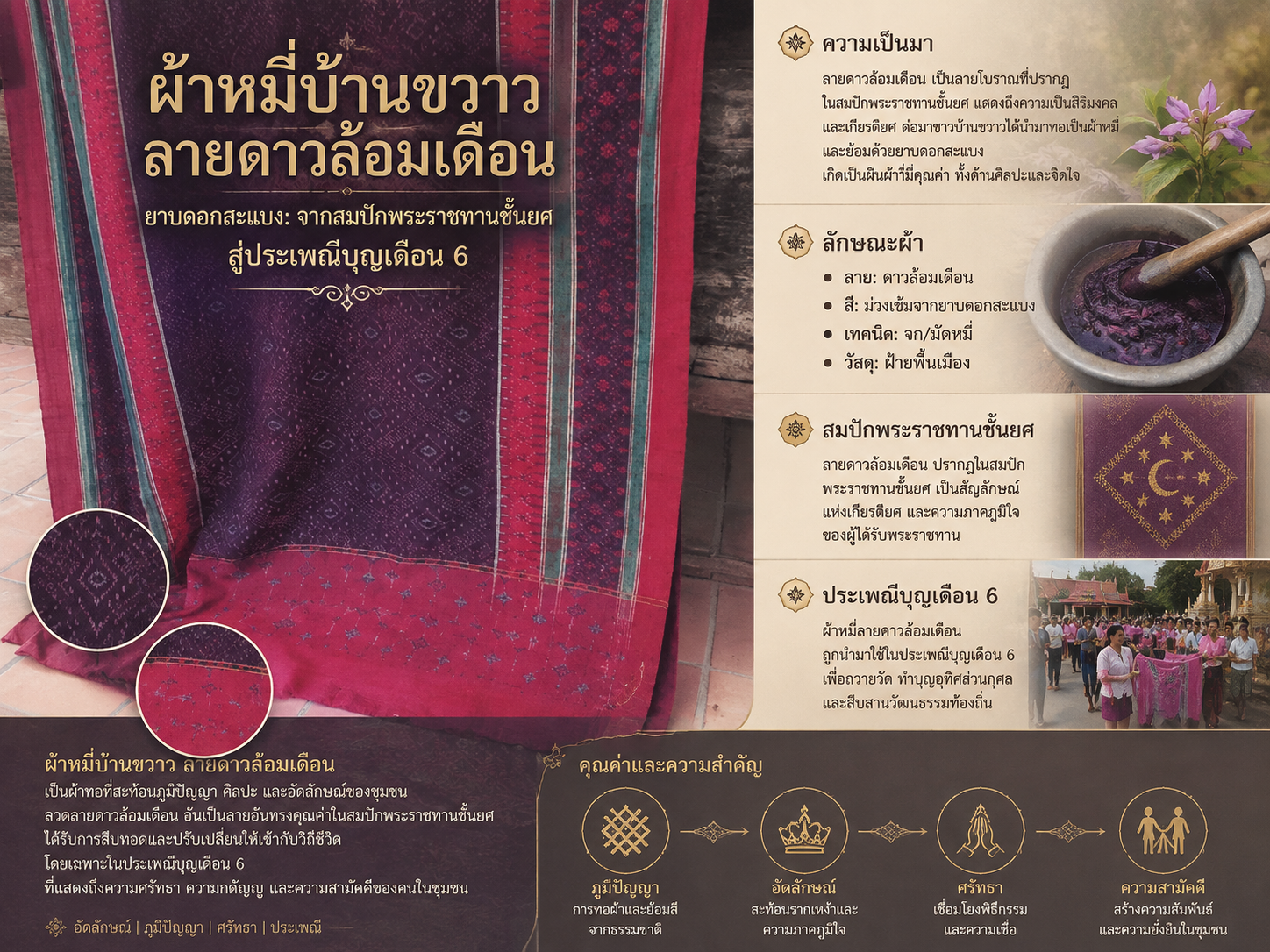
Main Article Content
Abstract
This research aimed to: (1) study the history, development, and symbolic meanings of Pha Mhi Ban Khwao Lai Dao Lom Duean Yab Dok Sabaeng, from its origins as royal court-presented rank textiles (Sompak Phra Ratchathan) to its connection with the Bun Duean Six tradition; (2) examine the production processes, utilization, and transmission of weaving knowledge; and (3) analyze its historical, cultural, and identity values, together with guidelines for its conservation and sustainable development as cultural capital. This study employed a qualitative research approach using cultural research methodology. Data were collected from documentary sources and fieldwork conducted in Ban Khwao, Roi Et Province. Purposive sampling was used to select 50 key informants, including local scholars, weaving practitioners, and community members. Data were gathered through in-depth interviews, participant observation, focus group discussions, and workshops. The data were analyzed using triangulation to ensure credibility, encompassing the historical, social, cultural, and creative economy dimensions of the community.
The findings revealed that: (1) Pha Mhi Ban Khwao Lai Dao Lom Duean Yab Dok Sabaeng had a historical development linked to royal court textiles (Sompak Poom) and had been continuously transformed into local weaving wisdom in Ban Khwao, Selaphum District, Roi Et Province. Its distinctive patterns reflected beliefs concerning the cosmos, fertility, and agricultural cycles, and were closely associated with the Bun Duean Six tradition. (2) Regarding the production process, the community continued to transmit knowledge of sericulture, dyeing, pattern tying, and weaving through intergenerational learning, while adapting to changing economic conditions without losing its traditional identity. (3) The textiles possessed multifaceted historical, cultural, identity, and economic values and could be sustainably developed as cultural capital. The recommended strategies for conservation and sustainable development included establishing knowledge databases, promoting knowledge transmission, developing contemporary textile products, strengthening branding, and promoting cultural tourism.
Article Details

This work is licensed under a Creative Commons Attribution-NonCommercial-NoDerivatives 4.0 International License.
This article is published under a Creative Commons Attribution-NonCommercial-NoDerivatives 4.0 International License (CC BY-NC-ND 4.0), which allows others to share the article with proper attribution to the authors and prohibits commercial use or modification. For any other reuse or republication, permission from the journal and the authors is required.References
กรมศิลปากร. (2506ก). จดหมายเหตุรัชกาลที่ 4 จุลศักราช 1215. กรุงเทพฯ: กรมศิลปากร.
กรมศิลปากร. (2513). ตำราราชเสวกว่าด้วยธรรมเนียมและหน้าที่ข้าราชการ. กรุงเทพฯ: กรมศิลปากร
จิรภิญญา สิงห์คํา และ ในตะวัน กําหอม. (2565). วัฒนธรรมชุมชน: ความยั่งยืน การอนุรักษ์ เพื่อการบูรณาการการสอนหน้าที่พลเมืองและศีลธรรม หน่วยศิลปวัฒนธรรมไทย วิทยาลัยเทคนิคแพร่. วารสารวิชาการรัตนบุศย์, 4(3), 89-104.
จิรวรรณ ทองพายัพ และในตะวัน กำหอม.(2564).การขอขึ้นบัญชีมรดกภูมิปัญญาทางวัฒนธรรม ตามพระราชบัญญัติส่งเสริมและรักษามรดกภูมิปัญญาทางวัฒนธรรม พ.ศ.2559 : กรณีศึกษาสภาวัฒนธรรม ตำบลขวาว อำเภอเสลภูมิ จังหวัดร้อยเอ็ด.คณะศึกษาศาสตร์และสังคมศาสตร์ วิทยาลัยทองสุข
ณฐนนท ทวีสิน. (2565). การมีส่วนร่วมของประชาชนในการจัดการมรดกภูมิปัญญาทางวัฒนธรรม “เซิ้งผ้าหมี่” ของบ้านขวาวอำเภอเสลภูมิ จังหวัดร้อยเอ็ด,คณะสังคมศาสตร์และศึกษาศาสตร์, วิทยาลัยทองสุข
ทรงคุณ จันทจร. (2553). การวิจัยเชิงคุณภาพทางวัฒนธรรมชั้นสูง. มหาสารคาม : สถานบันวิจัยศิลปและวัฒนธรรมอีสาน,
ในตะวัน กำหอม. (2559). การวิจัยประยุกต์ทางวัฒนธรรม (เล่ม 2). วิทยาลัยทองสุข.
ในตะวัน กำหอม. (2559). ผ้าหมี่ : การอนุรักษ์และพัฒนาเพื่อส่งเสริมวิถี วัฒนธรรมชุมชน ตำบลขวาวอำเภอเสลภูมิ จังหวัดร้อยเอ็ดความหลากหลายทางวัฒนธรรม. คณะวัฒนธรรมศาสต์
พรชัย น่าบัณฑิต (2569).เซิ้งผ้าหมี่บ้านขวาว: การพัฒนากระบวนการสืบทอดภูมิปัญญาการเซิ้งผ้าหมี่บ้านขวาว จังหวัดร้อยเอ็ด เพื่อเพิ่มคุณค่าทางสังคมและสร้างมูลค่าเพิ่มทางเศรษฐกิจ.สภาวัฒนธรรมตำบลขวาว
ศรีศักร วัลลิโภดม (2546) แอ่งอารยธรรมอีสาน : แฉหลักฐานโบราณคดีพลิกโฉมหน้าประวัติศาสตร์ไทย,
กรุงเทพฯ : มติชนศูนย์ส่งเสริมศิลปาชีพระหว่างประเทศ (องค์การมหาชน), (2558) สมปักปูม ภูมิผ้าเขมร: ไทย จากราชสํานักสู่สามัญชนบริษัท เนติกุลการพิมพ์ จำกัด กรุงเทพ สมเด็จฯ กรมพระยาดำรงราชานุภาพ และสมเด็จฯ กรมพระยานริศรานุวัดติวงศ์. (2505–2512). สาส์นสมเด็จ. กรุงเทพฯ: คุรุสภา.
สุภางค์ จันทวานิช. (2565). วิธีการวิจัยเชิงคุณภาพ. พิมพ์ครั้งที่ 26 (ฉบับปรับปรุงใหม่). กรุงเทพฯ : สำนักพิมพ์แห่งจุฬาลงกรณ์มหาวิทยาลัย.
Creswell, J.W. and Poth, C.N. (2018) Qualitative Inquiry and Research Design Choosing among Five Approaches. 4th Edition, SAGE Publications, Inc., Thousand Oaks.
Denzin, N. K. (1978). Triangulation: A Case for Methodological Evaluation and Combination. Sociological Methods, 339-357.
Lincoln, Y.S. and Guba, E.G. (1985) Naturalistic Inquiry. SAGE, Thousand Oaks, 289-331.http://dx.doi.org/10.1016/0147-1767(85)90062-8Miles, M.B., Huberman, A.M. and Saldana, J. (2014) Qualitative Data Analysis: A Methods Sourcebook. Sage, London.
Spradley, J. P. (1980). Participant Observation. New York: Holt, Rinehart and Wilson.
