
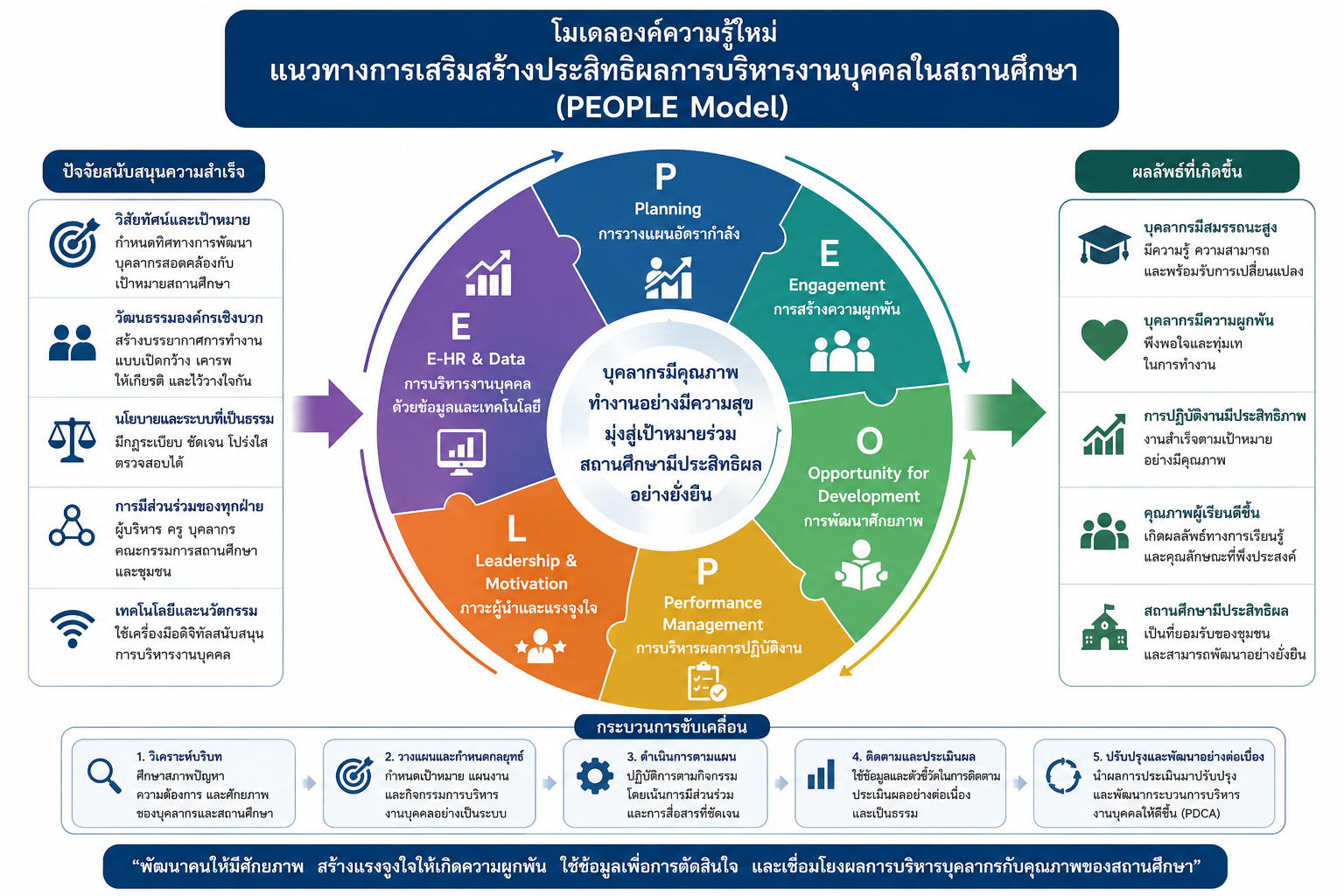
แนวทางการเสริมสร้างประสิทธิผลการบริหารงานบุคคลในสถานศึกษา
Article Sidebar
Main Article Content
บทคัดย่อ
บทความนี้นี้มีวัตถุประสงค์เพื่อศึกษาประสิทธิผลและแนวทางการเสริมสร้างการบริหารงานบุคคลในสถานศึกษา โดยใช้กรอบแนวคิดการจัดการทรัพยากรมนุษย์เชิงกลยุทธ์ (Strategic Human Resource Management: SHRM) เป็นฐานในการวิเคราะห์ เพื่อเชื่อมโยงการบริหารบุคลากรเข้ากับพันธกิจและเป้าหมายของสถานศึกษา องค์ประกอบสำคัญของ SHRM ได้แก่ การวางแผนกำลังคน การสรรหาและคัดเลือกบุคลากรที่มีคุณภาพ การพัฒนาศักยภาพอย่างต่อเนื่อง การประเมินผลที่เป็นธรรม และการบริหารค่าตอบแทนและสวัสดิการที่เหมาะสม ผลการศึกษาชี้ว่า ความสอดคล้องระหว่างนโยบายการบริหารบุคลากรกับบริบทของสถานศึกษา เช่น วัฒนธรรมองค์การ โครงสร้างการบริหาร และนโยบายต้นสังกัด มีบทบาทสำคัญต่อการยกระดับประสิทธิผลการดำเนินงาน แนวทางการพัฒนาที่เสนอประกอบด้วยการสรรหาและพัฒนาบุคลากร การสร้างแรงจูงใจและวัฒนธรรมองค์กรที่เข้มแข็ง การพัฒนาภาวะผู้นำ การจัดการความขัดแย้งอย่างสร้างสรรค์ และการใช้เทคโนโลยีสารสนเทศเพื่อการบริหารบุคลากร ทั้งนี้ ประสิทธิผลของการบริหารงานบุคคลสะท้อนผ่านพันธกิจที่ชัดเจน ภาวะผู้นำด้านวิชาการ บุคลากรที่เหมาะสมและทุ่มเท การทำงานที่รวดเร็วมีประสิทธิภาพ และบรรยากาศการทำงานที่ดี ซึ่งทั้งหมดเป็นกลไกสำคัญในการสร้างสถานศึกษาที่มีคุณภาพและตอบสนองต่อความท้าทายในยุคปัจจุบันได้อย่างมีประสิทธิผล
Article Details

อนุญาตภายใต้เงื่อนไข Creative Commons Attribution-NonCommercial-NoDerivatives 4.0 International License.
บทความนี้ได้รับการเผยแพร่ภายใต้สัญญาอนุญาต Creative Commons Attribution-NonCommercial-NoDerivatives 4.0 International (CC BY-NC-ND 4.0) ซึ่งอนุญาตให้ผู้อื่นสามารถแชร์บทความได้โดยให้เครดิตผู้เขียนและห้ามนำไปใช้เพื่อการค้าหรือดัดแปลง หากต้องการใช้งานซ้ำในลักษณะอื่น ๆ หรือการเผยแพร่ซ้ำ จำเป็นต้องได้รับอนุญาตจากวารสารเอกสารอ้างอิง
กระทรวงศึกษาธิการ. (2560). แนวทางการพัฒนาครูและบุคลากรทางการศึกษาผ่านชุมชนแห่งการเรียนรู้ทางวิชาชีพ. โรงพิมพ์คุรุสภาลาดพร้าว
กระทรวงศึกษาธิการ. (2561). นโยบายและแผนปฏิรูปการศึกษาในทศวรรษที่สองที่มุ่งเน้นการพัฒนาคุณภาพของคนไทยในศตวรรษที่ 21. กระทรวงศึกษาธิการ
พระธรรมปิฎก (ป. อ.ปยุตฺโต). (2554). กรอบแนวคิดเรื่องการศึกษาเพื่อสร้างสรรค์สังคม.มูลนิธิพุทธธรรม
พิมพันธ์ เดชะคุปต์, สมชาย นำประเสริฐชัย, และ วิไลวรรณ ทองอยู่. (2562). ประสิทธิผลการบริหารงานบุคคลของสถานศึกษาขั้นพื้นฐาน สังกัดสำนักงานคณะกรรมการการศึกษาขั้นพื้นฐาน. วารสารบริหารการศึกษา มหาวิทยาลัยศิลปากร, 9(1), 147–160
วิจารณ์ พานิช. (2555). การจัดการเรียนรู้ที่เน้นผู้เรียนเป็นสำคัญ. มูลนิธิสดศรี-สฤษดิ์วงศ์
สมาคมนักวิจัย. (2561). คุณภาพครูไทย: สถานการณ์และทิศทางการพัฒนา. สำนักพิมพ์จุฬาลงกรณ์มหาวิทยาลัย
สำนักงานคณะกรรมการการศึกษาขั้นพื้นฐาน. (2563). มาตรฐานการศึกษาขั้นพื้นฐาน เพื่อการประกันคุณภาพภายในของสถานศึกษา. โรงพิมพ์ชุมนุมสหกรณ์การเกษตรแห่งประเทศไทย
สำนักงานเลขาธิการสภาการศึกษา. (2560). แผนการศึกษาแห่งชาติ พ.ศ. 2560-2579. สำนักงานเลขาธิการสภาการศึกษา
สำนักงานเลขาธิการสภาการศึกษา. (2561). รายงานการวิจัยการพัฒนาชุมชนแห่งการเรียนรู้ทางวิชาชีพในสถานศึกษาไทย. พริกหวานกราฟฟิค
สุวิมล ติรกานันท์. (2561). ปัญหาและแนวทางการพัฒนาการบริหารงานบุคคลในสถานศึกษาขั้นพื้นฐาน. วารสารวิชาการมหาวิทยาลัยราชภัฏศรีสะเกษ, 12(3), 97–108
Armstrong, M., & Baron, A. (2005). Managing performance: Performance management in action. Chartered Institute of Personnel and Development
Bass, B. M., & Riggio, R. E. (2006). Transformational leadership (2nd ed.). Psychology Press
Cameron, K. S., & Whetten, D. A. (1983). Organizational effectiveness: One model or several? In K. S. Cameron & D. A. Whetten (Eds.), Organizational effectiveness: A comparison of multiple models (pp. 1–24). Academic Press
Creemers, B. P. M., & Reezigt, G. J. (1996). School level conditions affecting the effectiveness of instruction. School Effectiveness and School Improvement, 7(3), 197–228
Darling-Hammond, L. (2010). The flat world and education: How America's commitment to equity will determine our future. Teachers College Press
Darling-Hammond, L. (2017). Teacher education around the world: What can we learn from international practice European Journal of Teacher Education,40(3),291–309
Day, C., Sammons, P., Hopkins, D., Harris, A., Leithwood, K., Gu, Q., & Brown, E. (2009). The impact of school leadership on pupil outcomes (Research Report DCSF-RR108). Department for Children, Schools and Families
Deal, T. E., & Peterson, K. D. (2016). Shaping school culture (3rd ed.). Jossey-Bass.
Drucker, P. F. (2006). The effective executive: The definitive guide to getting the right things done. HarperBusiness
DuFour, R., & Eaker, R. (1998). Professional learning communities at work: Best practices for enhancing student achievement. Solution Tree Press
Edmonds, R. (1979). Effective schools for the urban poor. Educational Leadership, 37(1), 15–24
Fullan, M. (2007). The new meaning of educational change (4th ed.). Teachers College Press
Fullan, M. (2016). The new meaning of educational change (5th ed.). Teachers College Press
Goleman, D. (2000). Leadership that gets results. Harvard Business Review, 78(2), 78–90
Hargreaves, A., & Fullan, M. (2012). Professional capital: Transforming teaching in every school. Teachers College Press
Herzberg, F. (1959). The motivation to work. John Wiley & Sons
Hoy, W. K., & Miskel, C. G. (2013). Educational administration: Theory, research, and practice (9th ed.). McGraw-Hill
Mayo, E. (1933). The human problems of an industrial civilization. Macmillan.
Mintzberg, H. (1973). The nature of managerial work. Harper & Row
Noe, R. A., Hollenbeck, J. R., Gerhart, B., & Wright, P. M. (2017). Human resource management: Gaining a competitive advantage (10th ed.). McGraw-Hill Education
OECD. (2019a). Education at a glance 2019: OECD indicators. OECD Publishing.
OECD. (2019b). TALIS 2018 results (Volume I): Teachers and school leaders as lifelong learners. OECD Publishing
Rosenholtz, S. J. (1989). Teachers' workplace: The social organization of schools. Longman
Sammons, P., Hillman, J., & Mortimore, P. (1995). Key characteristics of effective schools: A review of school effectiveness research. Office for Standards in Education.
Scheerens, J., & Bosker, R. J. (1997). The foundations of educational effectiveness. Pergamon
Schein, E. H. (2010). Organizational culture and leadership (4th ed.). Jossey-Bass.
Schleicher, A. (2018). World class: How to build a 21st-century school system. OECD Publishing
Senge, P. M. (2006). The fifth discipline: The art and practice of the learning organization (Revised ed.). Currency
Sergiovanni, T. J. (1984). Leadership and excellence in schooling. Educational Leadership, 41(5), 4–13
Sergiovanni, T. J., & Starratt, R. J. (2007). Supervision: A redefinition (8th ed.). McGraw-Hill.
Spencer, L. M., & Spencer, S. M. (1993). Competence at work: Models for superior performance. John Wiley & Sons
Strohmeier, S. (2007). Research in e-HRM: Review and implications. Human Resource Management Review, 17(1), 19–37
Taylor, F. W. (1911). The principles of scientific management. Harper & Brothers.
Teddlie, C., & Reynolds, D. (2000). The international handbook of school effectiveness research. Falmer Press
Thomas, K. W., & Kilmann, R. H. (1974). Thomas-Kilmann conflict mode instrument. Xicom
