
THE DEVELOPMENT OF READING SPELLING AND WRITING SPELLING ABILITIES AND LEARNING MOTIVATION IN PRATHOMSUKSA 2 STUDENTS USING GAMIFICATION WITH COOPERATIVE LEARNING
Keywords:
Gamification, Cooperative Learning, Spelling Reading and WritingAbstract
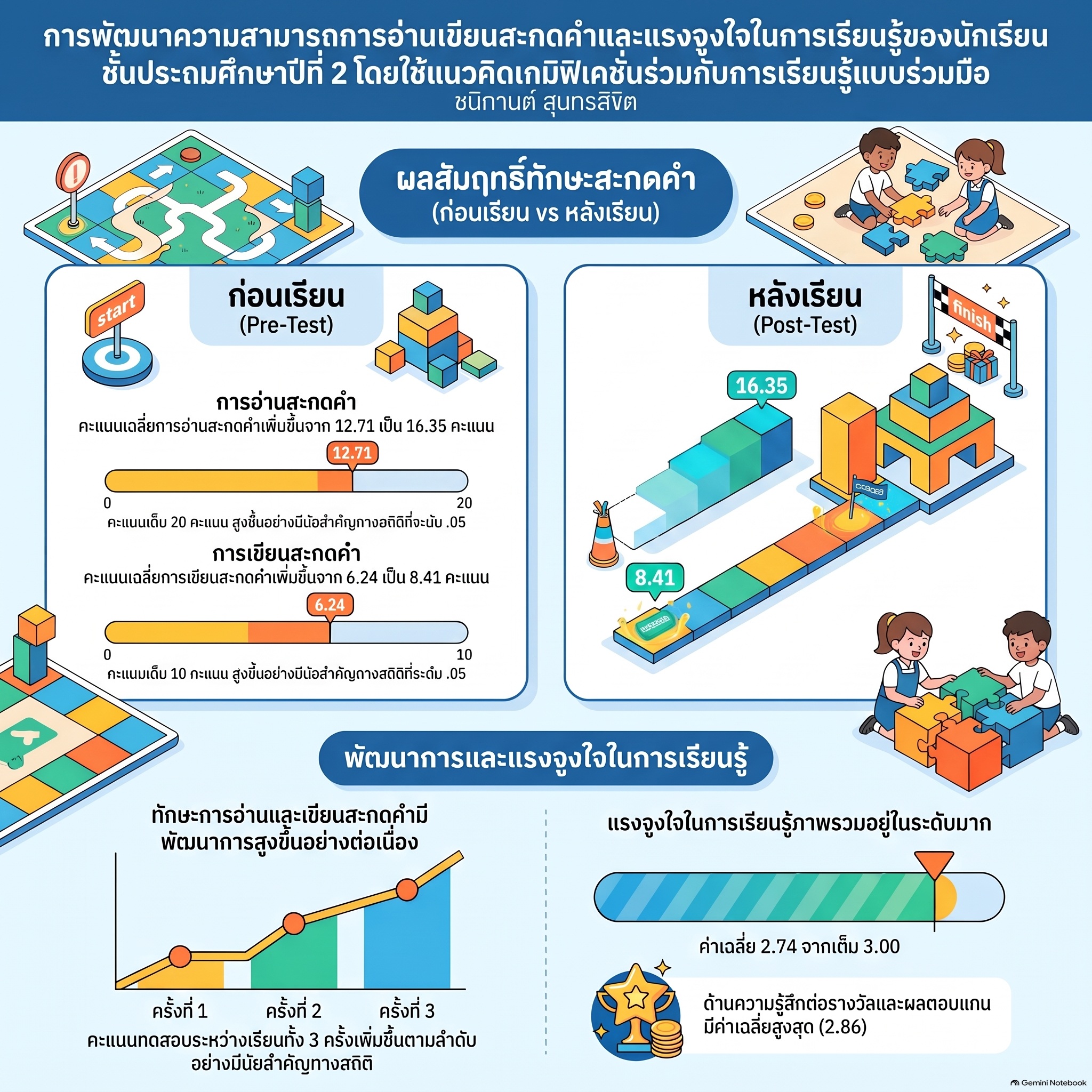
This research aimed to: 1) compare the reading spelling ability of Prathomsuksa 2 students before and after learning through gamification combined with cooperative learning, 2) compare writing spelling ability before and after the intervention, 3) examine the development of reading spelling ability during the intervention, 4) examine the development of writing spelling ability during the intervention, and 5) investigate students' learning motivation after the intervention. The sample consisted of 17 Prathomsuksa 2 students from Bannongyao School during the second semester of the 2025 academic year. The research design was a One-Group Time-Series Design. Research instruments included lesson plans, a pre- and post-test for reading spelling ability, a pre- and post-test for writing spelling ability, formative tests, and a learning motivation scale. Data were analyzed using mean (M), standard deviation (SD), dependent t-test, and Repeated Measures ANOVA. The results revealed that: 1) reading spelling ability after learning was significantly higher than before learning at the .05 level, 2) reading spelling ability increased at every measurement point at the .05 significance level, 3) writing spelling ability after learning was significantly higher than before learning at the .05 level, 4) writing spelling ability increased at every measurement point at the .05 significance level, and 5) students' overall learning motivation after the intervention was at a high level.
References
กระทรวงศึกษาธิการ. (2551). หลักสูตรแกนกลางการศึกษาขั้นพื้นฐาน พุทธศักราช 2551. โรงพิมพ์ชุมนุมสหกรณ์การเกษตรแห่งประเทศไทย.
จิราภรณ์ โตกราน, และพิณพนธ์ คงวิจิตต์. (2567). การพัฒนาความสามารถในการสะกดคำภาษาไทยและการทำงานร่วมกับผู้อื่นของนักเรียนชั้นประถมศึกษาปีที่ 1 โดยใช้รูปแบบการเรียนการสอนภาษาแนวบูรณาการสมดุลภาษาและการเรียนรู้แบบร่วมมือ. วารสารนวัตกรรมการจัดการศึกษาและการวิจัย, 6(3), 515–526.
ณัฐพงศ์ เชื้อเพชร. (2560). สภาพและแนวทางแก้ไขปัญหาการอ่านสะกดคำและเขียนสะกดคำของนักเรียนชั้นประถมศึกษาในโรงเรียนสังกัดสำนักการศึกษากรุงเทพมหานคร [วิทยานิพนธ์ปริญญามหาบัณฑิต, จุฬาลงกรณ์มหาวิทยาลัย]. https://doi.org/10.58837/CHULA.THE.2017.1021
พิมลพร พงษ์ประเสริฐ. (2563). การพัฒนาความสามารถด้านการอ่านและการเขียนสะกดคำของนักเรียนชั้นประถมศึกษาปีที่ 1 โดยการจัดการเรียนรู้ตามรูปแบบของฮันเตอร์ร่วมกับแบบฝึกทักษะ [วิทยานิพนธ์ปริญญามหาบัณฑิต, มหาวิทยาลัยศิลปากร].
มานิตา สาเหล้, และกิ่งกาญจน์ บูรณสินวัฒนกูล. (2567). การพัฒนาความสามารถด้านการอ่านวิเคราะห์ของนักเรียนชั้นมัธยมศึกษาปีที่ 6 โดยใช้คำถามแบบ QUEST ร่วมกับเทคนิคเกมิฟิเคชัน. Journal for Developing the Social and Community, 11(3), 103–118.
วันจรัตน์ เดชวิลัย, และเรวดี คงสุวรรณ. (2566). เทคนิคการจำ: สะท้อนการเรียนรู้การสะกดคำในภาษาไทย. วารสารวิชาการนอร์ทเทิร์น, 10(3), 79–96.
ศุภกร ถิรมงคลจิต, และฉัตรวรรณ์ ลัญฉวรรธนะกร. (2559). ผลของการจัดกิจกรรมการเรียนรู้วิชาวิทยาศาสตร์ตามแนวคิดเกมิฟิเคชัน เพื่อเสริมสร้างแรงจูงใจในการเรียนของนักเรียนชั้นประถมศึกษาปีที่ 2. An Online Journal of Education Chulalongkorn University, 11(4), 450–464. https://doi.org/10.58837/chula.the.2015.158
สำนักทดสอบทางการศึกษา สำนักงานคณะกรรมการการศึกษาขั้นพื้นฐาน. (2565). รายงานผลการประเมินความสามารถด้านการอ่านของผู้เรียน (RT) ชั้นประถมศึกษาปีที่ 1 ปีการศึกษา 2564. กระทรวงศึกษาธิการ.
สำนักทดสอบทางการศึกษา สำนักงานคณะกรรมการการศึกษาขั้นพื้นฐาน. (2566). รายงานผลการประเมินความสามารถด้านการอ่านของผู้เรียน (RT) ชั้นประถมศึกษาปีที่ 1 ปีการศึกษา 2565. กระทรวงศึกษาธิการ.
สำนักทดสอบทางการศึกษา สำนักงานคณะกรรมการการศึกษาขั้นพื้นฐาน. (2567). รายงานผลการประเมินความสามารถด้านการอ่านของผู้เรียน (RT) ชั้นประถมศึกษาปีที่ 1 ปีการศึกษา 2566. กระทรวงศึกษาธิการ.
สุรางค์ โค้วตระกูล. (2559). จิตวิทยาการศึกษา (พิมพ์ครั้งที่ 12). สำนักพิมพ์แห่งจุฬาลงกรณ์มหาวิทยาลัย.
Adams, M. J. (1990). Beginning to read: Thinking and learning about print. MIT Press.
Bandura, A. (1997). Self-efficacy: The exercise of control. W. H. Freeman.
Deterding, S., Dixon, D., Khaled, R., & Nacke, L. E. (2011). From game design elements to gamefulness: Defining gamification. In Proceedings of the 15th International Academic MindTrek Conference: Envisioning future media environments (pp. 9–15). https://doi.org/10.1145/2181037.2181040
Ehri, L. C. (2000). Learning to read and learning to spell: Two sides of a coin. Topics in Language Disorders, 20(3), 19–36. https://doi.org/10.1097/00011363-200020030-00005
Graham, S., & Hebert, M. (2011). Writing to read: A meta-analysis of the impact of writing and writing instruction on reading. Harvard Educational Review, 81(4), 710–744. https://doi.org/10.17763/haer.81.4.t2k0m13756113566
Johnson, D. W., & Johnson, R. T. (1994). Learning together and alone: Cooperative, competitive, and individualistic learning (4th ed.). Allyn & Bacon.
Khaleel, F. L., Ashaari, N. S., & Tengku Wook, T. S. M. (2020). The impact of gamification on students learning engagement. International Journal of Electrical and Computer Engineering, 10(5), 4965–4972. https://doi.org/10.11591/ijece.v10i5.pp4965-4972
National Reading Panel. (2000). Teaching children to read: An evidence-based assessment of the scientific research literature on reading and its implications for reading instruction. National Institute of Child Health and Human Development.
Nitiasih, P. K., Permana, I. G. Y., & Budiartha, L. G. R. (2022). Enhancing students' reading comprehension with gamification of local wisdom stories during emergency online learning. Journal of Education Technology, 6(3), 515–520. https://doi.org/10.23887/jet.v6i3.47289
Ouellette, G., & Sénéchal, M. (2017). Invented spelling in kindergarten as a predictor of reading and spelling in Grade 1: A new pathway to literacy, or just the same road, less known? Developmental Psychology, 53(1), 77–88. https://doi.org/10.1037/dev0000179
Ratsamee, J., Chomchaiya, C., & Jitsupa, J. (2025). Use of gamification to promote spelling skills of grade 3 students. Journal of English Language and Linguistics, 6(2), 134–149. https://doi.org/10.62819/jel.2025.1013
Ryan, R. M., & Deci, E. L. (2000). Self-determination theory and the facilitation of intrinsic motivation, social development, and well-being. American Psychologist, 55(1), 68–78. https://doi.org/10.1037/0003-066x.55.1.68
Sailer, M., Hense, J. U., Mayr, S. K., & Mandl, H. (2017). How gamification motivates: An experimental study of the effects of specific game design elements on psychological need satisfaction. Computers in Human Behavior, 69, 371–380. https://doi.org/10.1016/j.chb.2016.12.033
Snow, C. E., Burns, M. S., & Griffin, P. (Eds.). (1998). Preventing reading difficulties in young children. National Academy Press.
Sweller, J., van Merriënboer, J. J. G., & Paas, F. (2019). Cognitive architecture and instructional design: 20 years later. Educational Psychology Review, 31(2), 261–292. https://doi.org/10.1007/s10648-019-09465-5
Treiman, R. (1993). Beginning to spell: A study of first-grade children. Oxford University Press. https://doi.org/10.1093/oso/9780195062199.001.0001
Vygotsky, L. S. (1978). Mind in society: The development of higher psychological processes. Harvard University Press.
Webb, N. M. (2009). The teacher’s role in promoting collaborative dialogue in the classroom. British Journal of Educational Psychology, 79(1), 1–28. https://doi.org/10.1348/000709908x380772
Weiser, B., & Mathes, P. (2011). Using encoding instruction to improve the reading and spelling performances of elementary students at risk for literacy difficulties: A best-evidence synthesis. Review of Educational Research, 81(2), 170–200. https://doi.org/10.3102/0034654310396719
Downloads
Published
How to Cite
Issue
Section
Categories
License
Copyright (c) 2026 Faculty of Education, Srinakharinwirot university

This work is licensed under a Creative Commons Attribution-NonCommercial-NoDerivatives 4.0 International License.


