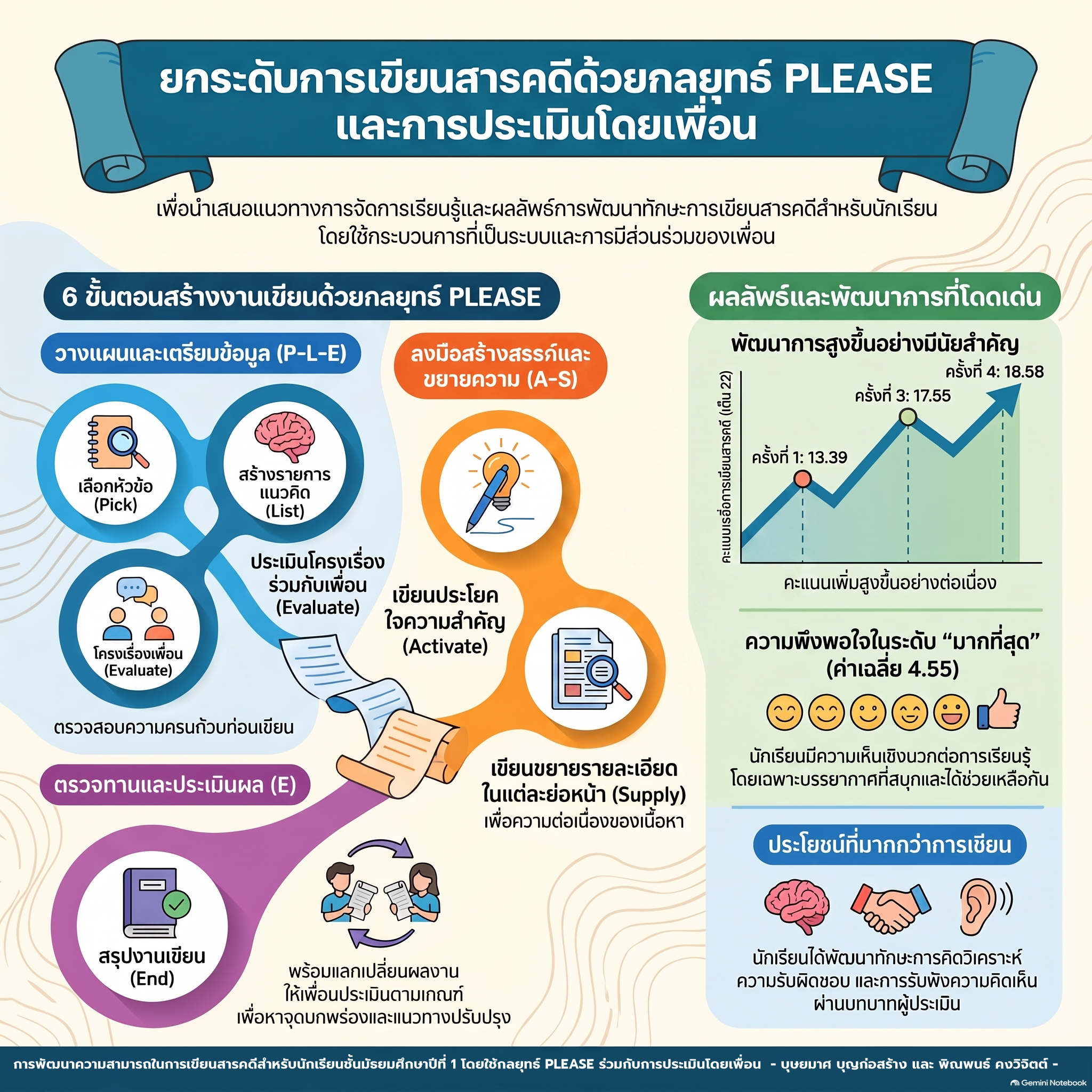
การพัฒนาความสามารถในการเขียนสารคดีสำหรับนักเรียนชั้นมัธยมศึกษาปีที่ 1 โดยใช้กลยุทธ์ PLEASE ร่วมกับการประเมินโดยเพื่อน
คำสำคัญ:
ความสามารถในการเขียนสารคดี, กลยุทธ์ PLEASE, การประเมินโดยเพื่อนบทคัดย่อ
การวิจัยครั้งนี้มีวัตถุประสงค์เพื่อ 1) ศึกษาพัฒนาการความสามารถในการเขียนสารคดีของนักเรียนชั้นมัธยมศึกษาปีที่ 1 ที่ได้รับการจัดการเรียนรู้โดยใช้กลยุทธ์ PLEASE ร่วมกับการประเมินโดยเพื่อน และ 2) ศึกษาความคิดเห็นของนักเรียนชั้นมัธยมศึกษาปีที่ 1 ที่มีต่อการจัดการเรียนรู้โดยใช้กลยุทธ์ PLEASE ร่วมกับการประเมินโดยเพื่อน กลุ่มตัวอย่างในการวิจัย คือ นักเรียนชั้นมัธยมศึกษาปีที่ 1/6 โรงเรียนกาญจนาภิเษกวิทยาลัย นครปฐม (พระตำหนักสวนกุหลาบมัธยม) ภาคเรียนที่ 2 ปีการศึกษา 2568 จำนวน 38 คน ซึ่งได้มาโดยการสุ่มแบบแบ่งกลุ่ม (Cluster Random Sampling) เครื่องมือที่ใช้ในการวิจัย ได้แก่ 1) แผนการจัดการเรียนรู้การเขียนสารคดีโดยใช้กลยุทธ์ PLEASE ร่วมกับการประเมินโดยเพื่อน จำนวน 4 แผน 2) แบบประเมินความสามารถในการเขียนสารคดี และ 3) แบบสอบถามความคิดเห็นของนักเรียนที่มีต่อการจัดการเรียนรู้ สถิติที่ใช้ในการวิเคราะห์ข้อมูล คือ ค่าเฉลี่ย (M) ส่วนเบี่ยงเบนมาตรฐาน (SD) และการวิเคราะห์ความแปรปรวนทางเดียวแบบวัดซ้ำ (One - way repeated measures ANOVA) ผลการวิจัยพบว่า พัฒนาการความสามารถในการเขียนสารคดีของนักเรียนชั้นมัธยมศึกษาปีที่ 1 สูงขึ้น อย่างมีนัยสำคัญทางสถิติที่ระดับ .05 และความคิดเห็นของนักเรียนชั้นมัธยมศึกษาปีที่ 1 ที่มีต่อการจัดการเรียนรู้โดยใช้กลยุทธ์ PLEASE ร่วมกับการประเมินโดยเพื่อนอยู่ในระดับมากที่สุด (M = 4.55, SD = .60)
เอกสารอ้างอิง
เกศินี จุฑาวิจิตร. (2557). การเขียนสร้างสรรค์ทางสื่อสิ่งพิมพ์: Idea ดี ๆ ไม่มีวันหมด (ฉบับปรับปรุง, พิมพ์ครั้งที่ 2). มหาวิทยาลัยราชภัฏนครปฐม.
ขนิษฐา บุญชัย. (2566). การพัฒนาความสามารถในการเขียนสารคดีของนักเรียนชั้นมัธยมศึกษาปีที่ 4 โดยใช้การจัดการเรียนรู้ตามแนวคิดอรรถฐานร่วมกับเทคนิคการเขียนรอบวง [วิทยานิพนธ์ปริญญาศึกษาศาสตรมหาบัณฑิต, มหาวิทยาลัยศิลปากร].
ชลอ รอดลอย. (2551). การเขียนสารคดี (พิมพ์ครั้งที่ 2). มหาวิทยาลัยเกษตรศาสตร์.
ดวงใจ ไทยอุบุญ. (2554). ทักษะการเขียนภาษาไทย (พิมพ์ครั้งที่ 7). สำนักพิมพ์แห่งจุฬาลงกรณ์มหาวิทยาลัย.
ทวีศักดิ์ ญาณประทีป. (2565). การเขียนสารคดี (พิมพ์ครั้งที่ 14). สำนักพิมพ์มหาวิทยาลัยรามคำแหง.
ทิศนา แขมมณี. (2564). ศาสตร์การสอน: องค์ความรู้เพื่อการจัดกระบวนการเรียนรู้ที่มีประสิทธิภาพ (พิมพ์ครั้งที่ 25). สำนักพิมพ์แห่งจุฬาลงกรณ์มหาวิทยาลัย.
ถวัลย์ มาศจรัส. (2538). สารคดีและการเขียนสารคดี. สำนักพิมพ์มิติใหม่.
ธัญญา สังขพันธานนท์. (2553). การเขียนสารคดีภาคปฏิบัติ (พิมพ์ครั้งที่ 2). สำนักพิมพ์อินทนิล.
รุ่งทิวา สิงห์เทียน. (2558). การพัฒนาแบบฝึกเสริมทักษะการเขียนสารคดีโดยใช้ข้อมูลท้องถิ่นอำเภอเขาย้อยสำหรับนักเรียนชั้นมัธยมศึกษาปีที่ 5 [วิทยานิพนธ์ปริญญาศึกษาศาสตรมหาบัณฑิต, มหาวิทยาลัยศิลปากร].
ลัดดาวัลย์ ศรีสุข. (2558). การใช้เทคนิค 4MAT ร่วมกับชุดกิจกรรมเพื่อพัฒนาทักษะการเขียนสารคดีสำหรับนักเรียนชั้นมัธยมศึกษาปีที่ 6 [วิทยานิพนธ์ปริญญาศึกษาศาสตรมหาบัณฑิต, มหาวิทยาลัยทักษิณ].
วีระศักดิ์ จันทร์ส่งแสง. (2562). วิชาสารคดี. สำนักพิมพ์สารคดี.
สำนักวิชาการและมาตรฐานการศึกษา. (2567). คำชี้แจงเครื่องมือประเมินความสามารถในการอ่านและการเขียน (ฉบับกรรมการสอบ). https://drive.google.com/drive/folders/148oSIE_a2QDtXm2si-Jj1xROWH11W1qZ
สุทิติ ขัตติยะ. (2552). ศาสตร์การเขียน (ฉบับปรับปรุงแก้ไข, พิมพ์ครั้งที่ 2). เปเปอร์เฮาส์.
Ayu, C., & Rizky, R. (2023). Unlocking the power of peer assessment technique: A catalyst for enhanced writing skills in higher education. Al-Ishlah: Jurnal Pendidikan, 15(4), 4891-4900. https://doi.org/10.35445/alishlah.v15i4.4735
Booth, F. (2020). 15 fun peer assessment techniques that children will love. Twinkl. https://www.twinkl.co.th/blog/15-fun-peer-assessment-techniques-that-children-will-love
Dewi, P. M. S. E. (2020). PLEASE and power strategies on students’ writing competency across text genres. Lingua Scientia, 27(1), 24-33. https://ejournal.undiksha.ac.id/index.php/JJBI/article/view/22573
Graham, S., & Harris, K. R. (2005). Writing better: Effective strategies for teaching students with learning difficulties. Paul H. Brookes Publishing.
Johnson, R. (2012). Improve your writing skills: Guidance notes for students. Clifton Press.
Kane, J. S., & Lawler, E. E. (1978). Methods of peer assessment. Psychological Bulletin, 85(3), 555-586. https://doi.org/10.1037/0033-2909.85.3.555
Maysaroh, S. (2020). Improving students’ writing ability of the tenth grade of MAN 1 Lampung Timur by using PLEASE strategy in the academic year of 2019/2020 [Bachelor's thesis, State Institute for Islamic Studies of Metro]. Raden Intan Repository. https://repository.metrouniv.ac.id/id/eprint/3689/1/skripsi%20siti%20maysaroh%20asli.pdf
Roberts, T. S. (2006). Self, peer, and group assessment in e-learning. Information Science Publishing.
Root, R. (2008). The nonfictionist’s guide: On reading and writing creative nonfiction. Rowman & Littlefield Publishers.
Sapnah, S. (2018). The influence of PLEASE (Pick-List-Evaluate-Activate-Supply-End) strategy toward students’ writing skill (An experimental research at the third grade of MTs Al-Amin) [Bachelor's thesis, State Islamic University Sultan Maulana Hasanuddin Banten]. UIN SMH Banten Institutional Repository. https://doi.org/10.30821/brightvision.v1i1.1050
Suci, S. A. (2023). The effect of Pick, List, Evaluate, Active, Supply, End (PLEASE) strategy on students’ writing ability in developing descriptive paragraphs. Journal of English Language and Education, 8(2), 43-51. https://doi.org/10.31004/jele.v8i2.413
Topping, K. J. (2018). Using peer assessment to inspire reflection and learning. Routledge.
Tshering, T. (2016). Peer assessment on grade eight students' descriptive essay writing at a lower secondary school in Bhutan. Journal of Roi Et Rajabhat University, 10(2), 1-10. https://so03.tci-thaijo.org/index.php/reru/article/view/176274
Tunagur, M. (2021). The effect of peer assessment application on writing anxiety and writing motivation of 6th grade students. Shanlax International Journal of Education, 10(1), 96-105. https://doi.org/10.34293/education.v10i1.4352
Zinsser, W. (2001). On writing well: The classic guide to writing nonfiction. HarperCollins.
ดาวน์โหลด
เผยแพร่แล้ว
รูปแบบการอ้างอิง
ฉบับ
ประเภทบทความ
หมวดหมู่
สัญญาอนุญาต
ลิขสิทธิ์ (c) 2026 คณะศึกษาศาสตร์ มหาวิทยาลัยศรีนครินทรวิโรฒ

อนุญาตภายใต้เงื่อนไข Creative Commons Attribution-NonCommercial-NoDerivatives 4.0 International License.


