
THE EFFECTS OF THE LITERATURE BASED LEARNING EXPERIENCE MANAGEMENT WITH ABCDE TECHNIQUE TO ENHANCE RESILIENCE OF KINDERGARTENERS
Keywords:
Mental resilience, Early childhood, Literature-based learning, ABCDE techniqueAbstract
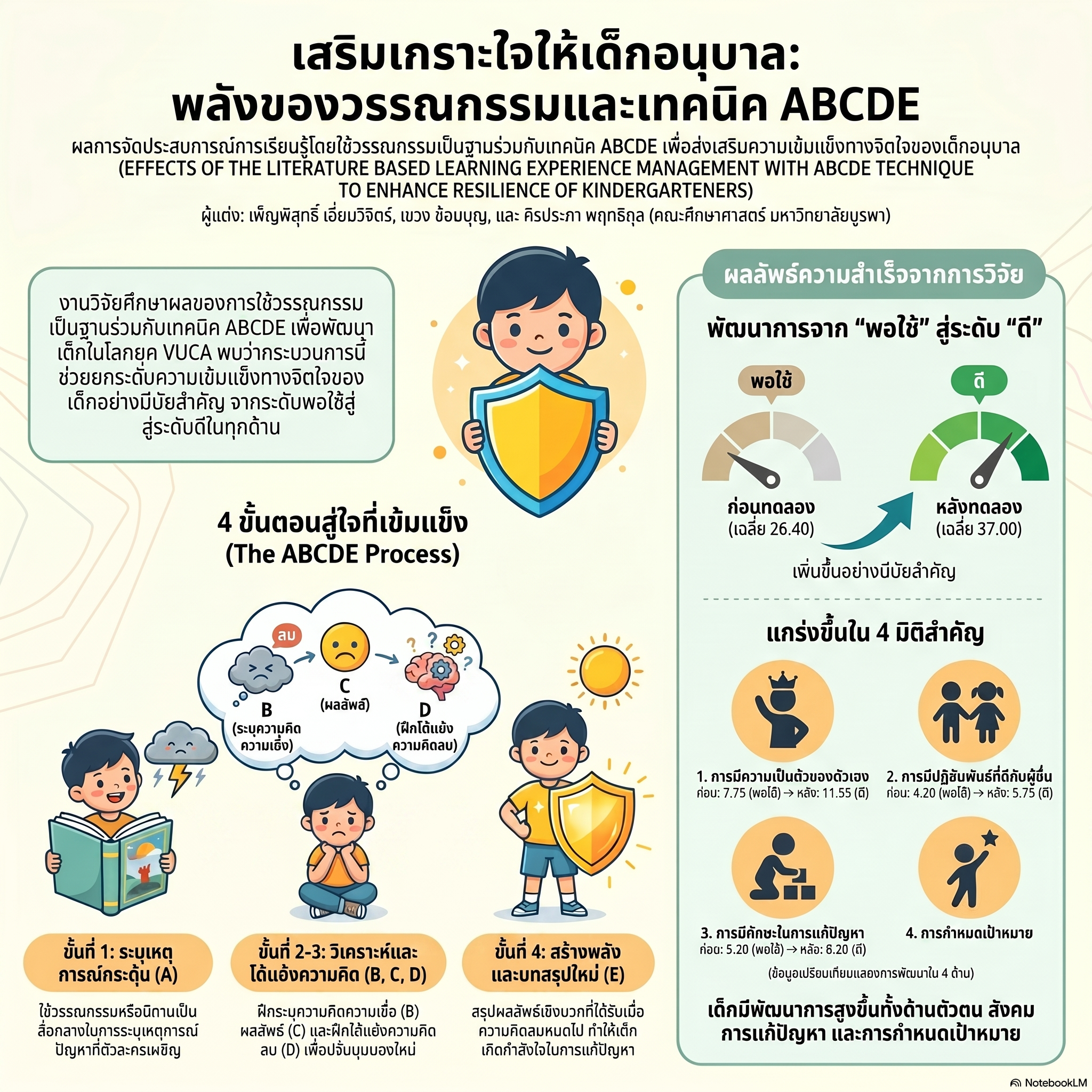
This study aimed to investigate and compare the mental resilience of kindergarten children across three phases—pre-, during-, and post-intervention—through literature-based learning integrated with the ABCDE technique within a cognitive-behavioral framework. A quasi-experimental research design with repeated measures was employed. The participants comprised 20 kindergarten children aged 5–6 years, enrolled in Kindergarten Year 3 during the second semester of the 2025 academic year at Wat Bang Tan Community School, under the Prachinburi Primary Educational Service Area Office 1. The sample was selected using cluster random sampling from one intact classroom. The intervention consisted of 24 structured learning experience plans grounded in literature-based pedagogy and the ABCDE model. The instructional process involved four stages: (1) engagement with literature to identify activating events (A); (2) guided reflection to examine beliefs (B) and consequences (C); (3) cognitive restructuring through disputation of irrational beliefs (D); and (4) consolidation of adaptive thinking and outcomes (E). Mental resilience was assessed using a validated observational assessment instrument for early childhood. Data were analyzed using descriptive statistics (mean, standard deviation) and inferential statistics via repeated measures ANOVA. The findings indicated that children’s mental resilience was at a fair level across all phases, both overall and across dimensions. Importantly, post-intervention scores were significantly higher than both pre- and during-intervention scores at the .05 level of statistical significance. Additionally, scores during the intervention were significantly higher than those at baseline. These results suggest that integrating literature-based learning with the ABCDE technique effectively enhances mental resilience in early childhood, highlighting its potential as a pedagogical approach for fostering socio-emotional competencies.
References
กรมสุขภาพจิต. (2565). รายงานสำรวจระดับความฉลาดทางอารมณ์ (EQ) เด็กไทย อายุ 3 - 5 ปี ประจำปี 2565. กระทรวงสาธารณสุข.
กรมสุขภาพจิต. (2566). แนวทางการจัดการความเปราะบางทางอารมณ์ในเด็กปฐมวัย. กระทรวงสาธารณสุข.
นรรัชต์ ฝันเชียร. (2562). การส่งเสริมการศึกษาไทยเพื่อรับมือกับโลกยุค VUCA. ทรูปลูกปัญญา. https://www.trueplookpanya.com
เนตรชนก รักกาญจนันท์. (2559). การจัดประสบการณ์การเรียนรู้โดยใช้วรรณกรรมเป็นฐานเพื่อเสริมสร้างทักษะทางสังคมของเด็กอนุบาล [วิทยานิพนธ์ปริญญามหาบัณฑิต, มหาวิทยาลัยสุโขทัยธรรมาธิราช].
มหาวิทยาลัยสุโขทัยธรรมาธิราช. (2563). เอกสารการสอนชุดวิชาจิตวิทยาสำหรับครู.
วิมลรัตน์ จตุรานนท์, ศิรประภา พฤทธิกุล, และ สุกัลยา นนทภา. (2565). การใช้วรรณกรรมเพื่อพัฒนาเด็กอนุบาล. สำนักพิมพ์มหาวิทยาลัยบูรพา.
สถาบันสุขภาพจิตเด็กและวัยรุ่นราชนครินทร์. (2560). คู่มือการสร้างความเข้มแข็งทางจิตใจ (RQ) สำหรับเด็กและวัยรุ่น. กรมสุขภาพจิต.
สำนักงานเลขาธิการสภาการศึกษา. (2566). รายงานการศึกษาไทย พ.ศ. 2566. กระทรวงศึกษาธิการ.
สำนักราชเลขานุการ. (2519). พระราชดำรัสในโอกาสต่าง ๆ ของพระบาทสมเด็จพระเจ้าอยู่หัว.
อภิพร เป็งปิง. (2563). การส่งเสริมความเข้มแข็งทางจิตใจในเด็กอนุบาล. สำนักพิมพ์แห่งจุฬาลงกรณ์มหาวิทยาลัย.
เอกสารอ้างอิงภาษาต่างประเทศ
Garmezy, N. (1991). Resiliency and vulnerability to adverse developmental outcomes associated with poverty. American Behavioral Scientist, 34(4), 416–430.
Gartrell, D., & Cairone, K. (2014). A guidance approach for the encouraging classroom (6th ed.). Cengage Learning.
Gillham, J. E., Reivich, K. J., Jaycox, L. H., & Seligman, M. E. P. (2000). Prevention of depressive symptoms in schoolchildren: Two-year follow-up of the Penn Resiliency Program. Psychological Science, 11(4), 315–321.
Ginsburg, K. R., & Jablow, M. M. (2014). Building resilience in children and teens: Giving kids roots and wings (3rd ed.). American Academy of Pediatrics.
Masten, A. S., Gewirtz, A. H., & Sapienza, J. K. (2013). Resilience in development. In S. Goldstein & R. B. Brooks (Eds.), Handbook of resilience in children (pp. 213–237). Springer.
Seligman, M. E. P. (2006). Learned optimism: How to change your mind and your life (2nd ed.). Vintage.
Stallard, P. (2010). Mental health prevention programs in schools: Cognitive behaviour therapy with children and young people. Child and Adolescent Mental Health, 15(4), 249–258.
UNESCO. (2015). Rethinking education: Towards a global common good?
World Economic Forum. (2020). The future of jobs report 2020.
Wright, M. O. (2013). Resilience and development: Positive life adaptations. In S. Goldstein & R. B. Brooks (Eds.), Handbook of resilience in children (pp. 15–37). Springer.
Downloads
Published
How to Cite
Issue
Section
Categories
License
Copyright (c) 2026 Faculty of Education, Srinakharinwirot university

This work is licensed under a Creative Commons Attribution-NonCommercial-NoDerivatives 4.0 International License.


