THE GUIDELINES FOR ENHANCING INNOVATIVE LEADERSHIP IN THE 21ST CENTURY OF SCHOOL ADMINISTRATORS UNDER KHON KAEN SECONDARY EDUCATIONAL SERVICE AREA OFFICE
Keywords:
Innovative Leadership, Guidelines for enhancing innovative leadership in the 21st century, Secondary Educational Service Area Office Khon KaenAbstract
This research article aimed to: (1) investigate the current state, the desirable state, and the priority needs for enhancing innovative leadership in the 21st century among school administrators, and (2) explore guidelines for strengthening innovative leadership of school administrators under the Secondary Educational Service Area Office Khon Kaen. A mixed-methods research design was employed, and the study was conducted in two phases.
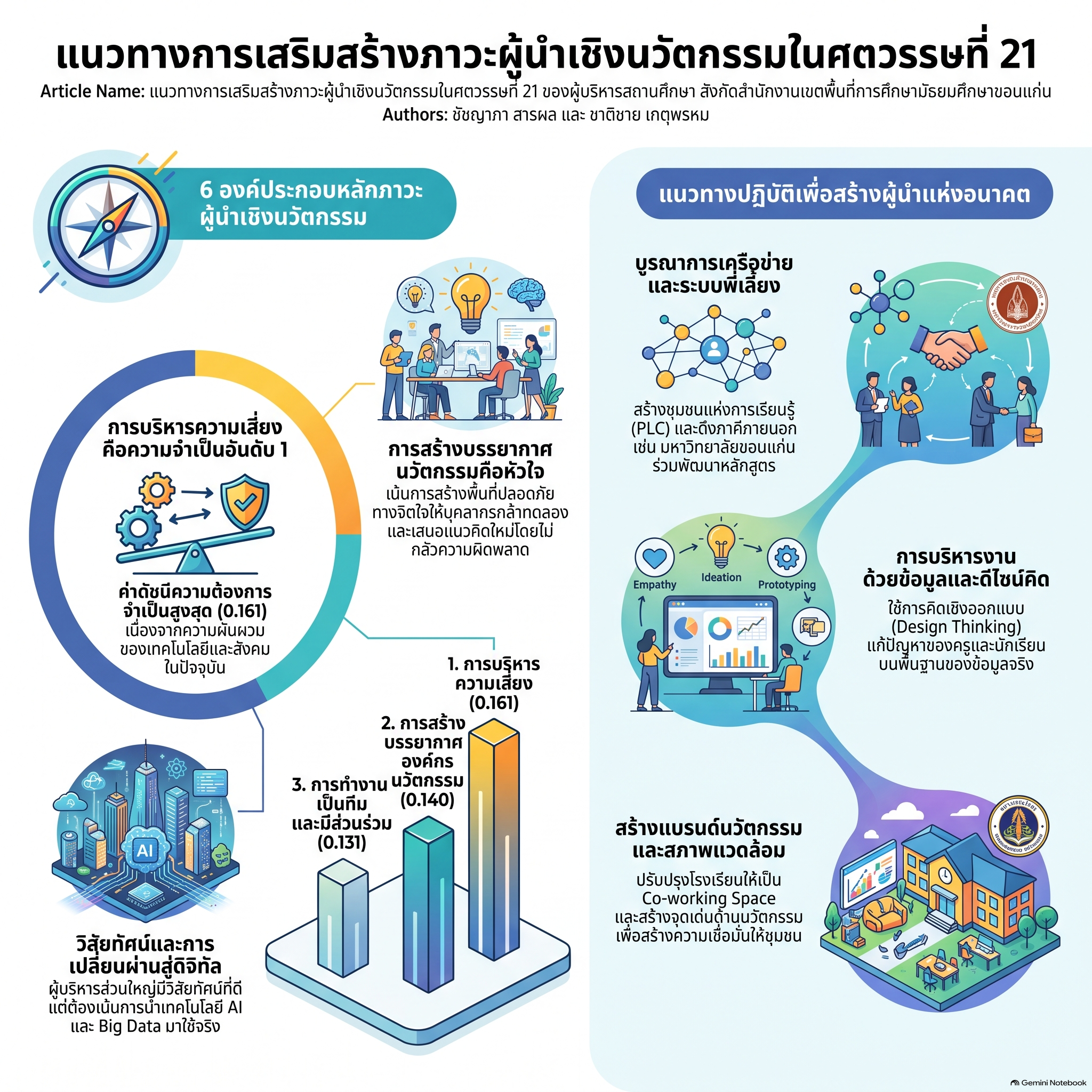
In Phase 1, the current state, desirable state, and priority needs for developing innovative leadership were examined. The sample consisted of 348 school administrators and teachers, with the sample size determined using the Yamane formula. The research instrument was a five-point rating scale questionnaire. The research tool was a questionnaire with a reliability of a current state was 0.94 and a reliability of a desirable state was 0.96. The data were analyzed using percentage, mean, standard deviation, and the Modified Priority Needs Index (PNI Modified) In Phase 2, guidelines for enhancing innovative leadership were explored through semi-structured interviews with four experts, and the data were analyzed using content analysis. The research findings revealed that: (1) the overall priority needs index was at a moderate to high level (PNI Modified = 0.124), (2) The guidelines for enhancing innovative leadership consisted of six aspects as follows: (2.1) transformational vision, with three developmental approaches; (2.2) teamwork and participation, with four approaches; (2.3) innovative creativity, with three approaches; (2.4) creating an innovative organizational climate, with three approaches; (2.5) innovation strategy, with three approaches; and (2.6) risk management, with three approaches.
References
เชิดพงษ์ งอกนาวัง, เอกราช โฆษิตพิมานเวช, และยิ่งสรรค์ หาพา. (2567). ภาวะผู้นำเชิงนวัตกรรมของผู้บริหารสถานศึกษา. Journal of Modern Learning Development, 9(6), 483-493.
ณิชาภา สุนทรไชย. (2561). แนวทางการพัฒนาภาวะผู้นําเชิงนวัตกรรมของผู้บริหารโรงเรียนเอกชนในจังหวัดกาฬสินธุ์ [วิทยานิพนธ์ศึกษาศาสตรมหาบัณฑิต, มหาวิทยาลัยขอนแก่น].
ถนอมวรรณ ช่างทอง. (2562). ความสัมพันธ์ระหว่างภาวะผู้นำเชิงนวัตกรรมของผู้บริหารสถานศึกษาและความเป็นองค์กรดิจิทัลของสถานศึกษา ในอำเภอท่าชนะ สังกัดสำนักงานเขตพื้นที่การศึกษาประถมศึกษาสุราษฎร์ธานี เขต 2 [การศึกษาค้นคว้าอิสระปริญญามหาบัณฑิต, มหาวิทยาลัยสุโขทัยธรรมาธิราช].
บริพัฒน์ สารผล. (2565). ภาวะผู้นำเชิงนวัตกรรมของผู้บริหารที่ส่งผลต่อประสิทธิผลการบริหารงานบุคคลของสถานศึกษา สังกัดสำนักงานเขตพื้นที่การศึกษามัธยมศึกษาอุดรธานี [วิทยานิพนธ์ปริญญาครุศาสตรมหาบัณฑิต, มหาวิทยาลัยราชภัฏสกลนคร].
ไปรยา แลกะสินธุ์, ทรงยศ แก้วมงคล, และดวงกมล แก้วแดง. (2566). การพัฒนารูปแบบภาวะผู้นำเชิงนวัตกรรมของผู้บริหารโรงเรียนประถมศึกษา สังกัดสำนักงานเขตพื้นที่การศึกษาประถมศึกษาจังหวัดจันทบุรี เขต 2. วารสารวิจัยมหาวิทยาลัยเวสเทิร์น มนุษยศาสตร์และสังคมศาสตร์, 9(2), 79-92.
เมธี ตั้งสิริพัฒนา. (2564). การศึกษาภาวะผู้นำเชิงนวัตกรรมของผู้บริหารสถานศึกษาที่ส่งผลต่อความเป็นพลเมืองดิจิทัลของครู สังกัดสำนักงานเขตพื้นที่การศึกษามัธยมศึกษากรุงเทพมหานคร เขต 1 [วิทยานิพนธ์ปริญญามหาบัณฑิต, มหาวิทยาลัยศรีนครินทรวิโรฒ].
ยินดี ฮานาฟี. (2562). แนวทางการส่งเสริมการมีภาวะผู้นำเชิงนวัตกรรมสำหรับครูโรงเรียนสามโคก สังกัดองค์การบริหารส่วนจังหวัดปทุมธานี [วิทยานิพนธ์ศึกษาศาสตรมหาบัณฑิต, มหาวิทยาลัยรังสิต].
เวียงวิวรรธน์ ทำทูล. (2557). ภาวะผู้นำเชิงนวัตกรรมของผู้บริหารที่ส่งผลต่อองค์การขีดสมรรถนะสูงของโรงเรียนในสังกัดเขตพื้นที่การศึกษามัธยมศึกษาเขต 21 [วิทยานิพนธ์ศึกษาศาสตรมหาบัณฑิต, มหาวิทยาลัยขอนแก่น].
ศิริพร พงษ์เนตร, และพิมลพรรณ เพชรสมบัติ. (2565). การศึกษาภาวะผู้นำเชิงนวัตกรรมของผู้บริหารสถานศึกษา สังกัดสำนักงานเขตพื้นที่การศึกษาประถมศึกษาปทุมธานี เขต 2. วารสารการบริหารนิติบุคคลและนวัตกรรมท้องถิ่น, 8(7), 34-48.
สำนักงานเขตพื้นที่การศึกษามัธยมศึกษาขอนแก่น. (2566). รายงานการสังเคราะห์ผลการประเมินตนเองของสถานศึกษา (Self-Assessment Report: SAR) ปีการศึกษา 2565.
สำนักงานเลขาธิการสภาการศึกษา. (2564). สรุปสาระสำคัญแผนการศึกษาแห่งชาติ (ฉบับปรับปรุง) พ.ศ. 2560-2579. พริกหวานกราฟฟิค.
สุกัญญา แช่มช้อย. (2560). การบริหารสถานศึกษาในยุคดิจิทัล. สำนักพิมพ์มหาวิทยาลัยนเรศวร.
อนุสรณ์ ทั่งหิรัญ. (2566). ภาวะผู้นำเชิงนวัตกรรมที่ส่งผลต่อการบริหารงานในสถานศึกษาศตวรรษที่ 21 สังกัดสำนักงานเขตพื้นที่การศึกษาประถมศึกษากำแพงเพชร เขต 1 [การค้นคว้าอิสระปริญญามหาบัณฑิต, มหาวิทยาลัยนเรศวร].
อรพิน อิ่มรัตน์. (2561). ปัจจัยที่ส่งผลต่อภาวะผู้นำเชิงนวัตกรรมของผู้บริหารสถานศึกษา ในสังกัดสำนักงานเขตพื้นที่การศึกษาประถมศึกษาชลบุรี เขต 3 [วิทยานิพนธ์ศึกษาศาสตรมหาบัณฑิต, มหาวิทยาลัยสุโขทัยธรรมาธิราช].
ภาษาต่างประเทศ
Adair, J. E. (2007). Leadership for innovation: How to organize team creativity and harvest ideas. Kogan Page Publishers.
Edmondson, A. C. (2019). The fearless organization: Creating psychological safety in the workplace for learning, innovation, and growth. John Wiley & Sons.
Fullan, M. (2001). Leading in a culture of change. Jossey-Bass.
Horth, D., & Buchner, D. (2014). Innovation leadership: How to use innovation to lead effectively, work collaboratively, and drive results [White paper]. Center for Creative Leadership. https://mcoed.edu.ng/library/ebooks/resources/Innovation_Leadership_by_david_horth.pdf
Kovacevic, M., Dagen, T., & Rajter, M. (2025). Leading AI-driven student engagement: The role of digital leadership in higher education. Education Sciences, 15(6), Article 775. https://doi.org/10.3390/educsci15060775
Leithwood, K., Day, C., Sammons, P., Harris, A., & Hopkins, D. (2006). Seven strong claims about successful school leadership revisited. School Leadership & Management, 40(1), 5–22. https://doi.org/10.1080/13632434.2019.1596077
OECD. (2016). School leadership for learning: Insights from TALIS 2013.
Pagaura, A. (2020). Innovative leadership attributes of school administrators in the Philippines: Implications for educational management. Interdisciplinary Research Review, 15(2), 1-7.
Sena, A., & Erena, E. (2012). Innovative leadership for the twenty-first century. Procedia - Social and Behavioral Sciences, 41, 1–14. https://doi.org/10.1016/j.sbspro.2012.04.001
Trilling, B., & Fadel, C. (2009). 21st century skills: Learning for life in our times. John Wiley & Sons.
UNESCO. (2021). Reimagining our futures together: A new social contract for education.
Yamane, T. (1973). Statistics: An introductory analysis (3rd ed.). Harper & Row.
Downloads
Published
How to Cite
Issue
Section
Categories
License
Copyright (c) 2026 Faculty of Education, Srinakharinwirot university

This work is licensed under a Creative Commons Attribution-NonCommercial-NoDerivatives 4.0 International License.


