THE CREATION OF SEMI-ABSTRACT MIXED MEDIA ART ON CANVAS USING CYANOTYPE TECHNIQUE
Keywords:
Mixed Media, Semi-Abstract, CyanotypeAbstract
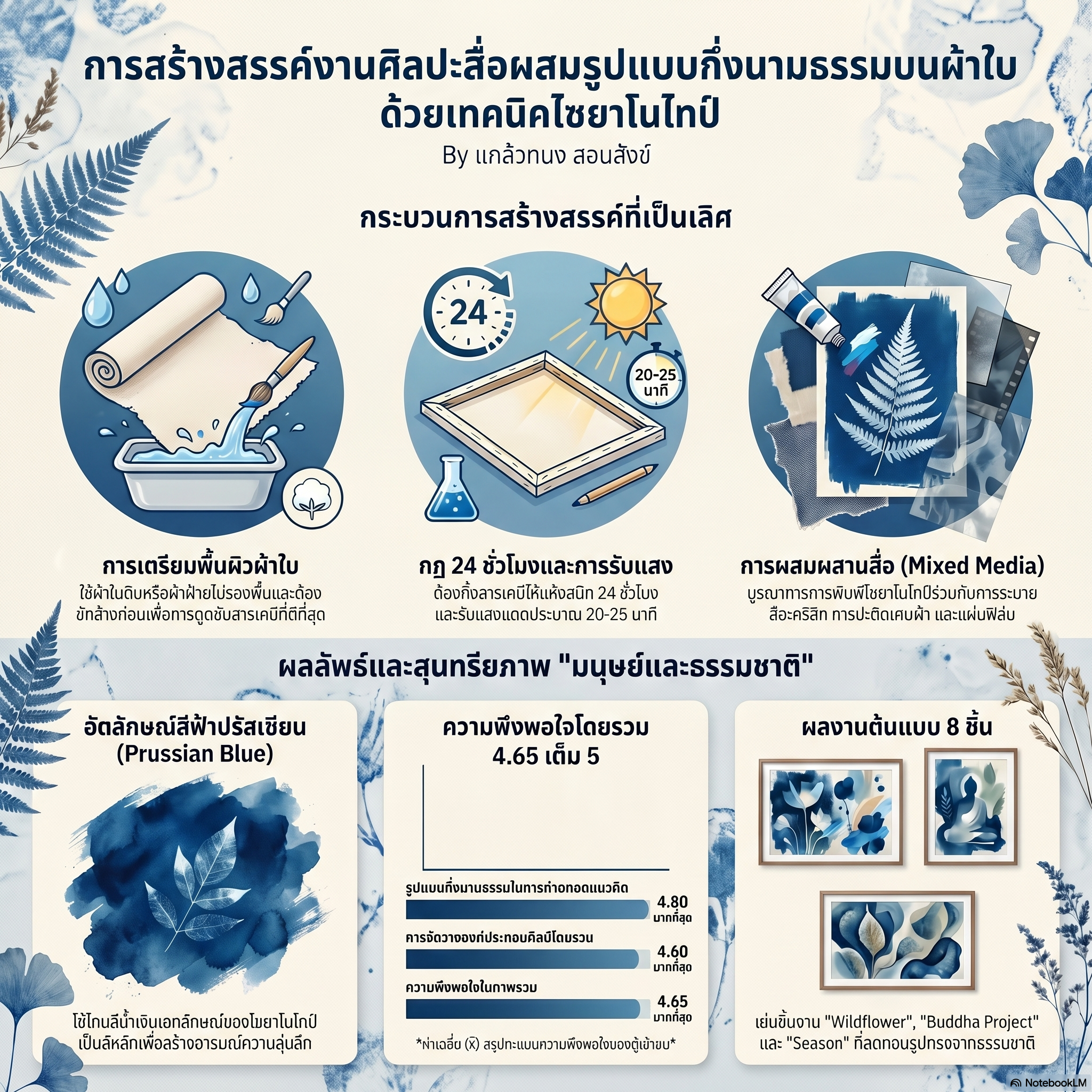
The purposes of this research were: 1) to study and experiment with the creative process of semi-abstract mixed media art on canvas by applying the cyanotype technique; 2) to create semi-abstract mixed media artworks under the theme “Humans and Nature”; and 3) to evaluate the impact of the cyanotype technique on the form and aesthetics of the created artworks. The research methodology involved documentary research, studio-based experiments, the creation of eight prototype artworks, and an evaluation phase. The target group consisted of 5 visual arts experts and 50 exhibition visitors. Qualitative data were analyzed through content analysis, while quantitative data were analyzed using descriptive statistics. The research results revealed that: 1) The cyanotype technique can be effectively applied to canvas by using unprimed raw canvas or raw cotton that has been pre-washed. Optimal results are achieved when the chemicals are allowed to dry for at least 24 hours and the sunlight exposure duration is controlled between 20–25 minutes. 2) The creative process resulted in eight semi-abstract mixed media pieces that harmoniously integrated cyanotype printing utilizing natural materials, synthetic objects, and photographic film with collage and acrylic painting, effectively conveying the "Humans and Nature" concept. 3) Experts concurred that the technique established a unique aesthetic through the signature Prussian blue tones and organic traces of nature. Overall, exhibition visitors reported the highest level of satisfaction ( = 4.65), with the highest satisfaction specifically noted in the use of semi-abstract forms to convey the underlying concept ( = 4.80). The knowledge gained from this research offers a novel approach to contemporary visual arts and serves as an innovative medium for art education to further promote creative thinking.
References
ธีรวัฒน์ งามเชื้อชิต. (2563). ศิลปะร่วมสมัย: บทบาทและความท้าทาย. วารสารศิลปศาสตร์ มหาวิทยาลัยขอนแก่น, 10(2), 45-58.
วิรุณ ตั้งเจริญ. (2546). ศิลปะร่วมสมัย. ทิพยวิสุทธิ์.
วิรุณ ตั้งเจริญ. (2562). ศิลปะกับการพัฒนาคน. ใน ศิลปะเพื่อชีวิตและสังคม (น. 1-23). สำนักพิมพ์จุฬาลงกรณ์มหาวิทยาลัย.
สำนักงานเลขาธิการสภาการศึกษา. (2560). พระบรมราโชบายด้านการศึกษาในรัชกาลที่ 9. http://www.onec.go.th/index.php/book-online/20-2012-09-19-05-39-33/238-king9
Acton, M. (2009). Learning to look at paintings (2nd ed.). Routledge.
Almeida, B., & Cuin, A. (2022). Creativity and cyanotype: Exploring camera-less photography as an alternative for art education. Quarks: Brazilian Electronic Journal of Physics, Chemistry & Materials Science, 4(1), 34-44. https://doi.org/10.34019/2674-9688.2022.v4.36460
Arnheim, R. (1974). Art and visual perception: A psychology of the creative eye. University of California Press. https://doi.org/10.1525/9780520351271
Chipp, H. B. (1968). Theories of modern art. University of California Press.
Hu, L. (2022). Design and application of cyanotype technology in cultural and creative products. BCP Social Sciences and Humanities, 8, 194-198. https://doi.org/10.54691/bcpssh.v18i.975
James, C. (2016). Cyanotype: The history and art of blueprint. Crowood Press.
Ware, M. (2014). Cyanotype: A guide to making blueprints. Routledge.
Downloads
Published
How to Cite
Issue
Section
Categories
License
Copyright (c) 2026 Faculty of Education, Srinakharinwirot university

This work is licensed under a Creative Commons Attribution-NonCommercial-NoDerivatives 4.0 International License.


