THE STRATEGIC CHANGE MANAGEMENT OF SCHOOL ADMINISTRATORS EFFECT TO TEACHERS WORK PASSION IN BANGKOK METROPOLITAN ADMINISTRATION SCHOOLS
Keywords:
Strategic Change Management, Work Passion, Educational AdministratorsAbstract
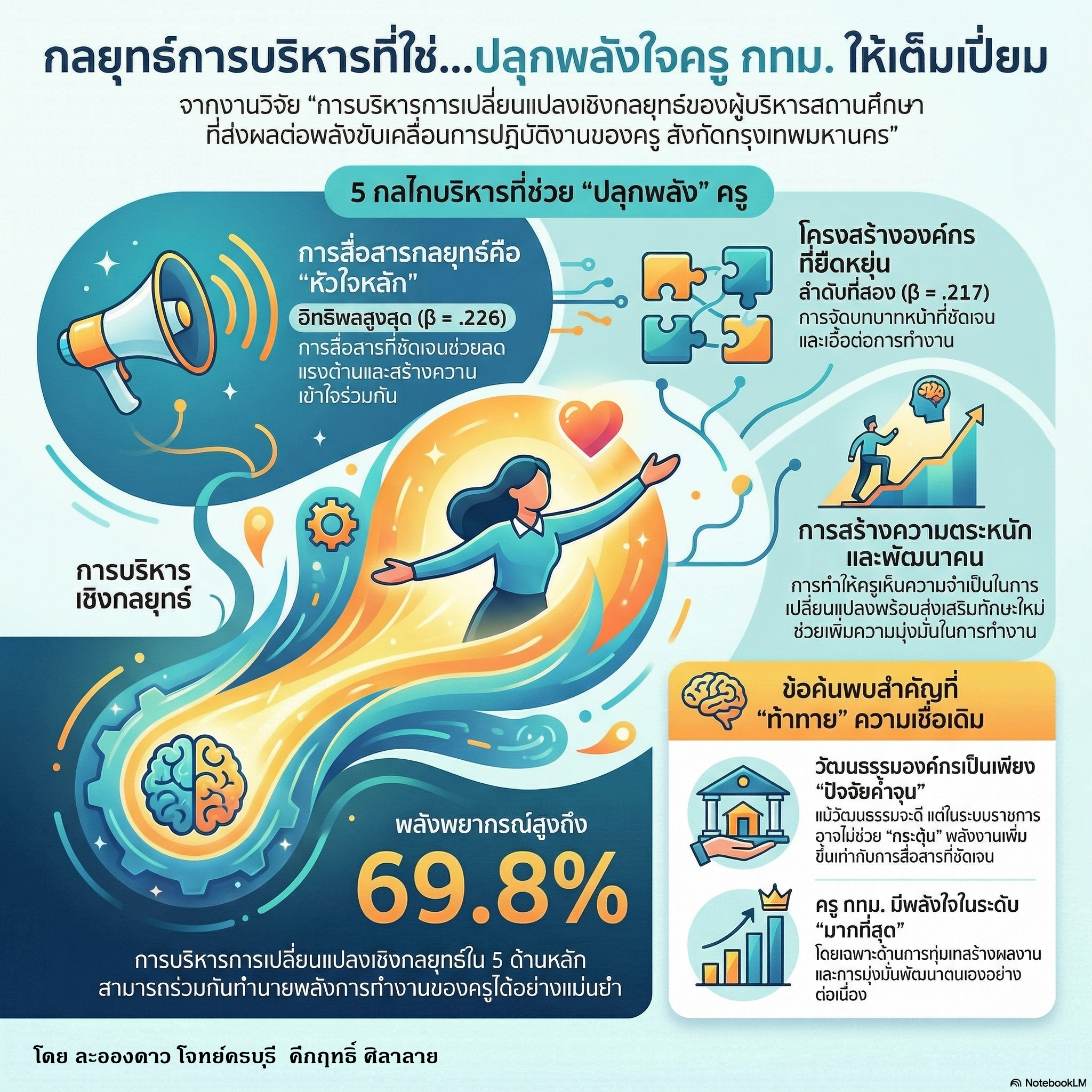
This research aimed to 1)study strategic change management of school administrators under the Bangkok Metropolitan Administration (BMA), 2) study the driving forces of teacher performance in the Bangkok Metropolitan Administration (BMA), 3) identify the relationship between strategic change management of school administrators and the driving forces of teacher performance in the Bangkok Metropolitan Administration, and
4) study the influence of strategic change management of school administrators on the driving forces of teacher performance in the Bangkok Metropolitan Administration. The sample consisted of 370 teachers under the Bangkok Metropolitan Administration (BMA) in the 2025 academic year, selected using a multistage random sampling method. The research instrument was a questionnaire with a reliability of 0.988. Statistics used included frequency, percentage, mean, standard deviation, Pearson’s product-moment correlation coefficient, and multiple regression. The results found that: 1)Overall and specific aspects of strategic change management of school administrators under the Bangkok Metropolitan Administration (BMA) were at the highest level., 2) Overall and specific aspects of teacher performance in the Bangkok Metropolitan Administration (BMA) were at the highest level., 3) Strategic change management of school administrators was positively correlated with the driving forces of teacher performance in the Bangkok Metropolitan Administration (BMA). Statistically significant at the .01 level. and 4) Strategic change management by school administrators significantly impacts the performance of teachers in Bangkok at the .05 level.
References
กนกพร แทนบุญ, นวรัตน์ ไวชมภู, และ ชณัฐ พรหมศรี. (2568). ภาวะผู้นำการเปลี่ยนแปลงของผู้บริหารสถานศึกษาที่ส่งผลต่อแรงจูงใจในการปฏิบัติงานของข้าราชการครู สังกัดสำนักงานเขตพื้นที่การศึกษาประถมศึกษาสงขลา เขต 3. วารสารมณีเชษฐาราม, 8(1), 266–281.
กมลนาถ แดนราช, เยาวลักษณ์ สุตะโคตร, และ ผกาพรรณ วะนานาม. (2567). ภาวะผู้นำการเปลี่ยนแปลงของผู้บริหารที่ส่งผลต่อแรงจูงใจใฝ่สัมฤทธิ์ในการปฏิบัติงานของครูในโรงเรียนประถมศึกษา สังกัดเทศบาลในกลุ่มการศึกษาท้องถิ่นที่ 11. วารสารการบริหารการศึกษาและภาวะผู้นำ มหาวิทยาลัยราชภัฏสกลนคร, 12(46), 111–121.
กองนโยบายและแผนการศึกษา. (2565). รายงานการพัฒนาการศึกษากรุงเทพมหานคร. สำนักนโยบายและแผนการศึกษา กระทรวงศึกษาธิการ.
ณัฐฐา วรรณสุข. (2563). ปัจจัยที่ทำให้เกิดความมุ่งมั่นและพลังขับเคลื่อน การคิดเชิงบวก และระดับความมุ่งมั่นและพลังขับเคลื่อนในการทำงานของพนักงานโรงแรมชั้นนำเทียบเท่าโรงแรมระดับ 4-5 ดาวในเขตกรุงเทพมหานคร [วิทยานิพนธ์ปริญญามหาบัณฑิต, สถาบันบัณฑิตพัฒนบริหารศาสตร์].
ทรายแก้ว จันทร์แจ่มฟ้า. (2566). บทบาทของผู้บริหารสถานศึกษาที่ส่งเสริมความมีใจรักและพลังขับเคลื่อน (Passion) ในการปฏิบัติงานของครูในโรงเรียน สังกัดสำนักงานเขตพื้นที่การศึกษามัธยมศึกษากรุงเทพมหานคร [วิทยานิพนธ์ปริญญามหาบัณฑิต, มหาวิทยาลัยสยาม].
ธนวัฒน์ กองแก้ว และ นิคม นาคอ้าย. (2565). ภาวะผู้นำการเปลี่ยนแปลงของผู้บริหารสถานศึกษา สังกัดสำนักงานเขตพื้นที่การศึกษามัธยมศึกษาพิษณุโลกอุตรดิตถ์. Journal of Roi Kaensarn Academi, 7(8), 322–333.
บุญชม ศรีสะอาด. (2560). การวิจัยเบื้องต้น (พิมพ์ครั้งที่ 10). สุวีริยาสาส์น.
พชร ใจอารีย์ และ ประสพชัย พสุนนท์. (2564). การวิเคราะห์สหสัมพันธ์คาโนนิคอล ระหว่างความรักและพลังขับเคลื่อนองค์กรกับประสิทธิภาพในการทำงานของนักบริหารทรัพยากรมนุษย์ในกรุงเทพมหานคร. วารสารวิชาการศรีปทุม ชลบุรี, 17(4), 58–68.
พิชญาภา วงศ์หมัดทอง. (2563). ภาวะผู้นำการเปลี่ยนแปลงที่ส่งผลกระทบต่อความมุ่งมั่นทุ่มเทในการทำงาน กรณีศึกษา บุคลากรโรงพยาบาลสงขลา [วิทยานิพนธ์ปริญญามหาบัณฑิต, มหาวิทยาลัยสงขลานครินทร์].
รัตดาวรรณ วงค์คำจันทร์, วาโร เพ็งสวัสดิ์, และ เอกลักษณ์ เพียสา. (2568). การศึกษาองค์ประกอบการบริหารการเปลี่ยนแปลงเชิงกลยุทธ์ของผู้บริหารโรงเรียนขยายโอกาสทางการศึกษา. วารสารวิจัยวิชาการ, 8(2), 145–160.
สำนักงานคณะกรรมการนโยบายรัฐวิสาหกิจ. (2561). แผนยุทธศาสตร์ชาติ 20 ปี พ.ศ. 2561-2580. กระทรวงการคลัง. (หมายเหตุ: ต้นฉบับมีซ้ำกัน 2 รายการ ปรับให้เหลือ 1 รายการ)
สำนักการศึกษา กรุงเทพมหานคร. (2565). แผนพัฒนาการศึกษาขั้นพื้นฐานกรุงเทพมหานคร ฉบับที่ 3 (พ.ศ. 2564-2569).
สำนักการศึกษา กรุงเทพมหานคร. (2568). รายงานสถิติการศึกษา ปีการศึกษา 2567 โรงเรียนสังกัดกรุงเทพมหานคร.
Albrecht, S. L., Bakker, A. B., Gruman, J. A., Macey, W. H., & Saks, A. M. (2022). Change-related resources and employee engagement in organizational transformation. Journal of Organizational Change Management, 35(4), 678–695. https://doi.org/10.1108/JOCM-06-2021-0186
Burnes, B. (2017). Managing change (7th ed.). Pearson Education.
Cohen, L., Manion, L., & Morrison, K. (2011). Research methods in education (7th ed.). Routledge.
Errida, A., & Lotfi, B. (2021). The determinants of organizational change management success: Literature review and case study. International Journal of Engineering Business Management, 13, 1–15. https://doi.org/10.1177/18479790211016273
Hair, J. F., Black, W. C., Babin, B. J., & Anderson, R. E. (2019). Multivariate data analysis (8th ed.). Cengage Learning EMEA.
Harris, A. (2013). Distributed leadership: Developing tomorrow's leaders. Routledge.
Herzberg, F., Mausner, B., & Snyderman, B. B. (1959). The motivation to work. John Wiley & Sons.
Hinkle, D. E., Wiersma, W., & Jurs, S. G. (2003). Applied statistics for the behavioral sciences (5th ed.). Houghton Mifflin.
Idris, M., Maryadi, Saripuddin, D., Firman, A., & Hidayat, M. (2022). The effect of transformational leadership style, organizational culture, and work motivation toward employee performance (Study on developer companies in Makassar). Academy of Strategic Management Journal, 21(S1), 1–15. https://doi.org/10.31219/osf.io/wrzqg
Kirkman, B. L., Stoverink, A. C., Mistry, S., & Rosen, B. (2022). Organizational change and employee motivation: A multi-level perspective. Journal of Organizational Behavior, 43(4), 289–306. https://doi.org/10.1002/job.2577
Kotter, J. P. (1996). Leading change. Harvard Business School Press.
Leithwood, K., Seashore Louis, K., Anderson, S., & Wahlstrom, K. (2004). How leadership influences student learning. The Wallace Foundation. https://doi.org/10.59656/EL-SB5787.001
Lewin, K. (1947). Frontiers in group dynamics: Concept, method and reality in social science. Human Relations, 1(1), 5–41. https://doi.org/10.1177/001872674700100103
Musaigwa, M. (2023). The role of leadership in managing change. International Review of Management and Marketing, 13(6), 1–9. https://doi.org/10.32479/irmm.13526
Nguyen, L. T., & Nguyen, H. T. (2023). Teachers' job engagement and organizational change: Evidence from urban schools. International Journal of Educational Development, 89, 102490. https://doi.org/10.1016/j.ijedudev.2022.102490
Zigarmi, D., Nimon, K., Houson, D., Witt, D., & Diehl, J. (2009). Beyond engagement: Toward a framework and operational definition for employee work passion. Human Resource Development Review, 8(3), 300–326. https://doi.org/10.1177/1534484309338171
Downloads
Published
How to Cite
Issue
Section
Categories
License
Copyright (c) 2026 Faculty of Education, Srinakharinwirot university

This work is licensed under a Creative Commons Attribution-NonCommercial-NoDerivatives 4.0 International License.


