ผลของการจัดการเรียนรู้คณิตศาสตร์แบบบูรณาการผ่านกิจกรรม “นักออกแบบอาหาร” โดยใช้กระบวนการออกแบบเชิงวิศวกรรมที่มีต่อความคิดสร้างสรรค์ของนักเรียนชั้นประถมศึกษาปีที่ 6
คำสำคัญ:
การจัดการเรียนรู้คณิตศาสตร์แบบบูรณาการ, กระบวนการออกแบบเชิงวิศวกรรม, นักเรียนชั้นประถมศึกษา, ความคิดสร้างสรรค์บทคัดย่อ
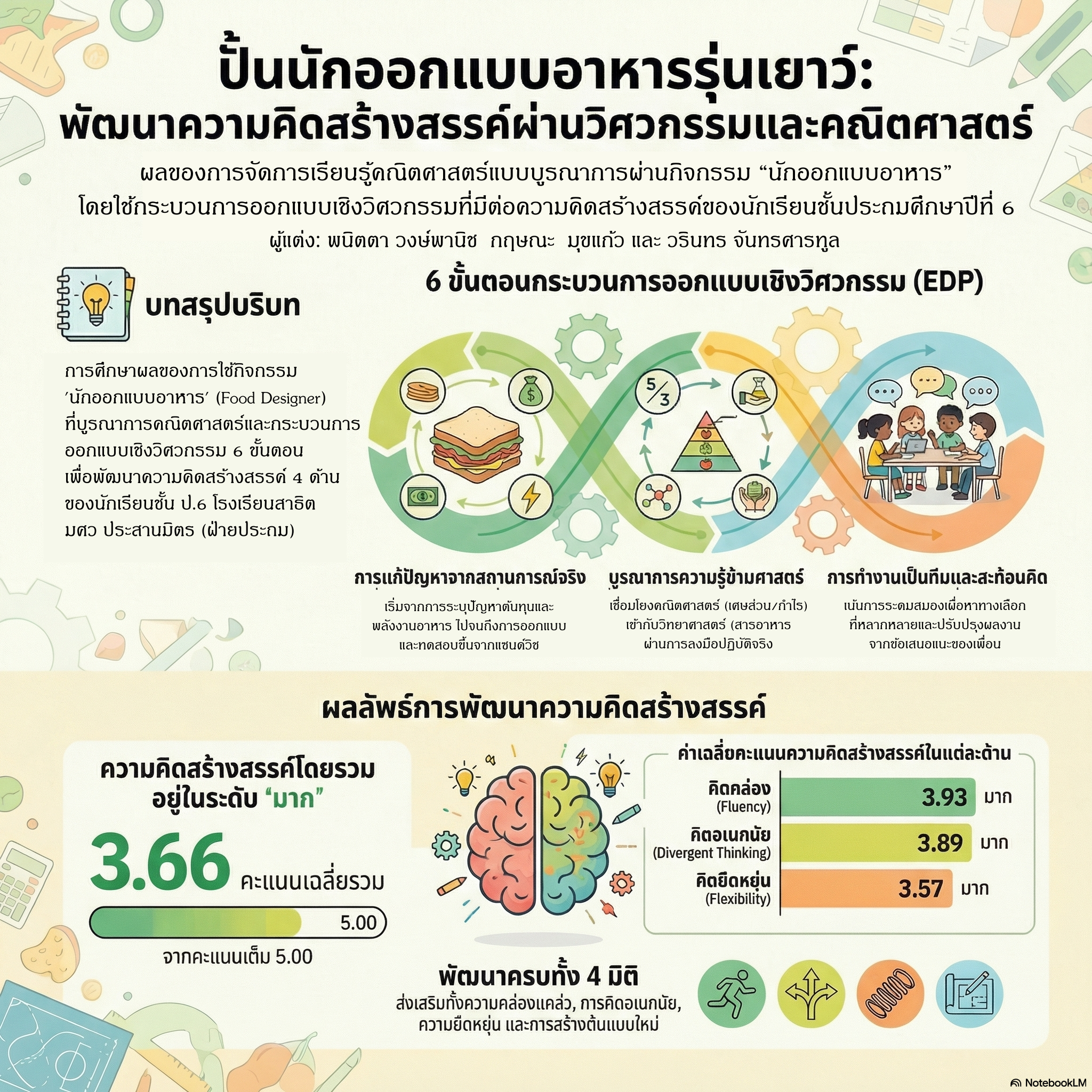
การวิจัยนี้มีวัตถุประสงค์การวิจัยเพื่อศึกษาผลการจัดการเรียนรู้คณิตศาสตร์แบบบูรณาการผ่านกิจกรรม "นักออกแบบอาหาร" โดยใช้กระบวนการออกแบบเชิงวิศวกรรมที่มีต่อความคิดสร้างสรรค์ของนักเรียนชั้นประถมศึกษาปีที่ 6 กลุ่มตัวอย่างที่ใช้ในการวิจัย เป็นนักเรียนชั้นประถมศึกษาปีที่ 6 โรงเรียนสาธิตมหาวิทยาลัยศรีนครินทรวิโรฒ ประสานมิตร (ฝ่ายประถม) จำนวน 30 คน ได้มาจากการเลือกกลุ่มตัวอย่างแบบเจาะจง เครื่องมือที่ใช้ในการวิจัย ประกอบด้วย แผนการจัดการเรียนรู้ เรื่อง การบวกลบเศษส่วนที่ตัวส่วนไม่เท่ากัน ใบกิจกรรม เรื่อง การคิดกำไรต้นทุน และใบกิจกรรม เรื่อง เลขวิทย์กับชีวิตเรา สถิติที่ใช้ในการวิจัย คือ สถิติพรรณนา (Descriptive Statistics) ผลการวิจัยพบว่า นักเรียนชั้นประถมศึกษาปีที่ 6 มีความคิดสร้างสรรค์โดยรวมอยู่ในระดับมาก (M=3.66 SD=1.68) เมื่อพิจารณาเป็นรายองค์ประกอบ พบว่า คิดคล่องมีค่าเฉลี่ยสูงสุด (M=3.93 SD=1.75) คิดอเนกนัย (M=3.89 SD=1.77) คิดยืดหยุ่น (M=3.57 SD=1.68) และคิดเป็นต้นแบบมีค่าเฉลี่ยต่ำสุด (M=3.25 SD=1.51) ตามลำดับ
เอกสารอ้างอิง
กมลพร จินดาหลวง. (2555). การจัดการเรียนรู้คณิตศาสตร์. https://www.gotoknow.org/posts/305858
กิตติมาพร จันทร และ ภูษณิศา สุวรรณศิลป์. (2568). การพัฒนาทักษะความคิดสร้างสรรค์ โดยใช้การจัดการเรียนรู้ตามแนวทางสะเต็มศึกษาด้วยกระบวนการออกแบบเชิงวิศวกรรมของนักเรียนระดับชั้นมัธยมศึกษาปีที่ 1. วารสารสังคมศาสตร์และมนุษยศาสตร์แห่งรัตนโกสินทร์, 7(1), 66–84.
คงศักดิ์ วัฒนะโชติ. (2568). การพัฒนากิจกรรมการเรียนรู้วิทยาศาสตร์เพื่อสร้างนวัตกรรมตามแนวคิดสะเต็มศึกษาด้วยกระบวนการออกแบบเชิงวิศวกรรม. วารสารสหศาสตร์ศรีปทุม ชลบุรี, 11(1), 10-113.
ชนาธิป พรกุล. (2561). กระบวนการสร้างความรู้ของครูกรณีการสอนบูรณาการ. สำนักพิมพ์จุฬาลงกรณ์มหาวิทยาลัย.
ฐานิตดา นัดที และ สกนธ์ชัย ชะนูนันท์. (2566). การจัดการเรียนรู้ตามแนวคิดสะตีมศึกษาด้วยกระบวนการคิดเชิงออกแบบเพื่อพัฒนาความสามารถในการสร้างสรรค์ผลงาน เรื่อง วัสดุและการใช้ประโยชน์สำหรับนักเรียนชั้นประถมศึกษาปีที่ 2. วารสารศึกษาศาสตร์ มหาวิทยาลัยนเรศวร, 25(4), 154-165.
ทิศนา แขมมณี. (2562). ศาสตร์การสอน: องค์ความรู้เพื่อการจัดกระบวนการเรียนรู้ที่มีประสิทธิภาพ. สำนักพิมพ์จุฬาลงกรณ์มหาวิทยาลัย.
ธัญญเรศ ก้อนจันทร์เทศ และ สิรินภา กิจเกื้อกูล. (2566). การจัดการเรียนรู้แบบสะตีมศึกษา เพื่อส่งเสริมทักษะความคิดสร้างสรรค์และเจตคติต่อวิทยาศาสตร์ เรื่อง สารอาหารของนักเรียนชั้นประถมศึกษาปีที่ 6. Journal of Roi Kaensarn Academi, 8(10), 50-69.
นิติพัฒน์ พินยะพงค์. (2555). การบูรณาการคณิตศาสตร์กับวิชาอื่น. https://www.gotoknow.org/posts/401850
ฟัตมาอัสไวนี ตาเย๊ะ, ณัฐินี โมพันธุ์, และ มัฮดี แวดราแม. (2560). ผลของการจัดการเรียนรู้ตามแนวคิดสะเต็มศึกษาที่มีต่อผลสัมฤทธิ์ทางการเรียนวิทยาศาสตร์ ความคิดสร้างสรรค์ และความพึงพอใจต่อการจัดการเรียนรู้ของนักเรียนชั้นประถมศึกษาปีที่ 6. วารสารมนุษยศาสตร์และสังคมศาสตร์ มหาวิทยาลัยนราธิวาสราชนครินทร์, 4(2), 1-14.
โรงเรียนสาธิตมหาวิทยาลัยศรีนครินทรวิโรฒ ประสานมิตร (ฝ่ายประถม). (2566). รายงานการประเมินตนเอง (Self-Assessment Report) ประจำปีการศึกษา 2565 [เอกสารไม่ตีพิมพ์]. คณะศึกษาศาสตร์ มหาวิทยาลัยศรีนครินทรวิโรฒ.
สมหญิง เพ็ชรสุวรรณ และ สิรินภา กิจเกื้อกูล. (2567). การจัดการเรียนรู้แบบสะตีมศึกษา เพื่อพัฒนาความคิดสร้างสรรค์ทางคณิตศาสตร์ เรื่อง รูปเรขาคณิตในลายผ้าทอน้ำอ่างของนักเรียนชั้นประถมศึกษาปีที่ 6. Journal of Education and Innovation, 26(2), 332-346.
สิทธิชัย พานิชย์วิไล และ สิรินภา กิจเกื้อกูล. (2566). การพัฒนาการจัดการเรียนรู้ที่เน้นปฏิบัติการทางคณิตศาสตร์ตามแนวทฤษฎีโซเชียลคอนสตรัคติวิสต์ร่วมกับโปรแกรม GeoGebra ที่ส่งเสริมความคิดสร้างสรรค์ทางคณิตศาสตร์ เรื่อง วงกลม ของนักเรียนระดับชั้นมัธยมศึกษาปีที่ 3. วารสารศึกษาศาสตร์ มหาวิทยาลัยนเรศวร, 25(3), 286–296.
สำนักบริหารงานการมัธยมศึกษาตอนปลาย. (2559). แนวทางจัดการเรียนรู้ในศตวรรษที่ 21. https://webs.rmutl.ac.th/assets/upload/files/2016/09/20160908101755_51855.pdf
Guilford, J. P. (1967). The nature of human intelligence. https://gwern.net/doc/iq/1967-guilford-thenatureofhumanintelligence.pdf
National Research Council. (2012). A framework for K-12 science education: Practices, crosscutting concepts, and core ideas. National Academies Press. https://doi.org/10.17226/13165
Soon, B. K., Dongsoo, N., & Tae, W. L. (2011). The effects of convergence education based STEAM on elementary school students’ creative personality. In The 19th International Conference on Computers in Education (pp. 783-785). https://library.apsce.net/index.php/ICCE/article/view/2639
ดาวน์โหลด
เผยแพร่แล้ว
รูปแบบการอ้างอิง
ฉบับ
ประเภทบทความ
หมวดหมู่
สัญญาอนุญาต
ลิขสิทธิ์ (c) 2026 คณะศึกษาศาสตร์ มหาวิทยาลัยศรีนครินทรวิโรฒ

อนุญาตภายใต้เงื่อนไข Creative Commons Attribution-NonCommercial-NoDerivatives 4.0 International License.


