GUIDELINES FOR USING ARTIFICIAL INTELLIGENCE (AI) TECHNOLOGY TO ENHANCE THE EFFICIENCY OF ACADEMIC ADMINISTRATION IN THE EXECUTIVE MANAGEMENT OF STATE-CONTROLLED HIGHER EDUCATION INSTITUTIONS
Keywords:
Needs Assessment, Academic Administration, State-Controlled Higher Education Institutions, Artificial Intelligence (AI)Abstract
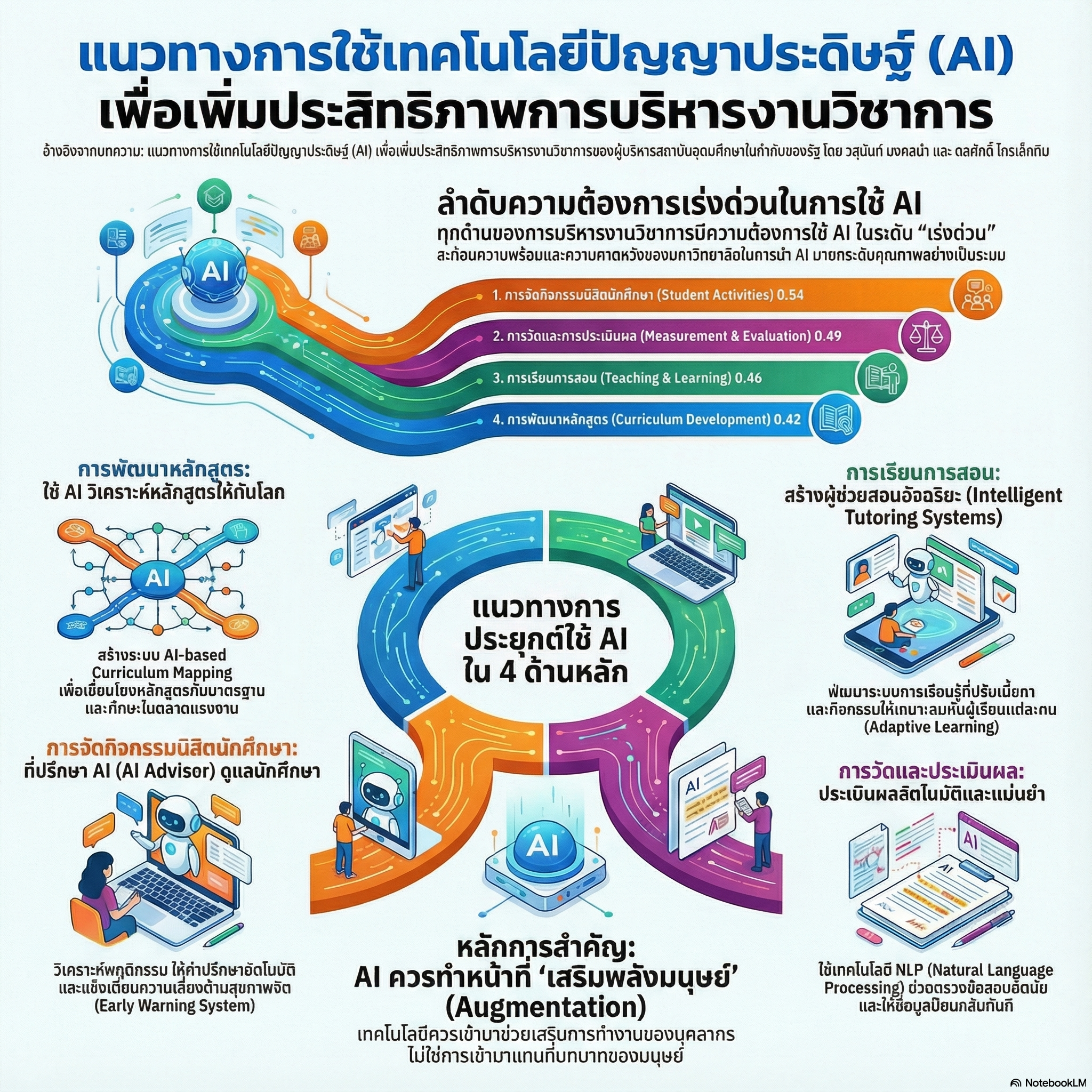
This study aimed 1) to assess the needs for applying artificial intelligence (AI) technology to enhance the efficiency of academic administration among executives of state-controlled higher education institutions, and 2) to propose practical guidelines for utilizing AI to improve academic administration in such institutions. The research was conducted in two phases. Phase 1 employed a quantitative method using questionnaires administered to a sample of 377 respondents from seven state-controlled universities. Data were analyzed using the PNImodified index to prioritize the needs. Phase 2 adopted a qualitative approach through in-depth interviews with nine experts, including four experts with experience in higher education academic administration and five AI specialists with expertise in the application of AI in higher education. Data were analyzed using content analysis. The findings revealed that 1) all aspects of academic administration showed an urgent level of need, reflecting the institutions, readiness and expectations to systematically adopt AI to enhance the quality of academic management. The prioritized needs, based on PNImodified values from highest to lowest, were student activity management (0.54), assessment and evaluation (0.49), teaching and learning (0.46), and curriculum development (0.42), respectively, and 2) the proposed AI application guidelines derived from the qualitative phase included the use of AI-based curriculum mapping systems to align programs with industry standards, intelligent tutoring systems and adaptive learning technologies, AI for analyzing student behavior and providing personalized academic counseling, as well as automated assessment through NLP technologies and scoring systems based on standard indicators. Importantly, AI implementation should adhere to the principle of “human augmentation” and be accompanied by strategic development in policy, infrastructure, personnel, and organizational culture to achieve sustainable transformation.
References
กระทรวงดิจิทัลเพื่อเศรษฐกิจและสังคม. (2565). แผนปฏิบัติการด้านปัญญาประดิษฐ์แห่งชาติ (พ.ศ. 2565–2570). สืบค้นจาก https://www.mdes.go.th/
กระทรวงดิจิทัลเพื่อเศรษฐกิจและสังคม. (2568). รายงานการประชุมคณะกรรมการขับเคลื่อนแผนปฏิบัติการด้าน AI แห่งชาติ ครั้งที่ 1/2568. สืบค้นจาก https://www.mdes.go.th/
กองยุทธศาสตร์และแผนงาน สำนักงานปลัดกระทรวงอุดมศึกษา วิทยาศาสตร์ วิจัยและนวัตกรรม. (2567). แผนปฏิบัติราชการรายปี พ.ศ. 2567 ของสำนักงานปลัดกระทรวงอุดมศึกษา วิทยาศาสตร์และนวัตกรรม. สืบค้นจาก https://www.ops.go.th/th/aboutus/strategic-policy/item/9542-2567-action-plan-2567
ณัฐกานต์ พวงไพบูลย์, และ แม้นวาด รชนีกรไกรลาศ. (2564). กลยุทธ์การบริหารวิชาการของสถาบันอุดมศึกษาในประเทศไทยเพี่อส่งเสริมการพัฒนาที่ยั่งยืน. วารสารพุทธศาสตร์ศึกษา, 12(1), 1-19. สืบค้นจาก https://so02.tcithaijo.org/index.php/JBS/article/view/246289/168552
ทนง ทองภูเบศร์, และคณะ. (2562). รายงานฉบับสมบูรณ์อนาคตภาพของรูปแบบการประเมินและการประกันคุณภาพการศึกษาภายนอกระดับอุดมศึกษาทศวรรษหน้า. สืบค้นจาก https://www.onesqa.or.th/upload/download/202112081151012.pdf
น้ำอ้อย ชินวงศ์. (2561). กลยุทธ์การบริหารวิชาการสถาบันอุดมศึกษาในการกำกับของรัฐตามแนวคิดสมรรถนะข้ามสายงาน (วิทยานิพนธ์ปริญญาดุษฎีบัณฑิต). กรุงเทพฯ: จุฬาลงกรณ์มหาวิทยาลัย. สืบค้นจาก https://digital.car.chula.ac.th/cgi/viewcontent.cgi?article=4039&context=chulaetd
นิจวรรณ วีรวัฒโนดม, และ นงณภัทร รุ่งเนย. (2555). การบริหารสถาบันอุดมศึกษาตามหลักปรัชญาเศรษฐกิจพอเพียง. วารสารวิทยาลัยพยาบาลพระปกเกล้า จันทบุรี, 23(2), 65-72.
ไพฑูรย์ สินลารัตน์. (2548). หลักการของพื้นฐานอุดมศึกษา. กรุงเทพฯ: จุฬาลงกรณ์มหาวิทยาลัย.
ราชบัณฑิตยสถาน. (2555). พจนานุกรมศัพท์ศึกษาศาสตร์ ฉบับราชบัณฑิตยสถาน. กรุงเทพฯ: อรุณการพิมพ์.
วิจิตร ศรีสอ้าน. (2559). มหาวิทยาลัยในกำกับของรัฐ: นวัตกรรมการบริหารมหาวิทยาลัยในประเทศไทย. กรุงเทพฯ: [ม.ป.พ.].
วิโรจน์ สารรัตนะ. (2566). การวิจัยทางการบริหารการศึกษา: แนวคิดและกรณีศึกษา (พิมพ์ครั้งที่ 5). กรุงเทพฯ: ศูนย์หนังสือแห่งจุฬาลงกรณ์มหาวิทยาลัย.
สมใจ ลักษณะ. (2544). ความหมายของประสิทธิภาพในการบริหาร. กรุงเทพฯ: สำนักพิมพ์การศึกษา.
สรรชัย ชูชีพ. (2558). กลยุทธ์การบริหารมหาวิทยาลัยตามแนวคิดการเสริมสร้างขีดความสามารถของมนุษย์ (วิทยานิพนธ์ปริญญาดุษฎีบัณฑิต). กรุงเทพฯ: จุฬาลงกรณ์มหาวิทยาลัย. สืบค้นจาก https://cuir.car.chula.ac.th/handle/123456789/50778
สำนักงานคณะกรรมการอุดมศึกษา. (2557). คู่มือการประกันคุณภาพการศึกษาภายในระดับอุดมศึกษา พ.ศ. 2557. กรุงเทพฯ: ภาพพิมพ์. สืบค้นจาก https://qm.kku.ac.th/downloads/hbMUA57ed3.pdf
สำนักงานปลัดกระทรวงการอุดมศึกษา วิทยาศาสตร์ วิจัยและนวัตกรรม. (2567ก). บุคลากรอุดมศึกษา ปีการศึกษา 2567 ภาคเรียนที่ 1 ในสถาบันอุดมศึกษาทั้งหมด จำแนกตาม. สืบค้นจาก https://info.mhesi.go.th/stat_stf.php?search_year=2567&download=7358&file_id=2024101106.xlsx
สำนักงานปลัดกระทรวงการอุดมศึกษา วิทยาศาสตร์ วิจัยและนวัตกรรม. (2567ข). อว. for AI. สืบค้นจาก https://www.mhesi.go.th/index.php/news-and-announce-all/news-all/106-minister-supamas/10300-for-ai-ai-fagship-al-3-al-ai-3-3-al.html
สิริวดี ชูเชิด. (2556). การศึกษาประสิทธิภาพการทำงานของบุคลากรในองค์กรภาครัฐ มหาวิทยาลัยศรีนครินทรวิโรฒ (สารนิพนธ์ปริญญามหาบัณฑิต). กรุงเทพฯ: มหาวิทยาลัยศรีนครินทรวิโรฒ.
สุดารัตน์ สารสว่าง. (2552). การบริหาร: การบริหารงานวิชาการอุดมศึกษา. สืบค้นจาก https://www.arit.rmutp.ac.th/kms/wp-content/uploads/2009/11/norborkor13.20.pdf
สุวิมล ว่องวาณิช. (2558). การวิจัยประเมินความต้องการจําเป็น (พิมพ์ครั้งที่ 3). กรุงเทพฯ: สํานักพิมพ์แห่งจุฬาลงกรณ์มหาวิทยาลัย.
เสริมศักดิ์ วิศาลาภรณ์. (2542). การบริหารงานวิชาการ (เอกสารประกอบการสอน). กรุงเทพฯ: บัณฑิตวิทยาลัย มหาวิทยาลัยศรีนครินทรวิโรฒ ประสานมิตร.
อัจฉราวรรณ จันทร์เพ็ญศรี. (2558). การนำเสนอรูปแบบความร่วมมือระหว่างงานวิชาการและงานกิจกรรมนิสิตนักศึกษาเพื่อพัฒนานิสิตนักศึกษาในสถาบันอุดมศึกษา. สืบค้นจาก https://shorturl.asia/pMARk
Baker, R. S., & Inventado, P. S. (2016). Educational data mining and learning analytics. In J. A. Larusson & B. White (Eds.), Learning analytics: From research to practice (pp. 61-75). New York, NY: Springer.
Chen, L., Chen, P., & Lin, Z. (2020). Artificial intelligence in education: A review. IEEE Access, 8, 75264-75278. doi:10.1109/ACCESS.2020.2988510
Goel, A., & Polepalli, S. (2018). Intelligent tutoring systems: The role of AI in adaptive learning environments. Educational Technology Research and Development, 66(4), 937-954.
Herodotou, C., Rienties, B., & Boroowa, A. (2019). Large scale implementation of learning analytics in higher education: Challenges and future directions. British Journal of Educational Technology, 50(5), 2466-2483. doi:10.1111/bjet.12879
Holmes, W., Bialik, M., & Fadel, C. (2019). Artificial intelligence in education: Promises and implications for teaching and learning. Boston, MA: Center for Curriculum Redesign.
Holmes, W., Bialik, M., & Fadel, C. (2022). Artificial intelligence in education: Promises and implications for teaching and learning (2nd ed.). Boston, MA: Center for Curriculum Redesign.
Holstein, K., McLaren, B. M., & Aleven, V. (2018). Student learning benefits of a mixed-reality teacher awareness tool in AI-enhanced classrooms. In S. Isotani, et al. (Eds.), Artificial Intelligence in Education: AIED 2018 (pp. 154-168). Cham: Springer.
Huang, M. H., & Rust, R. T. (2021). A strategic framework for artificial intelligence in marketing. Journal of the Academy of Marketing Science, 49(1), 30-50. doi:10.1007/s11747-020-00749-9
Knowles, A. (1970). Handbook of college and university administration. New York, NY: McGraw-Hill.
Krejcie, R. V., & Morgan, D. W. (1970). Determining sample size for research activities. Educational and Psychological Measurement, 30(3), 607-610.
Kukulska-Hulme, A., Lee, H., & Norris, L. (2021). Artificial intelligence and personalized learning in higher education: Opportunities and challenges. British Journal of Educational Technology, 52(4), 1235-1248. doi:10.1111/bjet.13078
Kumar, V. S., & Boulanger, D. (2020). Automated essay scoring and the deep learning black box: How are rubric scores determined? International Journal of Artificial Intelligence in Education, 31(4), 538-584. doi:10.1007/s40593-020-00211-5
Millett, J. D. (1954). Management in the public service: The quest for effective performance. New York, NY: McGraw-Hill.
Nguyen, L. T., & Wong, Y. K. (2019). The digital school project: Enabling technology-enhanced learning in K-12 education in Vietnam. In Handbook of research on emerging technologies for digital learning, teaching and assessment. Cham: Springer.
Organisation for Economic Co-operation and Development. (2022). OECD digital education outlook 2022. Retrieved from https://www.oecd.org/
Popencil, A., & Ken, D. (2017). The role of AI in curriculum design and personalization. International Journal of Advanced Education Technology, 5(3), 101-114.
Romeo, L., & Ventura, F. (2020). Artificial intelligence in academic decision-making: A systematic review. Journal of Educational Technology, 18(2), 45-59.
Russell, S. J., & Norvig, P. (2021). Artificial intelligence: A modern approach (4th ed.). Hoboken, NJ: Pearson.
Smith, J. (2022). Efficient academic management using artificial intelligence. New York, NY: Educational Innovation Press.
UNESCO. (2023). Global education monitoring report 2023: Technology in education – A tool on whose terms? Retrieved from https://www.unesco.org/reports/global-education-monitoring-report/2023
Zhang, W., Wang, L., & Li, J. (2020). The impact of artificial intelligence on higher education learning outcomes. International Journal of Artificial Intelligence in Education, 30(2), 123-139. doi:10.1007/s40593-020-00191-3
Downloads
Published
How to Cite
Issue
Section
Categories
License
Copyright (c) 2025 Faculty of Education, Srinakharinwirot university

This work is licensed under a Creative Commons Attribution-NonCommercial-NoDerivatives 4.0 International License.


