THE DEVELOPMENT OF THE STRUCTURAL FRAMEWORK, COMPONENTS, AND INDICATORS OF RESEARCH COMPETENCY FOR GRADUATE STUDENTS IN EDUCATION PROGRAMS
Keywords:
Research Competency, Graduate Student, Educational ProgramAbstract
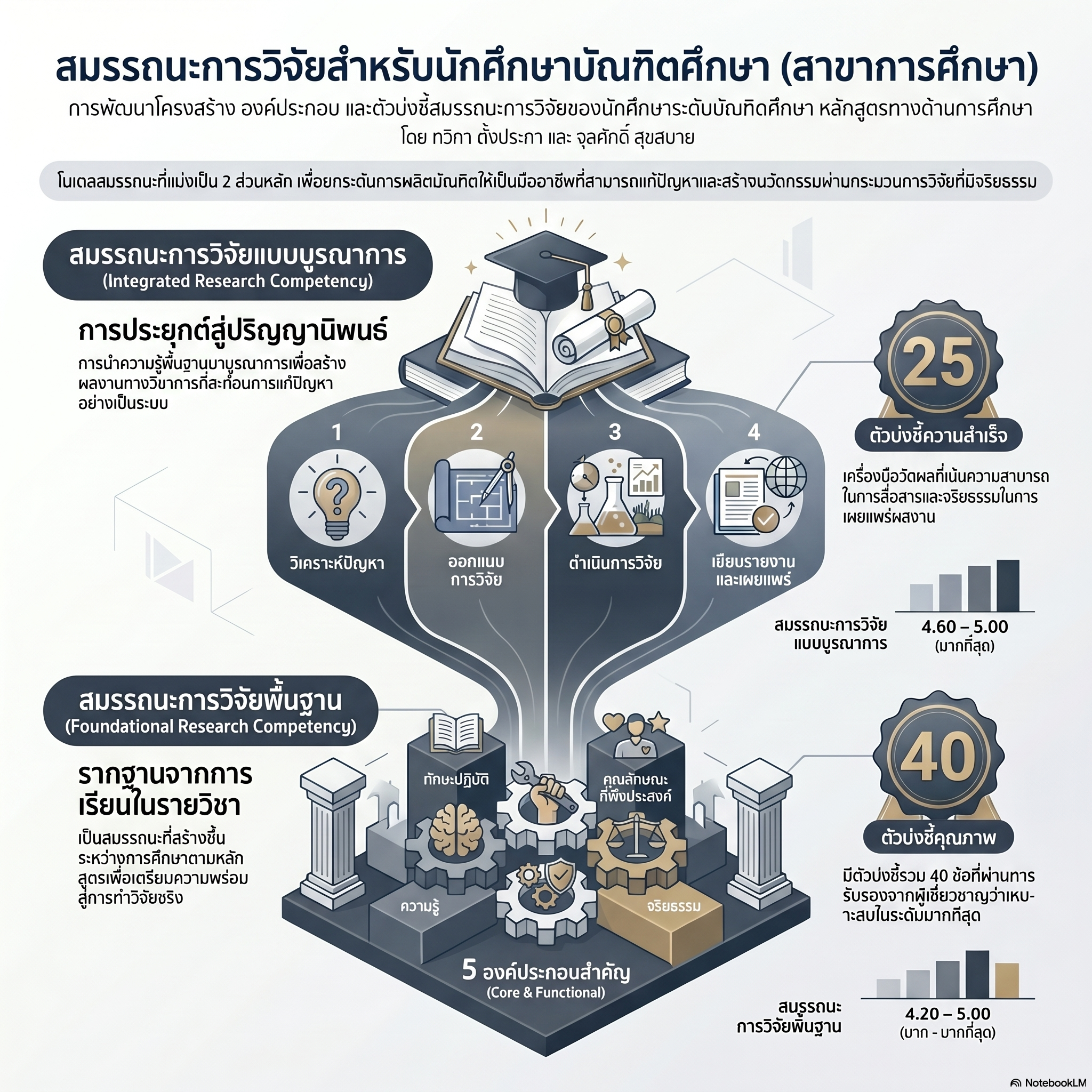
This research aimed to develop the structural framework and components of research competency, and to establish indicators for research competency specifically for graduate students enrolled in education programs. The study was conducted in two distinct phases. Phase 1 focused on developing the structure and components, employing
a qualitative study that included in-depth interviews and focus group discussions. For this phase, interview protocols and focus group discussion guidelines served as the research instruments, with data gathered from stakeholders in graduate production and experts, subsequently analyzed through content analysis. Phase 2 concentrated on developing the indicators, utilizing a quantitative study to assess the quality of these indicators, which was then complemented by a qualitative study involving focus group discussions to finalize them. A quality assessment form and focus group discussion guidelines were the tools for this phase, where data were collected from experts and analyzed using both descriptive statistics and content analysis. The research findings are summarized as follows: 1. The structural framework and components of research competency comprise: 1) Basic Research Competency, which includes core competencies and functional competencies. This is further broken down into five sub-components: knowledge, practical research skills, cognitive skills, attributes, and research ethics. 2) Integrated Research Competency, which consists of four sub-components: problem analysis and formulation of research questions and objectives, research design and implementation, research execution, and research report writing and dissemination. 2. The indicators of research competency consist of: 1) 40 indicators for Basic Research Competency, and 2) 25 indicators for Integrated Research Competency. The evaluation results for these indicators showed mean scores ranging from 4.20 to 5.00, indicating a suitability level from high to highest. Experts concurred that the indicators are accurate, appropriate, comprehensive, and applicable.
References
เจษฎาภรณ์ วิริยะสกุลธรณ์, จันทร์ชลี มาพุทธ, & สุวิชัย โกศัยยะวัฒน์. (2020). อนาคตภาพสมรรถนะพื้นฐานของนักศึกษาระดับบัณฑิตศึกษาไทย. วารสารการศึกษาและการพัฒนาสังคม, 15(2), 81–91.
ณรงค์วิทย์ แสนทอง. (2004). มารู้จัก competency กันเถอะ. กรุงเทพฯ: เอช อาร์ เซ็นเตอร์.
ปิยวรรณ บุญเพ็ญ, ยุทธนา ไชยจูกุล, & ดุษฎี โยเหลา. (2018). สมรรถนะวิจัยและตัวแปรที่เกี่ยวข้องกับการทำวิจัยให้ประสบความสำเร็จ: กรณีศึกษานักวิจัยในมหาวิทยาลัยวิจัยแห่งชาติ. วารสารเกษมบัณฑิต, 19(1), 73–88.
พิมพ์ปวีณ์ สุวรรณโณ, สมศักดิ์ ลิลา, & พงศ์เทพ จิระโร. (2017). การพัฒนารูปแบบการประเมินสมรรถนะการวิจัยของอาจารย์มหาวิทยาลัยราชภัฏภาคใต้. วารสารการศึกษาและการพัฒนาสังคม, 13(1), 79–95.
สุกัญญา รัศมีธรรมโชติ. (2004). Competency: เครื่องมือบริหารที่ปฏิเสธไม่ได้. Productivity, 9(53), 44–48.
Ain, C., Sabir, F., & Willison, J. (2019). Research skills that men and women developed at university and then used in workplaces. Studies in Higher Education, 44(12), 2346–2358. https://doi.org/10.1080/03075079.2018.1496412
Creswell, J. W., & Creswell, J. D. (2017). Research design: Qualitative, quantitative, and mixed methods approaches. SAGE.
George-Reyes, C., & Glasserman-Morales, L. (2021). Research competencies mediated by technologies: A systematic mapping of the literature. Education in the Knowledge Society, 22, e23897. https://doi.org/10.14201/eks.23897
Mayowski, C. A., Norman, M. K., & Kapoor, W. N. (2018). Assessing an assessment: The review and redesign of a competency-based mid-degree evaluation. Journal of Clinical and Translational Science, 2, 223–227. https://doi.org/10.1017/cts.2018.321
McClelland, D. C. (1973). Test for competence, rather than intelligence. American Psychologist, 28(1), 1–14. https://doi.org/10.1037/h0034092
Mustafa, E., Mohd Ariffin, N., Mohd Arshad, A. H., Mohamad, A. M., & Hanafiah, N. A. H. (2019). Roles of higher education institutions (HEIs) in producing holistic graduates. International Journal of Education, Psychology and Counseling, 4(32), 29–42. https://doi.org/10.35631/IJEPC.432004
Organization for Economic Co-operation and Development. (2019). The OECD framework for competencies in education and training (PISA). https://www.oecd.org/careers/competency_framework_en.pdf
Zlatkin-Troitschanskaia, O. (2021). Advances and perspectives of competence research in higher education: Report on the German KoKoHs program. International Journal of Chinese Education, 10(1). https://doi.org/10.1177/22125868211006205
Downloads
Published
How to Cite
Issue
Section
Categories
License
Copyright (c) 2025 Faculty of Education, Srinakharinwirot university

This work is licensed under a Creative Commons Attribution-NonCommercial-NoDerivatives 4.0 International License.


