
THE EFFECTS OF LEARNING MANAGEMENT USING THE DESIGN THINKING PROCESS ON THE CREATIVITY OF GRADE 6 STUDENTS IN THE TOPIC OF VOLUME AND CAPACITY
Keywords:
Design Thinking Process, Creativity, Volume and CapacityAbstract
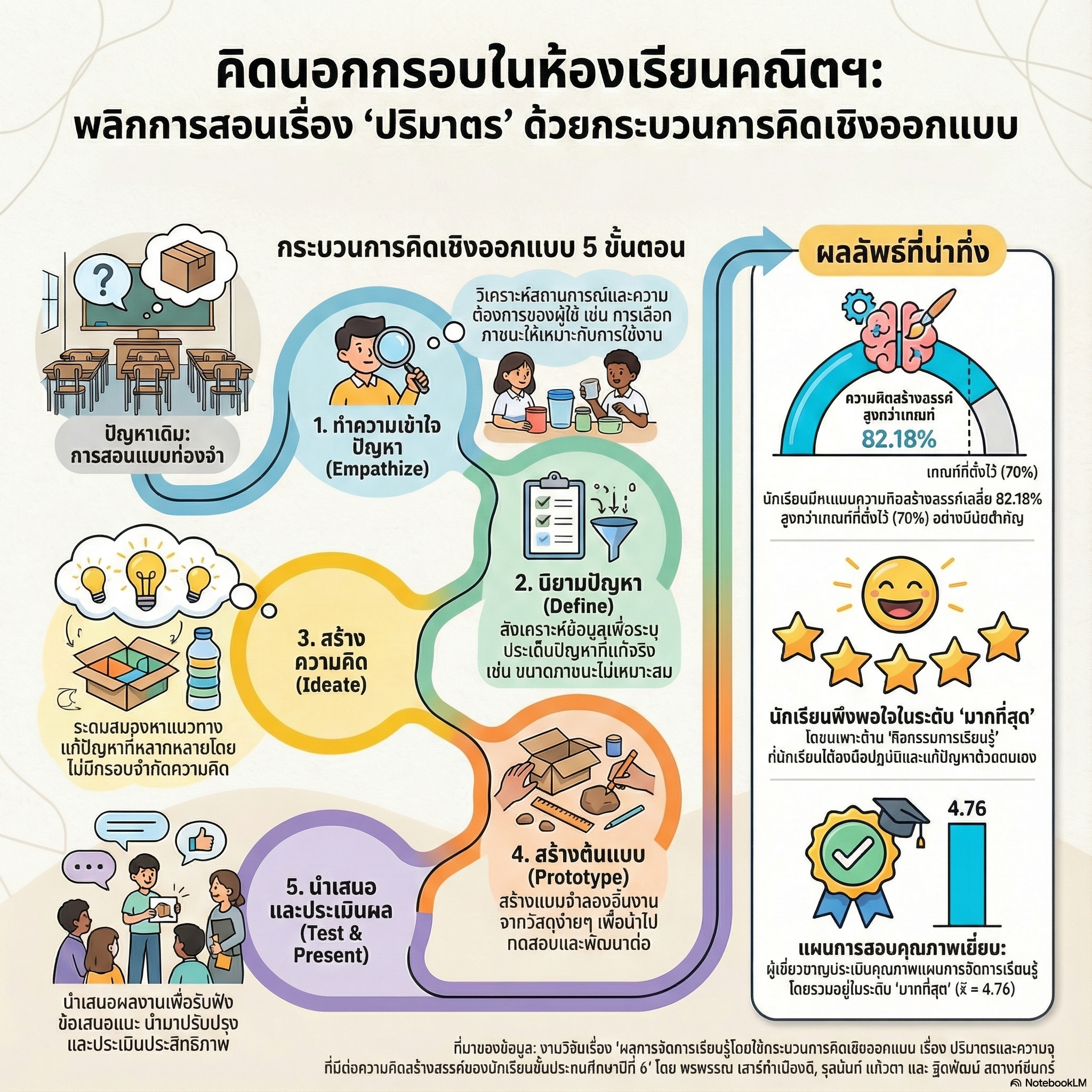
The objectives of this research were: (1) evaluate the effectiveness of learning management using the design thinking process on the topic of volume and capacity, (2) assess the creativity of Grade 6 students following the implementation, and (3) investigate students’ satisfaction with the design thinking-based learning approach. The sample consisted of 12 Grade 6 students from Ban Rongkham School, during the second semester of the 2024 academic year. Research instruments included (1) a learning management plan based on the design thinking process (2) a creativity assessment form and (3) a student satisfaction questionnaire. Data were analyzed using percentage mean standard deviation and t-test one sample. The results revealed that (1) the instructional plan demonstrated high quality and suitability, with mean scores ranging from 4.76 to 4.80 and standard deviations between 0.21 and 0.29 (2) students' creativity scores exceeded the 70 percent benchmark after the learning management intervention and (3) students reported a very high level of satisfaction with the learning experience. These findings suggest that integrating the design thinking process into mathematics instruction can effectively enhance students’ creativity and engagement.
References
จันทิมา อ่อนเกตุพล. (2563). การพัฒนาทักษะการคิดสร้างสรรค์ของนักเรียนด้วยกระบวนการคิดเชิงออกแบบ. วารสารศึกษาศาสตร์, 45(2), 12–27.
ประพันธ์ศิริ สุเสารัจ. (2556). ความคิดสร้างสรรค์: แนวคิดและการพัฒนา. กรุงเทพฯ: สำนักพิมพ์มหาวิทยาลัยเกษตรศาสตร์.
พัชรี พึ่งสุข. (2563). การจัดการเรียนรู้โดยใช้กระบวนการคิดเชิงออกแบบเพื่อส่งเสริมความสามารถในการคิดของนักเรียน. วารสารการวิจัยเพื่อพัฒนาชุมชน, 13(3), 45–60.
วิภาพร สุทธิอัมพร. (2555). การจัดการเรียนรู้คณิตศาสตร์เพื่อพัฒนาความคิดสร้างสรรค์. กรุงเทพฯ: สถาบันพัฒนาคุณภาพวิชาการ.
ศิริวรรณ ศิริรักษ์. (2564). ผลของการจัดการเรียนรู้โดยใช้กระบวนการคิดเชิงออกแบบที่มีต่อความคิดสร้างสรรค์ของนักเรียน. วารสารครุศาสตร์ศึกษา, 17(1), 87–101.
สำนักงานเลขาธิการคุรุสภา. (2562). แนวทางการจัดการเรียนรู้เพื่อพัฒนาผู้เรียนในศตวรรษที่ 21. กรุงเทพฯ: คุรุสภา.
อัมพร ม้าคนอง. (2553). วิธีการสอนคณิตศาสตร์เพื่อพัฒนาทักษะและความสามารถทางคณิตศาสตร์. กรุงเทพฯ: สำนักพิมพ์ฟิสิกส์เซ็นเตอร์.
อุบลวรรณา ภวกานันท์. (2556). ความสามารถในการคิดสร้างสรรค์. กรุงเทพฯ: สำนักพิมพ์จุฬาลงกรณ์มหาวิทยาลัย.
Brown, T. (2009). Change by design: How design thinking creates new alternatives for business and society. Boston, MA: Harvard Business Press.
Cropley, A. J. (2001). Creativity in education & learning: A guide for teachers and educators. London, England: Kogan Page.
Guilford, J. P. (1967). The nature of human intelligence. New York, NY: McGraw-Hill.
IDEO. (2012). Design thinking for educators. Retrieved from https://designthinkingforeducators.com
Kim, M., & Bae, J. (2020). The impact of design thinking-based mathematics education on creativity. Journal of Educational Research, 113(4), 275–288.
Mendoza, A. (2009). Creative teaching of mathematics. Manila, Philippines: Phoenix Publishing House.
Rawlinson, J. G. (2005). Creative thinking and problem solving. New York, NY: McGraw-Hill.
Robinson, K. (2011). Out of our minds: Learning to be creative. New York, NY: Capstone.
Torrance, E. P. (1965). Rewarding creative behavior: Experiments in classroom creativity. Englewood Cliffs, NJ: Prentice-Hall.
Downloads
Published
How to Cite
Issue
Section
Categories
License
Copyright (c) 2025 Faculty of Education, Srinakharinwirot university

This work is licensed under a Creative Commons Attribution-NonCommercial-NoDerivatives 4.0 International License.


